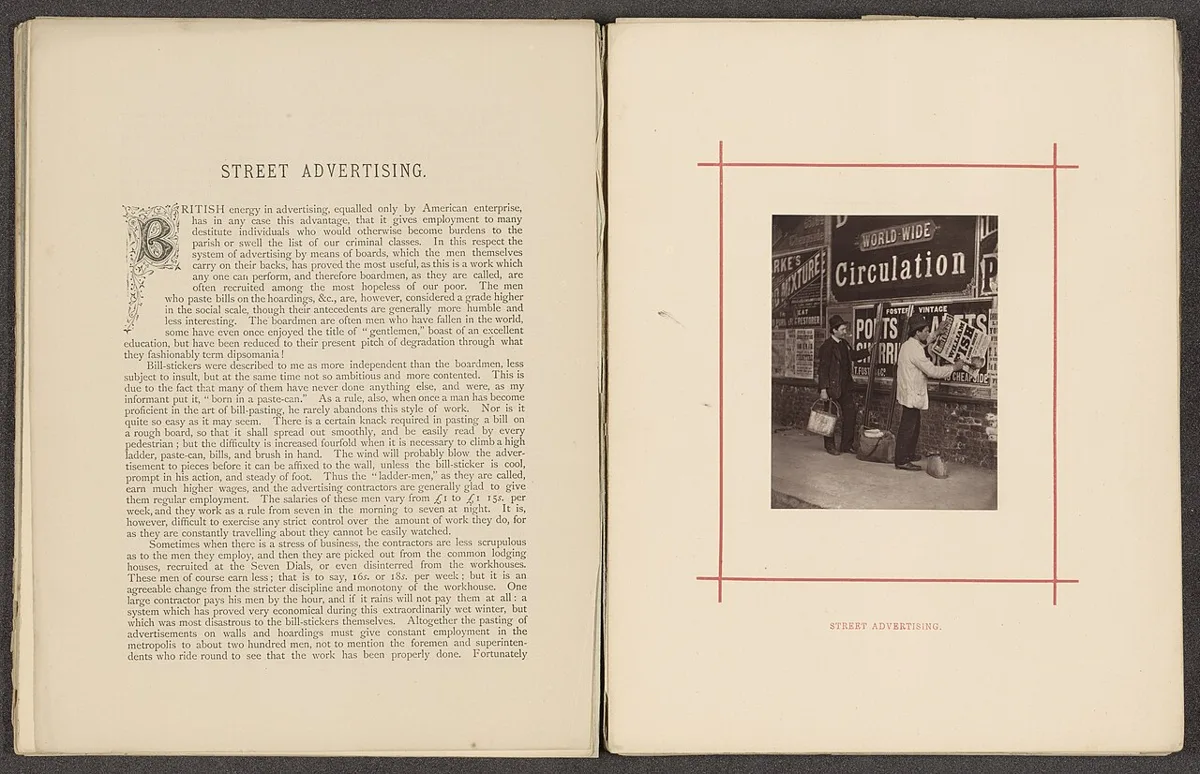
Woodburytype Book Illustration. This book spread features a tipped-in photographic print depicting men putting up street advertisements.Rijksmuseum · CC0 · via Wikimedia CommonsView source ↗
Prompt
Transform this image into a Woodburytype with rich continuous brown-black tones, luminous cream highlights, and exceptionally smooth tonal gradations without halftone dots. Suggest pigmented gelatin through faintly raised glossy shadows, subtle relief visible in grazing light, and a clean paper support. Keep the original subject and composition.
You see aphotographic print with [rich, continuous tones1]and absolutely no dot pattern. The dark areas are slightly raised, giving the image afaint physical relief.
Principle
It relies on [variable thickness of pigmented gelatin2]to create shades. Ametal mold presses gelatin onto paper, leaving [thicker ink for shadows].
Example
John Thomson: Street Life in London, 1877.
Try it out
Tilt aWoodburytype near alight source to spot the slight physical texture mapping exactly to the dark shadows.
Background
Walter Bentley Woodbury patented this method to mass-produce photographs without fading. It bridged the gap between photography and mechanical printing. First, light exposed alayer of light-sensitive gelatin, hardening it based on the image's brightness. The unhardened gelatin washed away, leaving athree-dimensional gelatin relief3. Ahydraulic press then crushed this fragile gelatin into asheet of soft lead. This created adurable metal mold. Finally, printers filled this mold with pigmented gelatin and pressed paper onto it. The varying depth of the mold created perfect continuous tones, unlike dot grids used in later printing.
Distinction
Unlike half-tone prints that rely on grids of tiny dots to simulate shades, Woodburytypes use actual varying thicknesses of ink.
Aftermath
It shows how early inventors used physical depth to perfectly replicate photographic lighting.
Further examples · 11 images
02Cast-Iron Billy WoodburytypeThis printed photograph of a coachman displays extremely smooth tonal gradations and fine details. The absence of a mechanical screen and the deep, rich dark areas are definitive features of a genuine Woodburytype print.Rijksmuseum · CC0 · Wikimedia Commons03Alexandre Dumas Woodburytype PortraitA formal portrait of Alexandre Dumas exhibits velvety blacks and continuous shading across the face. These rich, uninterrupted tonal variations demonstrate the variable-thickness gelatin technique unique to Woodburytypes.Rijksmuseum · CC0 · Wikimedia Commons04Covent Garden Flower WomenThis mounted print of flower sellers captures fine textures with smooth, photographic realism. It exemplifies the Woodburytype's ability to reproduce continuous-tone images without a visible dot matrix, making it ideal for documentary publications.Rijksmuseum · CC0 · Wikimedia Commons05Seated Woman Woodburytype PrintThis vintage portrait of a seated woman features soft highlights and dense, continuous shadows. The technique's reliance on pigmented gelatin rather than ink dots creates this distinctive, richly toned photographic effect.Fanny Fleury · Public domain · Wikimedia Commons06Frontispiece Animal Trophies WoodburytypeA book frontispiece displays a detailed photograph of animal trophies with deep, rich contrast. The continuous-tone quality and slight sheen in the shadows reveal it as a Woodburytype, commonly used for premium 19th-century volumes.Rijksmuseum · CC0 · Wikimedia Commons07Juliette Lamber Woodburytype PortraitThis mounted portrait of Juliette Lamber shows exquisitely smooth transitions between the light skin tones and the dark dress. The rich, dot-free reproduction is a hallmark of the Woodburytype photomechanical printing method.Rijksmuseum · CC0 · Wikimedia Commons08Gustave Aimard Woodburytype PortraitAn oval portrait of Gustave Aimard presents striking, continuous tones with deep, rich dark areas. This flawless reproduction without halftone dots clearly identifies it as a classic Woodburytype.Rijksmuseum · CC0 · Wikimedia Commons09Woodburytype Portrait of Henri MonnierThis portrait features rich, dark shadows and smooth gradients without any visible halftone dot matrix. It perfectly exemplifies the Woodburytype process, which uses variable depths of pigmented gelatin to create continuous photographic tones.Étienne Carjat · CC0 · Wikimedia Commons10Woodburytype Portrait of Baron TaylorThis mounted photographic print displays deep, velvety tones and a completely continuous image structure. It represents a classic Woodburytype, where varying shades are formed by the actual physical thickness of the tinted gelatin.Unknown authorUnknown author · CC0 · Wikimedia Commons11Oval Woodburytype Portrait of a GentlemanThis oval-framed portrait shows exceptionally smooth tonal transitions and dense, dark areas that lack any underlying printed pattern. The image is a characteristic Woodburytype, relying on molded pigmented gelatin for its photographic depth.Unknown author · CC BY 4.0 · Wikimedia Commons
Question
Why did the Woodburytype eventually become obsolete?
Show possible answer +Hide answer −
The process was slow and required prints to be trimmed and mounted by hand. Faster halftone printing presses eventually replaced it for books.