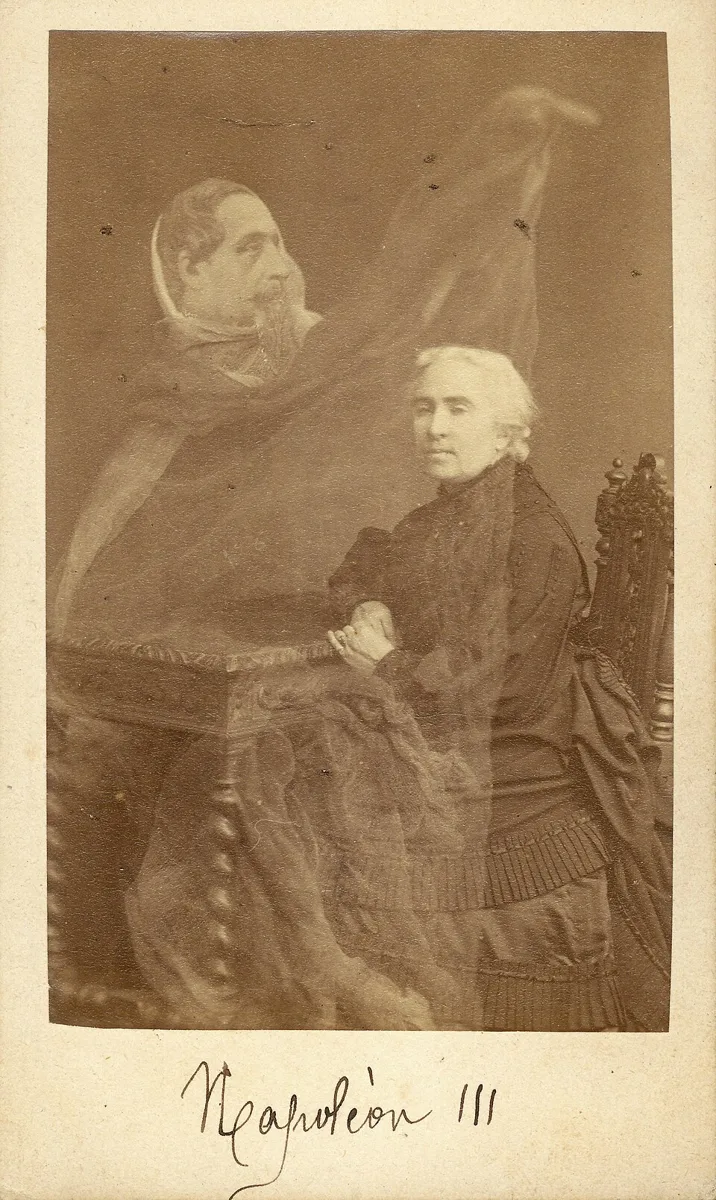
Seated Woman with Translucent Male Apparition. A seated woman in a dark dress is overlapped by a large, pale male apparition and flowing translucent forms.Buguet (Paris) · Public domain · via Wikimedia CommonsView source ↗
Prompt
Apply a Spirit Photography effect with antique sepia tones, fine plate grain, subdued lighting, and a faint translucent duplicate of the subject nearby. Let the background show through this secondary apparition, adding soft exposure halos and slight motion softness while keeping the primary figure solid. Keep the original subject and composition.
You see astandard 19th-century portrait with afaint, [translucent figure standing nearby]. The background often shows right through the faded ghost.
Principle
This is an additive process1[created through double exposure2]. The photographer exposes the [same glass plate twice]before developing it chemically.
Example
William Mumler: Portrait of Mary Todd Lincoln with the ghost of Abraham Lincoln, roughly 1869.
Try it out
Look at awindow reflection at night. Notice how your reflected image overlaps additively with the darker objects outside.
Background
In the 1860s, the American Civil War left countless families grieving. Simultaneously, the Spiritualist movement convinced many that the dead could communicate. William Mumler capitalized on this by producing the first spirit photographs in Boston in 1861. He secretly used previously prepared glass plates3that already held afaint, underexposed image. When he took aportrait of aliving client, the two exposures added light together. Because photography was new, many clients believed these translucent figures were genuine spirits. They trusted the camera's mechanical eye implicitly.
Distinction
Unlike asimple motion blur, which smears amoving subject, double exposure freezes two distinct moments in time onto one surface.
Aftermath
It shows how easily technical novelty can be weaponized to exploit human grief and trust.
Further examples · 7 images
02Bearded Sitter with a Pale ApparitionA bearded man sits in a studio chair while a pale female figure appears behind his head and shoulders. Her faded body merges with the studio background, demonstrating the ghostly superimposition characteristic of double-exposure spirit portraits.William H. Mumler · Public domain · Wikimedia Commons03Seated Woman Beside a Fading FigureA woman rests her face against one hand beside a faint standing figure at the right of the portrait. The background remains visible through the apparition's torso, clearly showing the translucent layering associated with spirit photography.Unidentified maker. [Woman with a hand on her face with a spirit image of a man in the … · Public domain · Wikimedia Commons04Male Portrait with a Ghostly FaceA sharply defined man in a dark suit sits beneath a faint face emerging in the upper-right background. The pale apparition dissolves into the backdrop, providing a clear example of the superimposed ghost effect used in spirit portraiture.Abraham Bogardus · Public domain · Wikimedia Commons05Victorian Spirit Portraits with Translucent ApparitionsThree sepia portraits show seated Victorian sitters accompanied by pale, translucent figures hovering behind their shoulders. These overlapping apparitions exemplify spirit photography, using double exposure to place ghostlike presences within otherwise conventional portraits.William H Mumler · CC0 · Wikimedia Commons06Published Spirit Photograph with Standing ApparitionAn open French publication contains a photographic illustration of a pale standing apparition overlapping a darker portrait figure. The illustration itself visibly preserves the layered, translucent spirit effect rather than merely describing it in the surrounding text.Rijksmuseum · CC0 · Wikimedia Commons07Spirit Portrait Reproduced in Revue SpiriteAn open issue of Revue Spirite includes a small photograph showing a pale draped figure beside and overlapping a darker sitter. Despite its modest size, the reproduced photograph visibly demonstrates the ghostly superimposition central to spirit photography.Rijksmuseum · CC0 · Wikimedia Commons
Question
Why does the background show through the ghost?
Show possible answer +Hide answer −
The plate captures light from both exposures. Dark areas of the ghost let the bright background light show through additively.