H 109 / 3211930s

Stroboscopic Photography

1931, Harold Edgerton's high-speed flashes
Typeface · Glegoo

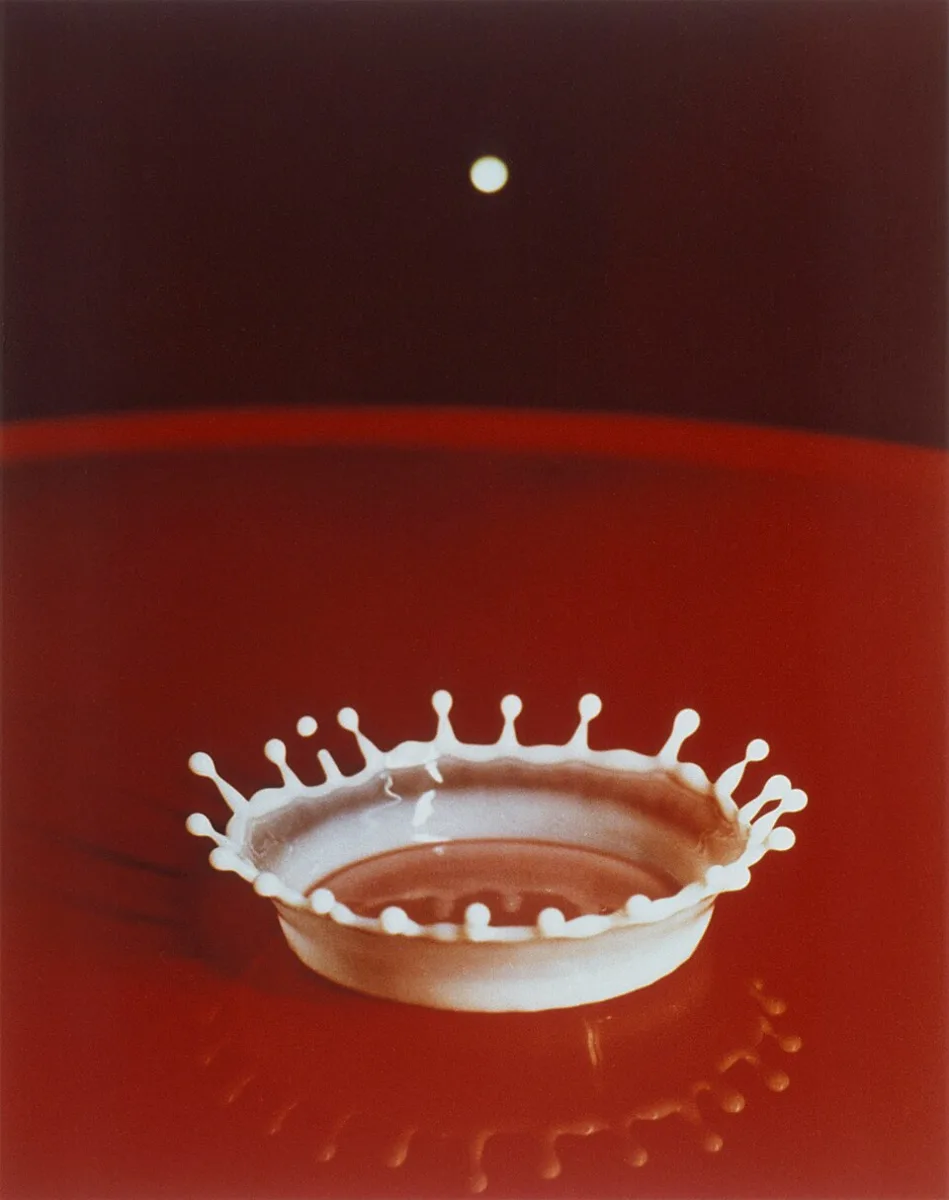
Milk Drop Crown. A milk splash forms a delicate crown, with rounded droplets suspended above a red surface.
Milk Drop Crown. A milk splash forms a delicate crown, with rounded droplets suspended above a red surface.Harold Edgerton · Public domain · via Wikimedia CommonsView source ↗

Prompt

Apply a Stroboscopic Photography effect with several sharply frozen, translucent movement echoes trailing closely along a plausible motion path. Use a darkened setting, crisp flash illumination, bright repeated edges, and minimal continuous blur, keeping the main exposure dominant. Keep the original subject and composition.

Identify

You see a single image showing multiple overlapping stages of a fast movement. Alternatively, you see a frozen moment in absolute detail.

Principle

The camera shutter stays open in a dark room. A rapidly pulsing electronic flash1 exposes the moving subject multiple times onto one film frame.

Example

Harold Edgerton: Golfer (Densmore Shute), 1938.

Try it out

Wave your hand under a flickering fluorescent tube to see continuous motion break into separate steps.

Background

Before the 1930s, freezing high-speed motion was nearly impossible. Mechanical shutters could not open and close fast enough to stop a speeding bullet. Harold Edgerton, an electrical engineer at MIT, solved this problem with light. He invented a gas-filled tube2 that fired brilliant, microscopic bursts of light. By leaving the camera shutter open in the dark, only the brief flashes recorded onto the film. Each flash acted as a tiny, precise exposure3. This allowed photographers to capture bullets shattering apples or multiple stages of an athlete's swing on a single frame.

Distinction

Chronophotography uses multiple cameras or a spinning disc to create a series of separate images. Stroboscopic photography uses one camera and flashing light to layer multiple exposures on one frame.

Aftermath

It reveals that continuous motion is made of countless unseen, distinct phases.

Further examples · 7 images

Golf Ball Falling Under Repeated Flashes
02 Golf Ball Falling Under Repeated FlashesSix successive positions of a descending golf ball appear against a black background. Repeated flashes isolate the ball at discrete intervals, revealing its rotation and increasing spacing during the fall.LASZLO ILYES from Cleveland, Ohio, USA · CC BY 2.0 · Wikimedia Commons
Flash-Frozen Milk Splash
03 Flash-Frozen Milk SplashA white crown of splashing milk rises above a red surface beneath a suspended droplet. The sharply arrested liquid demonstrates how brief flash illumination makes a transient event visible in extraordinary detail.Harold Edgerton · Public domain · Wikimedia Commons
Light Bulb Shattering in Midair
04 Light Bulb Shattering in MidairA light bulb breaks apart as glass fragments and fine debris spread into the surrounding darkness. The arrested instant demonstrates high-speed flash photography capturing a destructive event too rapid for unaided vision.Markus Kempf, Frank Bastian · CC BY-SA 2.5 · Wikimedia Commons
Walking Figure in Successive Motion Phases
05 Walking Figure in Successive Motion PhasesSuccessive overlapping images of a walking man extend across a single photographic field. This chronophotographic study clearly demonstrates the discrete movement phases associated with the stroboscopic effect, although electronic flash use is not established.Thomas Eakins · CC0 · Wikimedia Commons
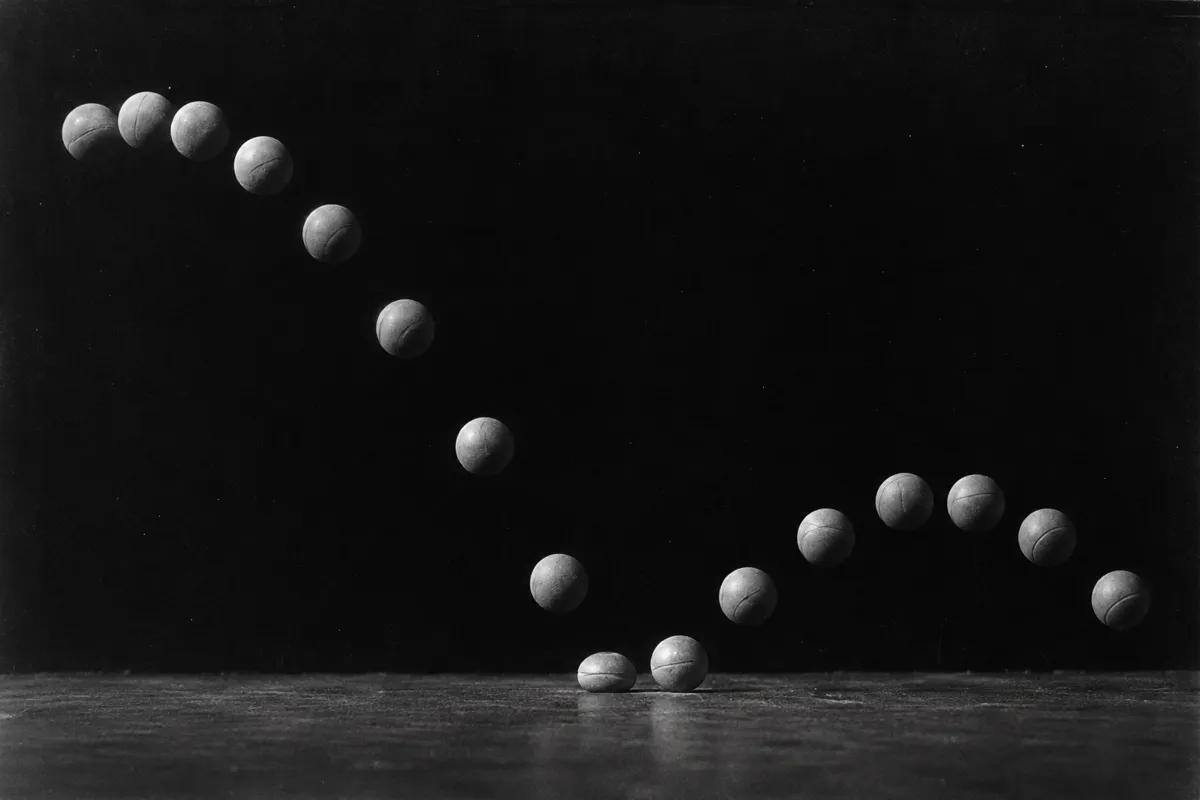
AI illustration: Stroboscopic study of a bouncing ball
06 AI illustration: Stroboscopic study of a bouncing ballA single photographic frame displays a bouncing ball at seventeen distinct points along its trajectory against a dark background. The image demonstrates the use of a high-speed stroboscopic flash to freeze motion at regular intervals during a long exposure.Illustration generated for the Atlas (AI)
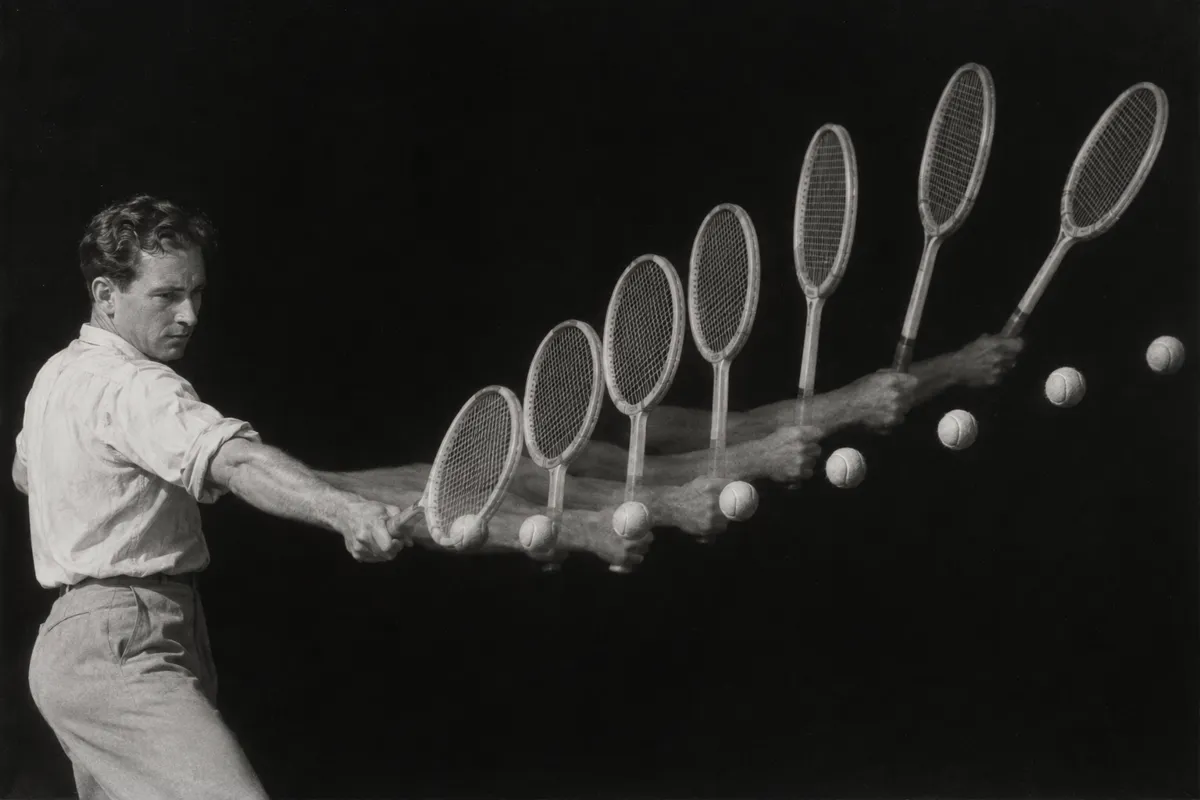
AI illustration: Multi-flash sequence of a tennis forehand
07 AI illustration: Multi-flash sequence of a tennis forehandA tennis player's swing is captured as a series of overlapping exposures showing the progression of the racket and ball. This technique utilizes multiple pulses of light to map the mechanics and fluid motion of human athletic performance.Illustration generated for the Atlas (AI)

Question

Why doesn't the background get overexposed when capturing multiple flashes?

Show possible answer +

The photos are taken against a black backdrop in a darkened room. Since black absorbs light, the background remains unexposed during each flash.

Sources