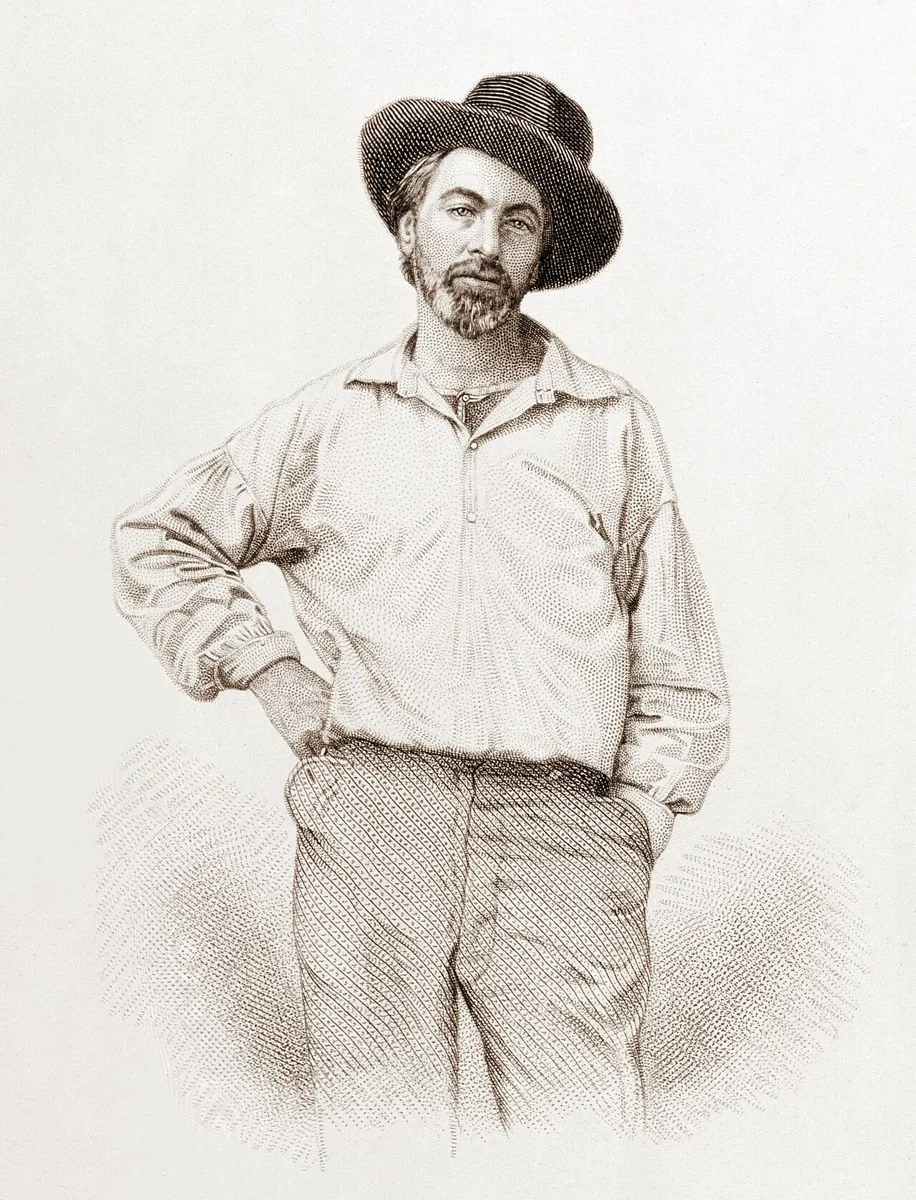
Walt Whitman in Hat and Work Clothes. Walt Whitman stands in a broad-brimmed hat and open-necked shirt, with one hand resting on his hip.Samuel Hollyer (1826-1919) of a daguerreotype by Gabriel Harrison (1818-1902)(original … · Public domain · via Wikimedia CommonsView source ↗
Prompt
Transform this image into a Steel Engraving printed in black ink on ivory paper. Build tones entirely from exceptionally fine parallel lines, precise crosshatching, stippled accents, and tiny tapered strokes. Add crisp contours, delicate highlights, subtle paper fibers, and a faint plate impression. Keep the original subject and composition.
Extremely [fine parallel lines]build delicate skies, crisp architecture, and detailed landscapes. Close inspection reveals [crosshatched shadows]and tiny strokes rather than continuous gray washes.
Principle
In this intaglio1process, ink fills [incised lines]in asteel plate while the surface is wiped clean. Printing pressure pushes damp paper into these grooves, transferring ink onto the sheet.
Example
Samuel Rogers: Italy (illustrated edition), 1830.
Try it out
Magnify asteel-engraved landscape, then step back to see separate lines merge visually into gray tones.
Background
Steel engraving became important for illustrated books during the 1820s. Engravers translated paintings and drawings into networks of lines, sometimes combining acid etching2with cuts made using aburin3. Plates could be softened for working and hardened for printing. Hardened steel resisted wear better than copper, supporting larger editions while retaining fine detail. Publishers used these durable plates for landscapes, portraits, travel books, and literary annuals. The resulting gray tones depend on line spacing and thickness, not acontinuous layer of gray ink.
Distinction
Copperplate engraving uses the same basic intaglio principle, but copper generally wears faster. Fine lines alone cannot reliably identify the plate metal.
Aftermath
Steel engraving shows how durable printing surfaces and carefully spaced lines made detailed images available to larger audiences.
Further examples · 11 images
02Christ at the Door, Engraved DetailA haloed Christ raises his hand toward a door, surrounded by tightly patterned architectural shadows. The enlarged detail exposes intersecting engraved lines and curved hatching that build flesh, cloth, and masonry without continuous gray washes.Peter Carl Geissler · Public domain · Wikimedia Commons03Harbor Panorama with Pagodas and PalmsSailing vessels fill a broad harbor beneath distant mountains, with pagodas, palms, and small figures along the shore. Minute strokes distinguish foliage and rigging, while finely spaced lines establish luminous water and atmospheric distance characteristic of steel engraving.Drawn by Thomas Allom. Engraved by W. A. Le Petit. · Public domain · Wikimedia Commons04Hillside Travelers Above a Coastal SettlementTravelers and animals occupy a wooded hillside above a waterfront settlement and expansive bay. Dense foreground hatchwork gives way to extremely fine horizontal lines across the sky and water, demonstrating steel engraving's delicate tonal range.W. H. Bartlett (artist) · Public domain · Wikimedia Commons05Capitol Above a Busy RoadThe Capitol crowns a wooded slope above a road animated by pedestrians and a horse-drawn carriage. Delicate atmospheric shading, crisp architectural details, and densely interwoven foliage strokes exemplify steel-engraved landscape illustration.Osborne, Milo, approximately 1810-, engraver; Bartlett, W. H. (William Henry), 1809-185… · Public domain · Wikimedia Commons06Mountain River and Rocky CrossingFigures stand on a rocky ledge beside a broad river enclosed by steep mountain slopes. Extremely fine parallel lines describe the distant terrain and water, while intricate crossing strokes deepen the foreground rocks.Unknown · Public domain · Wikimedia Commons07Travelers Overlooking a River BridgeTravelers gather beneath a slender tree overlooking a long bridge across a broad river. Fine linear sky tones, sharply articulated bridge piers, and minute foliage marks demonstrate the delicate tonal range of steel engraving.after William H. Bartlett · Public domain · Wikimedia Commons08Island Lake with Sailing VesselsSailing vessels cross a luminous lake dotted with rocky islands, framed by trees and small foreground figures. Exceptionally fine water lines and tiny foliage strokes build graduated tones without continuous gray washes, characteristic of steel engraving.After William Henry Bartlett · Public domain · Wikimedia Commons09Colored River View from Mount HolyokeA colored landscape shows visitors on a rocky summit overlooking a winding river and distant settlement. Beneath the added color, fine parallel terrain lines and tightly engraved foreground textures remain visible, revealing the steel-engraved foundation.W H Bartlett, published by George Virtue · Public domain · Wikimedia Commons10Waterfront with Soldiers and FlagstaffUniformed figures and a flagstaff overlook a busy waterfront lined with palms and buildings. Fine linear shading articulates the water, clouded sky, and distant architecture in the delicate tonal manner of steel engraving.Unknown authorUnknown author · Public domain · Wikimedia Commons11Harpers Ferry by MoonlightMoonlight illuminates the river at Harpers Ferry between dark wooded heights, above an engraved title in the lower margin. Closely worked linear textures describe the hills and shimmering water, showing how steel engraving can sustain a richly shadowed nocturnal landscape.Robert Hinshelwood · Public domain · Wikimedia Commons
Question
Why does a patch of separate black lines look gray from a distance?
Show possible answer +Hide answer −
At that distance, your eye cannot resolve every line and gap. Black ink and white paper blend visually into agray tone.