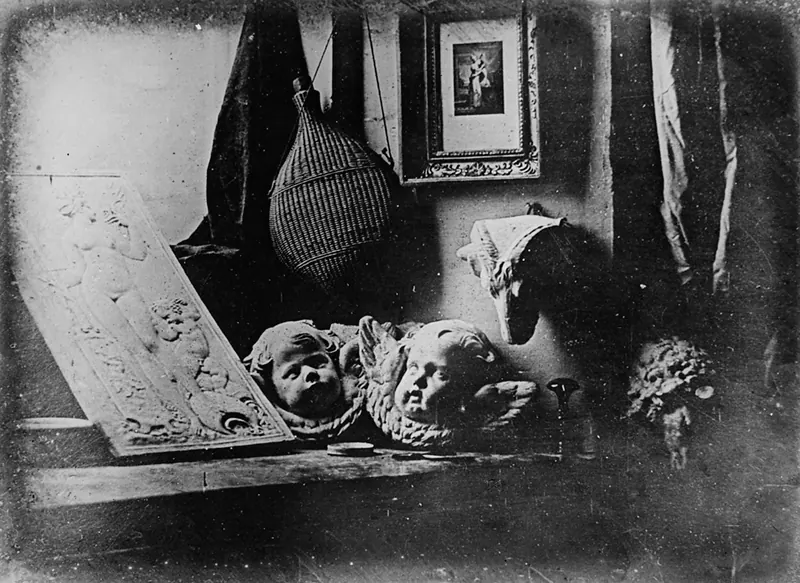
Louis Daguerre: L’Atelier de l’artiste, 1837. Historical daguerreotype.Louis Daguerre; Société française de photography / Wikimedia Commons. Public domain (Commons PDM / faithful reproduction).View source ↗
Prompt
Transform this image into a Daguerreotype on polished silver-plated copper, with exceptionally sharp fine detail, silvery monochrome tones, and mirrorlike reflections. Suggest viewing-angle-dependent contrast through localized bright sheen and dark reflective patches, adding delicate peripheral tarnish and microscopic surface scratches. Keep the original subject and composition.
Examine the reflection. Abrown filter alone does not reconstruct either the sharpness or the metallic surface.
Background
Publicly presented in 1839; Daguerre had been working on it before then. Internationally widespread in the 1840s–1850s, especially for portraits. Detailed mechanism: Adirect, unique print on highly polished, silvered copper. Light-sensitive plate, exposure, development, and fixing produce the finest details. Daguerreotype is not simply sepia. The substrate is part of the visible effect.
Distinction
Daguerreotype does not simply mean sepia. The substrate is part of the visible effect.
02Boulevard du TempleA Parisian street scene is shown with architectural details. The long exposure time results in empty streets, typical of early daguerreotypes capturing stationary objects.Louis Daguerre · Public domain · Wikimedia Commons03Portrait of a Daguerreotypist, 1845 (with Frame)A man holds a display of smaller cased images within a decorative frame. It demonstrates the reflective, metallic surface and the common use of the medium for portraits.UnknownUnknown Restored by Wcamp9 · Public domain · Wikimedia Commons04Daguerreotype of Thomas Carlyle, April 1846A profile portrait of Thomas Carlyle is presented in a velvet-lined case. The casing highlights how these unique images were protected from oxidation and physical damage.Unknown author · Public domain · Wikimedia Commons05Susse Frères Daguerreotype camera 1839A wooden box camera with a brass lens is shown. This equipment was used to expose the light-sensitive silvered copper plates described in the daguerreotype process.Liudmila & Nelson · Public domain · Wikimedia Commons06Dutch: Portret van een echtpaar uit Suriname Portrait of a married couple in SurinameA seated couple is depicted in an oval gold-colored frame. The image shows the slight solarization and edge tarnish often found on historical silver-plated substrates.Unknown authorUnknown author · Public domain · Wikimedia Commons07Andrew-Jackson-DaguerreotypeA portrait of Andrew Jackson shows significant surface scratches and wear. These artifacts emphasize the delicate, polished metallic nature of the original photographic plate.Edward Anthony · Public domain · Wikimedia Commons08Daguerreotype processA diagram outlines eight steps from polishing copper to final sealing. It explains the chemical and mechanical complexity required to produce a single daguerreotype image..mw-parser-output .messagebox{margin:4px 0;width:auto;border-collapse:collapse;border:2px solid var(--border-color-progr · CC BY-SA 4.0 · Wikimedia Commons09Unidentified woman c1850 daguerreotype by Southworth & HawesThis portrait exhibits the high level of detail and sharpness characteristic of the process. The subtle metallic sheen and tonal range demonstrate the photographic quality achieved on silvered copper plates.Southworth & Hawesen · Public domain · Wikimedia Commons