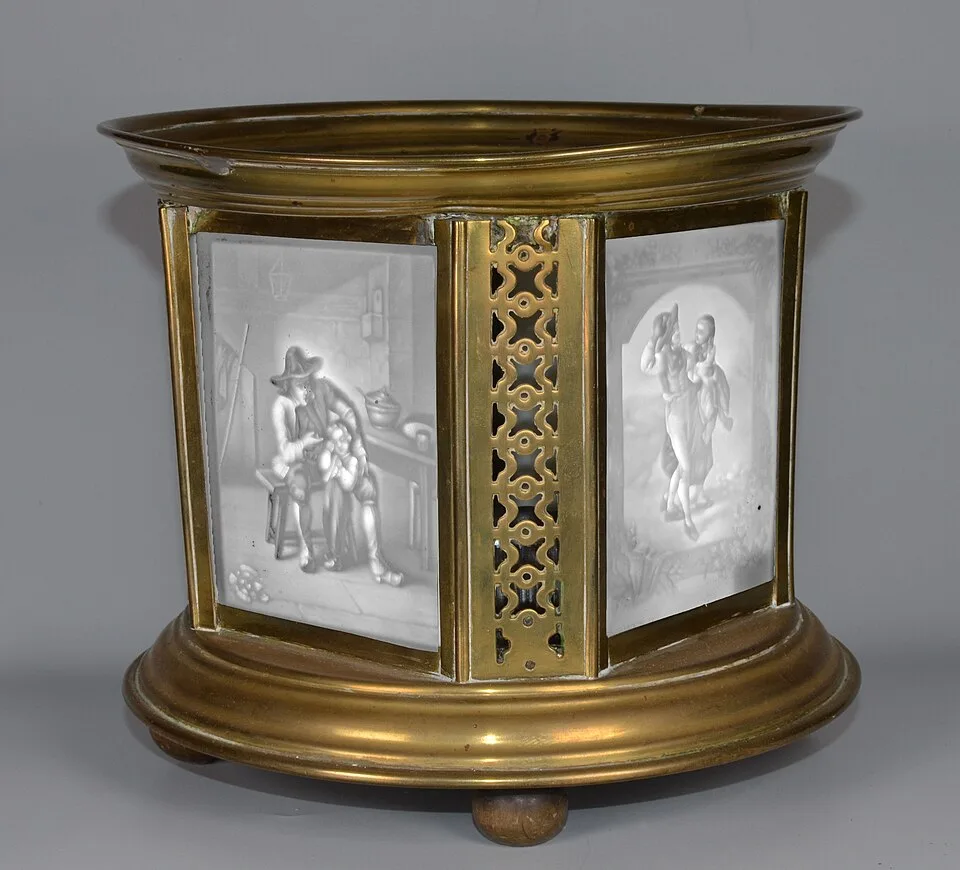
1820s; patented in France by Paul de Bourgoing in 1827
Typeface · Libre Caslon Display
Brass Enclosure with Lithophane Panels. A brass enclosure holds pale translucent panels depicting detailed figure scenes.Detlef Dauer · CC BY-SA 4.0 · via Wikimedia CommonsView source ↗
Prompt
Transform this image into a Lithophane, a thin ivory porcelain relief illuminated from behind. Make thin areas glow creamy white and thicker areas form soft gray-brown shadows, with continuous unpainted tonal modeling, delicate raised contours, and a subtly translucent ceramic surface. Keep the original subject and composition.
A[thin porcelain plaque]reveals asoftly shaded picture when lit from behind. Under front lighting, the same surface looks like a[shallow relief1].
Principle
Variations in porcelain thickness control transmitted light2: thinner areas appear brighter, while thicker areas appear darker. These differences create [continuous tones]without requiring painted shading.
Example
Unknown maker: The Last Supper (after Leonardo da Vinci), 19th century.
Try it out
Compare alithophane under front lighting and against abright window; notice which raised areas become dark.
Background
Lithophanes emerged in Europe during the 1820s, with aFrench patent granted to Paul de Bourgoing in 1827. Makers shaped an original model, often in wax, and used molds to reproduce its relief in porcelain. After firing, the thin ceramic remained translucent3. Its varying thickness converted asculpted surface into ashaded image when illuminated from behind. Portraits, landscapes, and scenes copied from paintings became popular subjects. Plaques appeared in window hangings, candle screens, and lampshades, placing pictures within everyday domestic lighting.
Distinction
Unlike apainted transparency, alithophane forms its shading through material thickness rather than applied pigment. Unlike ordinary relief sculpture, its intended picture depends on transmitted light.
Aftermath
The lithophane shows how athree-dimensional surface can encode atwo-dimensional image through controlled light transmission.
Further examples · 8 images
02Domestic Scene in Bordered PorcelainAn elaborately bordered translucent plaque depicts an adult and children in a domestic interior. Backlighting reveals continuous shades within the porcelain, turning thickness variations into a detailed picture.Enyavar · CC BY-SA 4.0 · Wikimedia Commons03Circular Lithophane of a CoupleA circular porcelain image shows a standing couple against a softly rendered outdoor setting. Transmitted light makes the thinner areas glow while thicker portions form the darker figures and scenery.Tetzemann · CC0 · Wikimedia Commons04Seated Soldier in Translucent PorcelainA luminous rectangular plaque portrays a seated uniformed man with a long gun beside barrels. Its bright background and deeply shaded clothing demonstrate how porcelain thickness creates pictorial tones in transmitted light.Elke Wetzig (Elya) · CC BY-SA 3.0 · Wikimedia Commons05Lithophane Lantern with Seated FigureAn ornate cylindrical lantern contains pale panels, with a seated figure visible on the front. The illuminated porcelain combines shallow relief with transmitted tonal shading characteristic of lithophanes.Unknown author · CC BY 4.0 · Wikimedia Commons06Front-Lit Lithophane on a PedestalA rectangular white plaque on a dark pedestal shows an adult holding a child in shallow relief. This front-lit view displays the sculpted porcelain surface that generates a lithophane's tonal image when illuminated from behind.Creator:Koenigliche Porzellan Manufaktur · CC0 · Wikimedia Commons07Backlit Mountain Lake LithophaneA glowing rectangular panel in a red frame depicts mountains and trees reflected in a lake. Rear illumination translates the panel's varying thickness into bright snow, dark woodland, and intermediate landscape tones.Odojek · CC BY-SA 4.0 · Wikimedia Commons08Oval Lithophane Portrait with FirearmAn oval plaque presents a seated bearded man beside a table bearing a firearm. The thick dark border and softly luminous facial and clothing details show the tonal structure of a backlit lithophane portrait.original photograph by P. Graff 1855, etching 1855 Berlin. 111 exact duplicates made. · Public domain · Wikimedia Commons
Question
Why do the thickest parts of a porcelain lithophane look darkest when backlit?
Show possible answer +Hide answer −
Thicker porcelain transmits less light to the viewer. Its thickness supplies the dark tones without needing dark paint.