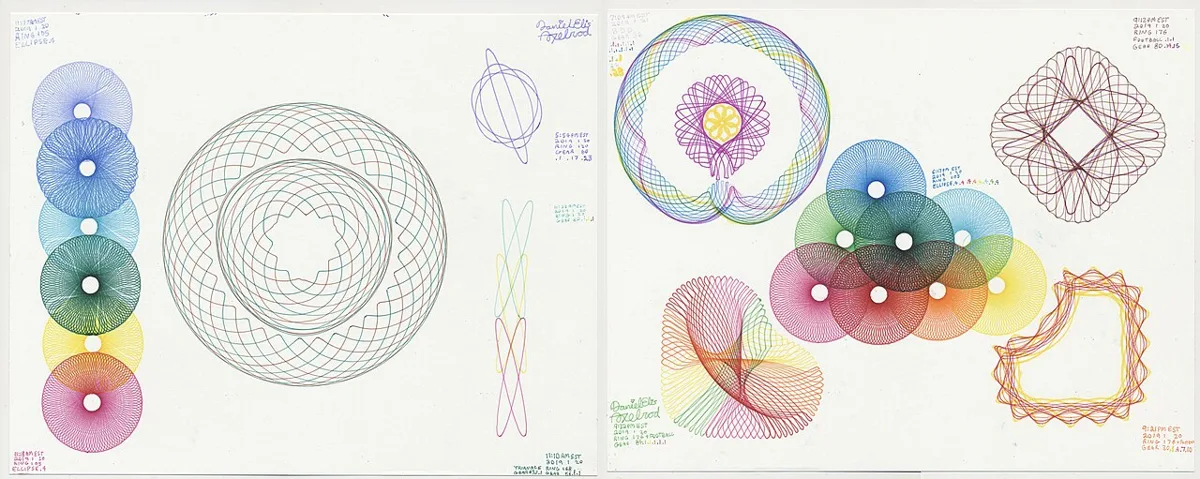
Multicolored Spirograph Pattern Studies. Two study sheets display multicolored circular rosettes, interlaced rings, and angular loop patterns.Rev. Daniel Elis Axelrod · CC0 · via Wikimedia CommonsView source ↗
Prompt
Apply a Gear-Drawn Rosette effect, reconstructing visible forms through fine looping curves, repeated radial petals, dense woven line bands, and open star-shaped spaces. Use overlapping cyan, magenta, and blue pen lines on warm white paper, with precise paths and delicate ink accumulation. Keep the original subject and composition.
Fine lines form [looping rosettes], with repeated petals arranged around ashared center. Overlapping curves create [dense woven bands]and open, star-shaped spaces.
Principle
Apen sits off-center in atoothed wheel that rolls around afixed gear or ring. Rolling inside acircular ring produces [hypotrochoid curves1]; rolling outside acircular gear produces epitrochoid curves2.
Example
Denys Fisher: Spirograph, 1965.
Try it out
Draw twice with the same wheel and ring, changing only the pen hole; compare the depth of the loops.
Background
British engineer Denys Fisher introduced Spirograph in 1965, turning gear-guided drawing into awidely recognized toy. Its mathematics was much older than the plastic kit. Asmall toothed wheel rolls against astationary ring, while apen follows ahole away from the wheel’s center. The gear teeth prevent slipping and keep the motion regular. Tooth counts determine how the rotations repeat, while the pen’s offset3changes the curve’s shape. Changing ink colors or starting positions builds layered patterns without changing the underlying mechanical rule.
Distinction
Aharmonograph draws looping patterns using swinging pendulums rather than meshing gears. Spirograph’s regularity comes from gear ratios, not the timing and decay of pendulum motion.
Aftermath
Spirograph shows how simple mechanical constraints can generate intricate, predictable visual patterns.
Further examples · 10 images
02Spirograph Demonstration Among Pattern SheetsA seated demonstrator handles circular drawing components above sheets covered with colorful rosettes and looping designs. The tools and surrounding pen drawings together present an unmistakable demonstration of the Spirograph technique.Jay.Jarosz · CC BY-SA 4.0 · Wikimedia Commons03Annotated Spirograph Drawing TrialsAn annotated sheet presents green radial rings, blue interlaced rosettes, and an elongated rounded border. Their recurring fine-line loops, dense crossings, and open centers clearly display Spirograph geometry.Rev. Daniel Elis Axelrod · CC0 · Wikimedia Commons04Circular Drawing Tools and Spirograph RosettesHands hold circular drawing components over a sheet surrounded by red, blue, and purple geometric patterns. The visible ring apparatus and finely looped rosettes connect the Spirograph process directly with its results.Kannanshanmugam,shanmugamstudio,Kollam · CC BY 3.0 · Wikimedia Commons05Drawing a Spirograph PatternOne hand steadies a circular ring while the other guides a pen through a smaller drawing component. Nearby rosettes and densely interlaced curves show the patterns produced by this Spirograph drawing method.Kannanshanmugam,shanmugamstudio,Kollam · CC BY 3.0 · Wikimedia Commons06Interwoven Floral Spirograph RingFine orange, brown, and green curves form a large floral ring around an open polygonal center. Repeated looped petals and overlapping woven bands make this an unmistakable Spirograph-style geometric drawing.Ged Carroll from Hong Kong mostly, HKSAR · CC BY 2.0 · Wikimedia Commons07Multicolored Spirograph StudiesMulticolored pen drawings cover a sheet with circular rosettes, interwoven bands, and star-shaped openings. Their repeated loops around shared centers clearly display the characteristic geometry of Spirograph drawing.Ashkan P. · CC BY-SA 3.0 · Wikimedia Commons08Drawing With a SpirographHands guide a pen through an orange toothed wheel inside a larger ring, surrounded by red and blue patterned drawings. The visible mechanism and completed looping curves directly demonstrate the Spirograph technique.Kannanshanmugam,shanmugamstudio,Kollam · CC BY 3.0 · Wikimedia Commons09Sheets of Looping Spirograph PatternsOverlapping sheets carry red and blue rosettes, woven circular bands, and elongated looping patterns. The fine repeated curves and evenly distributed petals clearly show the visual effects produced by Spirograph drawing.Kannanshanmugam,shanmugamstudio,Kollam · CC BY 3.0 · Wikimedia Commons10Looped Rosettes and Petal CurvesSix green curve diagrams range from densely interlaced circular rosettes to open flowers with distinct looping petals. Their repeated loops and visible circular constructions unmistakably demonstrate Spirograph geometry.Ruta.62 · CC BY-SA 4.0 · Wikimedia Commons
Question
Why does moving the pen to another hole change the drawing?
Show possible answer +Hide answer −
The new hole changes the pen’s distance from the wheel’s center. This changes the loops’ depth while leaving the gear ratio unchanged.