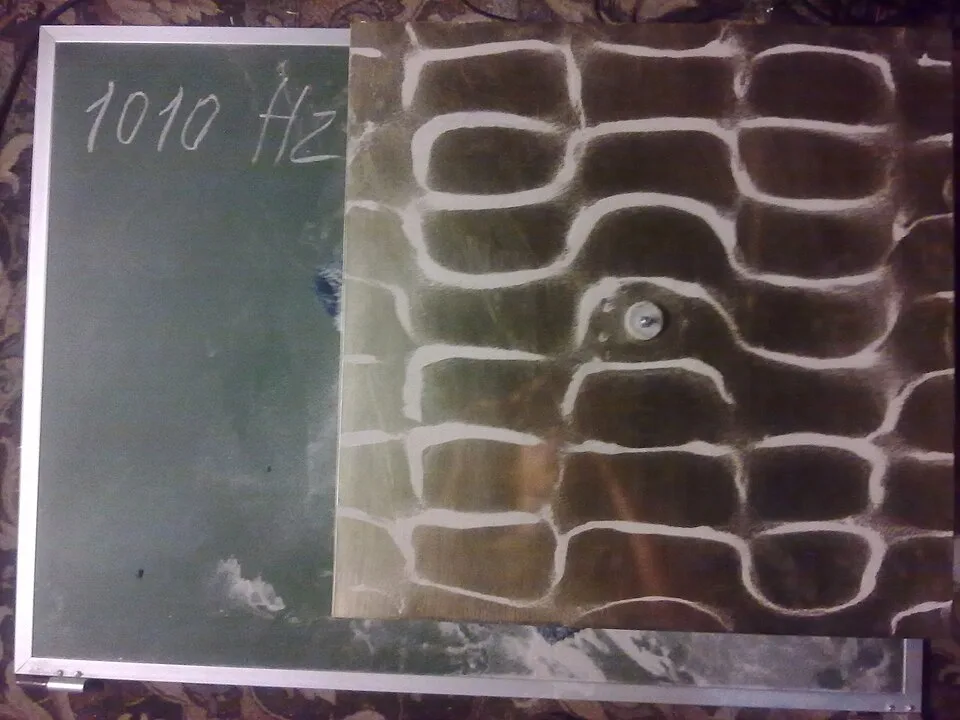
Sand Nodes at 1010 Hz. Pale sand traces stacked, rounded cells across a centrally fastened metal plate beside a 1010 Hz inscription.Hladnison · CC BY-SA 4.0 · via Wikimedia CommonsView source ↗
Prompt
Transform this image into a Cymatics study, using fine pale sand gathered into branching nodal lines, symmetrical lattices, and concentric rings across dark vibrating surfaces. Introduce shallow liquid cells, rippling highlights, granular deposits, and precise standing-wave geometry that follows existing forms. Keep the original subject and composition.
Sand forms [branching lines]and symmetrical grids on vibrating plates. Liquids display [rippling cells], rings, and shifting surface patterns.
Principle
Mechanical vibration drives these patterns; [standing waves1]can organize the motion. On vibrating plates, sand typically gathers along nodal lines2, where the surface moves least.
Example
Hans Jenny: Cymatics, volume 1, 1967.
Try it out
Stretch plastic wrap tightly over abowl, sprinkle afew salt grains, and gently tap the rim to observe vibration moving them.
Background
Swiss physician Hans Jenny introduced the term cymatics for his studies of visible vibration patterns. His first volume of Cymatics appeared in 1967, documenting experiments with powders, liquids, and other materials. The work extended earlier demonstrations by Ernst Chladni, who made sand patterns on vibrating plates. Aplate’s shape, supports, and driving frequency determine which vibration modes appear. Sand often collects where motion is weakest, outlining the mode rather than tracing sound travelling through air. Liquid patterns also depend on depth, viscosity3, and surface tension.
Distinction
Chladni figures specifically describe patterns formed by particles on vibrating surfaces, especially plates. Cymatics includes these figures but also investigates liquids and other vibrating materials.
Aftermath
Cymatics shows how invisible vibration becomes visible through its interaction with matter, rather than revealing one universal shape for each sound.
Further examples · 11 images
02Winding Nodal Lines at 1020 HzWhite sand forms winding bands and closed loops on a metal plate beside a 1020 Hz inscription. These accumulations reveal the low-motion nodal lines produced by mechanical vibration.Hladnison · CC BY-SA 4.0 · Wikimedia Commons03Looped Sand Pattern at 1290 HzPale granular lines divide a square metal plate into irregular loops and curved compartments beside a 1290 Hz inscription. Sand gathering along standing-wave nodes directly demonstrates cymatic pattern formation.Hladnison · CC BY-SA 4.0 · Wikimedia Commons04Central Ring and Wavy Sand NodesA ring of sand surrounds the central fastener while longer wavy lines extend across a plate marked 1305 Hz. The pattern records nodal regions where vibration is weakest and loose grains collect.Hladnison · CC BY-SA 4.0 · Wikimedia Commons05Cellular Nodal Network on a PlatePale sand outlines a dense network of rounded cells and diagonal curves around a plate's central mounting point. This organized granular network reveals the nodal structure of a mechanically excited plate.Hladnison · CC BY-SA 4.0 · Wikimedia Commons06Symmetrical Sand Cells on a Vibrating PlateSand forms a nearly symmetrical array of rounded compartments around a central fastener beside the number 2560. The repeated loops and intersecting lines expose a standing-wave mode through granular accumulation at its nodes.Hladnison · CC BY-SA 4.0 · Wikimedia Commons07Sand Patterns on a Vibrating PlateWhite sand traces branching curves and enclosed cells across a square plate mounted on a vibration generator. The grains reveal nodal lines where the vibrating plate moves least, making its standing-wave pattern visible.High Contrast (https://commons.wikimedia.org/wiki/User:High_Contrast) · CC BY-SA 3.0 · Wikimedia Commons08Granular Patterns Across Multiple Vibration ModesSixteen panels show red particles arranged into stripes, rings, branching networks, and symmetrical cells. These varied granular configurations reveal the spatial patterns produced by different modes of plate vibration.Faraday Telsa · CC BY-SA 3.0 · Wikimedia Commons09Cellular Ripples in a Circular VesselA circular vessel holds a pale liquid with a concentrated lattice of rippling ridges and bright surface cells. The organized intersecting waves visibly demonstrate cymatic patterning in a liquid medium.Collin Cunningham (CollinMel (talk)) · CC BY-SA 3.0 · Wikimedia Commons10Granular Nodal Traces on a Braced PanelDark grains trace long curved lines and scattered narrow deposits across a pale, braced panel. Their alignment into nodal traces demonstrates how vibration organizes loose particles on a resonating surface.WikiRigaou · CC BY-SA 3.0 · Wikimedia Commons11Bowed Plate Demonstrating Chladni PatternsAn engraving depicts a bow drawn against a supported plate, with grains arranged in intersecting bands across its surface. This demonstration shows the Chladni technique of using mechanical vibration to gather particles along nodal lines.Unknown authorUnknown author · Public domain · Wikimedia Commons
Question
Why can the same driving frequency produce different patterns on different plates?
Show possible answer +Hide answer −
Each plate’s shape, material, thickness, and supports affect its vibration modes. Frequency alone does not determine the pattern.