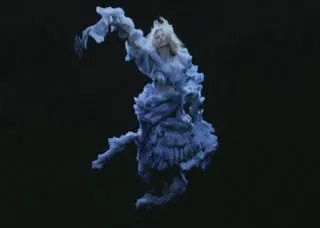
Pepper's Ghost. 1860s: popular stage illusion; later film and live performance
Typeface · Spectral
Kate Moss as Pepper’s Ghost, McQueen, Fall/Winter 2006.Alexander McQueen / V&A; Photo and work rights according to the V&A source page.View source ↗
Prompt
Apply a Pepper’s Ghost effect by making the main subject appear as a faint, luminous reflection suspended against the existing background. Allow background details to show through, with pale highlights, subdued contrast, slight glass reflections, and minimal reflected-edge doubling rather than smoky outlines. Keep the original subject and composition.
A[translucent1figure]appears to be standing freely in space.
Principle
[Slanted glass2reflects]an [illuminated scene hidden to the side].
Example
Alexander McQueen: The Widows of Culloden, 2006.
Try it out
Test atransparent disc against adark background.
Background
This stage trick, which became popular in the 19th century, combines avisible stage with the reflection of ahidden area. Changes in lighting make the apparition appear or disappear. The V&Aexplicitly describes Kate Moss's performance at McQueen's 2006 show as arevival of Pepper's Ghost. The attribution to the 1860s refers to its Victorian popularization, not to modern projection technology.
Distinction
The glass image is often called ahologram. However, it is created through reflection; viewing angle, darkness, and brightness levels are crucial.
Aftermath
New displays can spectacularly reuse very old principles.
Further examples · 8 images
02Peppers GhostA theatrical cross-section shows a hidden actor below the stage reflected onto a glass pane. This diagram demonstrates how Victorian stage lighting and glass positioning create a translucent apparition for the audience.Bertrand (no first name given) · Public domain · Wikimedia Commons03Peppers ghost low angleA simplified digital model shows an object to the left reflecting onto a transparent surface to appear in a box. It illustrates the basic geometry and lighting required to project a phantom figure into a new space.The original uploader was Wapcaplet at English Wikipedia. · CC BY-SA 3.0 · Wikimedia Commons04Pepper's ghost with video screenA modern setup shows a man interacting with a figure reflected from a horizontal video screen. It displays how contemporary digital displays replace live actors while maintaining the same reflective optical principles of the original illusion.Riksutställningar / Swedish Exhibition Agency · CC BY-SA 3.0 · Wikimedia Commons05Pepper's ghost effect, triangles, cyan and red Australia, 2018, Taree Mackenzie. On display at entrance of The Story of the Moving Image exhThis installation demonstrates the optical trick using colored light. It shows the distinctive visual layering and transparency created when an object's reflection is superimposed over a physical background through a transparent pane.Ravalight · CC BY-SA 4.0 · Wikimedia Commons06Holographic image of carA semi-transparent car appears within a display case. The technique uses a beam splitter to project a virtual image that seems to occupy the physical space inside the booth.Boksi · CC BY-SA 3.0 · Wikimedia Commons07Peppers ghostThe diagram illustrates the structural setup of the effect. It shows the spatial relationship between the actual person, the LED source, the angled foil, and the resulting virtual apparition.Abughalia01 · CC BY-SA 4.0 · Wikimedia Commons08Pyramid holographic 3D holographic projection phone projector 3D holographic projection 3D mobile phone naked eye 3D pyramidA small jellyfish appears to float inside a transparent pyramid. It demonstrates the modern use of the effect where light from a screen reflects off angled plastic to create a ghostly apparition.Karthikch98 · CC BY-SA 4.0 · Wikimedia Commons
Question
Why does a black background help?
Show possible answer +Hide answer −
It reduces competing light and makes the reflected bright image clearer.