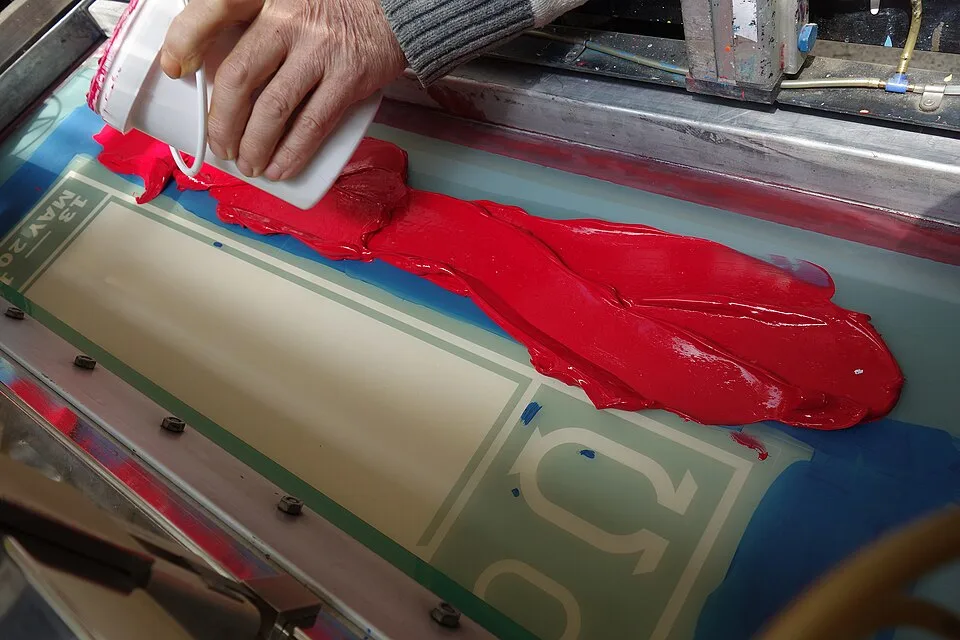
Red Ink Applied to a Printing Screen. A hand spreads thick red ink across a framed screen containing a masked graphic design.Manolis Angelakis · CC BY 4.0 · via Wikimedia CommonsView source ↗
Prompt
Transform this image into a Silkscreen Print with flattened vivid color blocks, stark photographic shadow shapes, and coarse stencil edges. Add slight color-layer misregistration, overlapping translucent inks, occasional mesh texture, uneven ink coverage, and visible paper fibers for a tactile printed finish. Keep the original subject and composition.
You see [flat, bold areas]of vivid color separated by stark photographic outlines. Colors often overlap or miss their outlines entirely.
Principle
Ink is pushed through a[porous mesh stencil1]onto paper or canvas. Misaligned stencils cause colors to [slip outside their boundaries].
Example
Andy Warhol: Marilyn Diptych, 1962.
Try it out
Cut apaper stencil, place it over another drawing, and dab paint through it to see how misalignment alters the image.
Background
Silkscreen printing began as acommercial method for making signs and advertisements. In the 1960s, Pop artists adopted it to mass-produce art. The process relies on atight mesh screen coated with alight-sensitive emulsion2. Aphotographic positive blocks UV light, leaving specific areas of the emulsion soft. When washed, these areas create open pores. Asqueegee3forces ink through these open pores onto acanvas. To print multiple colors, artists use adifferent screen for each hue. If the screens do not align perfectly, colorful gaps and overlaps appear.
Distinction
Unlike awoodcut print where raised wood stamps ink onto paper, silkscreen forces ink through open holes in aflat mesh.
Aftermath
It reveals how industrial manufacturing errors can be embraced as adistinctive artistic style.
Further examples · 9 images
02Lassen Volcanic National Park Silkscreen PosterAn erupting mountain rises above dark trees and a lake in broad fields of yellow, cream, and muted purple. The limited palette and sharply separated stencil-like color layers clearly illustrate the silkscreen poster technique.Work Projects Administration Poster Collection · Public domain · Wikimedia Commons03Yellowstone Geyser Silkscreen PosterA cream-colored geyser shoots into a blue sky above a dark foreground in this Yellowstone park poster. Broad, uniform ink fields and crisply outlined color separations demonstrate the graphic economy of silkscreen printing.Work Projects Administration Poster Collection · Public domain · Wikimedia Commons04Grand Canyon Layered Color PrintLayered canyon walls appear in interlocking patches of pink, cream, orange, and deep blue beneath a pale sky. The landscape is constructed from distinct flat color separations characteristic of a multicolor silkscreen print.Work Projects Administration Poster Collection · Public domain · Wikimedia Commons05Pictograms Across Overlapping Color BlocksSmall black pictograms repeat across broad overlapping rectangles of red, yellow, and green. The flat color passes and independent black stencil layer vividly demonstrate the layered construction of a silkscreen print.Alexey Parygin · CC BY-SA 4.0 · Wikimedia Commons06RUR Three-Color Theatre PosterAn angular mechanical figure dominates a theatrical poster rendered in bright yellow, red, and black. Its bold, unmodulated color separations and sharply bounded overlapping forms clearly display the visual language of silkscreen poster printing.Creator:Charles Verschuuren, artist Related Names Bufano, Remo. · Public domain · Wikimedia Commons07Red and Black Print Beside Drying RackA printer handles a red, black, and cream illustrated sheet beside a drying rack. The bold ink fields and sharply defined stencil-like imagery, presented in a printmaking setting, clearly support a silkscreen example.Manolis Angelakis · CC BY 4.0 · Wikimedia Commons08Diphtheria Prevention PosterA public-health poster depicts orange lightning, a blue protective shield, and a seated child within strongly colored lettering. Its limited palette, separately printed color shapes, and uneven ink coverage show the character of a vintage silkscreen poster.pingnews.com · Public domain · Wikimedia Commons09Turquoise Symbols Over Red ZigzagsOpaque turquoise symbols and red zigzag lines cross a dark background with softly mottled yellow-green areas. The crisp, independently layered foreground shapes visibly demonstrate silkscreen-like stencil printing, distinct from the softer background treatment.Alexey Parygin · CC BY-SA 4.0 · Wikimedia Commons
Question
Why do silkscreen prints often have a gritty, dotted texture?
Show possible answer +Hide answer −
Artists often use halftone dot patterns to replicate photographic shading. The mesh screen transfers these dots as solid black ink.