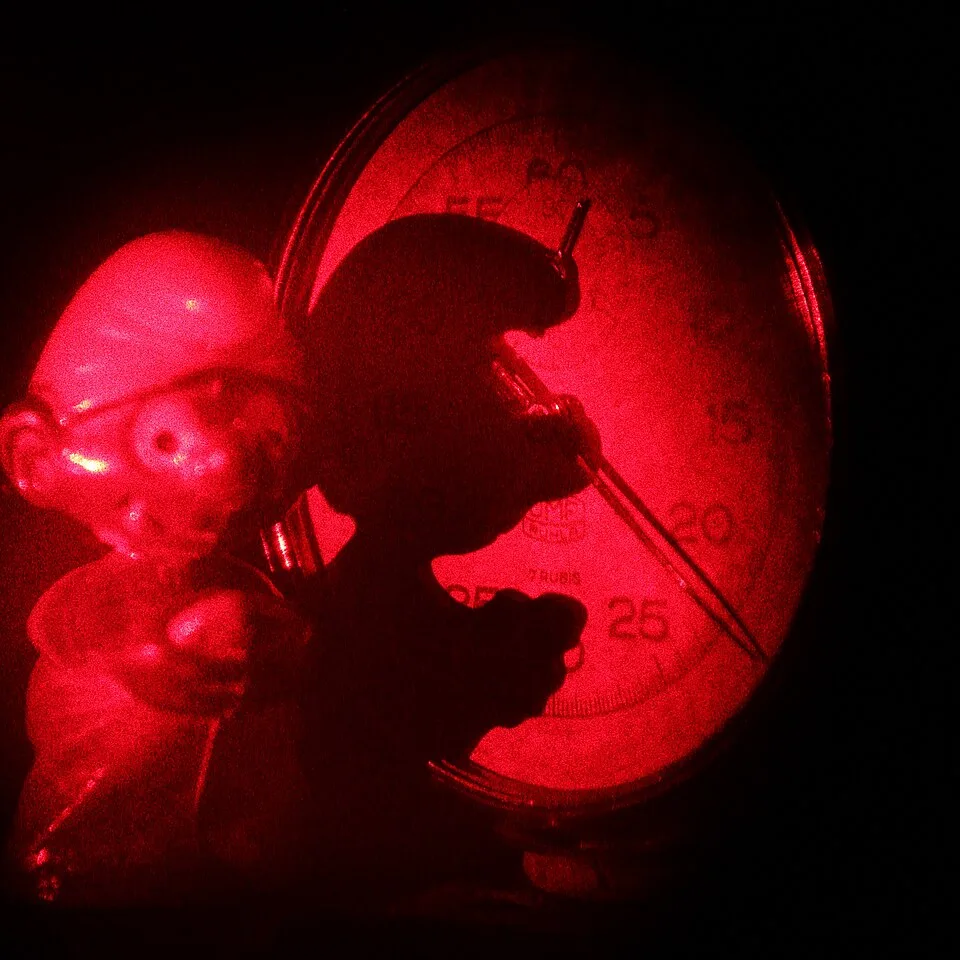
1962, Emmett Leith and Juris Upatnieks' first laser transmission holograms
Typeface · Plaster
Red Laser Reconstructing a Transmission Hologram. A brilliant red laser beam illuminates a glass plate, revealing a fully three-dimensional scene of a Smurf standing before a clock.Tomasz Kawalec · CC BY-SA 4.0 · via Wikimedia CommonsView source ↗
Prompt
Apply a Holography effect, making the image appear reconstructed in luminous depth within a dark, glossy plate. Use emerald and cyan light, fine interference shimmer, translucent contours, subtle spectral fringes, and layered depth cues that suggest viewpoint-dependent parallax rather than solid painted surfaces. Keep the original subject and composition.
You see a[fully three-dimensional image]trapped on aflat surface. As you move your head, the perspective changes, revealing different sides of the object.
Principle
Alaser beam is split in two to record the [interference pattern1of light waves]bouncing off an object. When illuminated later, this microscopic pattern bends light to perfectly [reconstruct the original 3D light field].
Example
Emmett Leith and Juris Upatnieks: Train and Bird, 1964.
Try it out
Look closely at aholographic sticker on acredit card. Tilt it back and forth to see how the image has depth and changes perspective, unlike aregular flat print.
Background
Hungarian-British physicist Dennis Gabor first proposed holography in 1947 to improve electron microscopes. However, practical 3D holography required apure, coherent2light source. The invention of the laser in 1960 changed everything. By 1962, researchers Emmett Leith and Juris Upatnieks successfully created the first high-quality 3D laser holograms. They achieved this by splitting asingle laser beam. One part hit aphotographic plate directly, while the other bounced off an object first. The meeting of these two beams created an interference pattern. This captured not just the intensity of light, but its physical phase3. Developing the plate locked this microscopic wave record in place permanently.
Distinction
Lenticular prints use tiny plastic lenses over sliced images to fake depth from specific angles. Holography uses microscopic wave interference to recreate acontinuous, true 3D light field.
Aftermath
It reveals that light behaves as aphysical wave, and its phase can be frozen and replayed.
Further examples · 10 images
02Embossed Rainbow Hologram of a Flying DoveA macro photograph captures an iridescent, glowing dove that appears to hover above the dark surface of a payment card. This clearly displays an embossed rainbow hologram, utilizing microscopic interference patterns to reconstruct a three-dimensional image visible under normal white light.Dominic Alves · CC BY 2.0 · Wikimedia Commons03Monochromatic Laser Transmission Hologram of a CrescentA glowing red crescent moon and sunburst design float brightly in the dark when illuminated by a coherent light source. The photograph successfully displays the characteristic monochromatic glow and spatial presence of a laser-reconstructed transmission hologram.Eto2pii · CC BY-SA 4.0 · Wikimedia Commons04Security Hologram Dove on a Bank CardAn angled view of a bank card highlights a small, colorful dove gleaming within a square metallic patch. It visibly demonstrates a commercial application of the technique, reflecting ambient light to produce a dynamic, color-shifting security image.Neil Turner from Sowerby Bridge, United Kingdom · CC BY-SA 2.0 · Wikimedia Commons05Holographic Recording Setup on Optical TableA researcher sits behind an optical table densely packed with lenses, mirrors, and a laser source. This intricate setup captures the recording phase of traditional holography, where a split laser beam creates an interference pattern.Epzcaw · CC BY-SA 4.0 · Wikimedia Commons06Embossed Security Hologram on Bank CardA bank card displays a square, metallic foil patch revealing a three-dimensional bust of Beethoven. This embossed security hologram effectively traps a three-dimensional light field on a completely flat surface, changing perspective as the card is tilted.Sludge G · CC BY-SA 2.0 · Wikimedia Commons07Laser Holographic ReconstructionA glowing, crescent-like pattern is reconstructed by passing laser light through a diffractive element. This illustrates the principle of synthetic holography, where a calculated microscopic pattern bends incoming light to form a specific image.Eto2pii · CC BY-SA 4.0 · Wikimedia Commons08Holographic Security Sticker on GuitarThe back of a guitar headstock features a tuning mechanism next to a small, iridescent security sticker. This sticker contains an embossed hologram, which diffracts ambient light to create a shifting, multi-dimensional visual effect.Gibson Les Paul Standard 2015 rear headstock with Min-ETune & Les Paul holography (2015… · CC BY 3.0 · Wikimedia Commons09Electron Holography of DNA StrandsA schematic diagram explains electron holography alongside an actual nanoscale interference pattern of DNA strands. This scientific application uses the principles of holography with electron waves instead of visible light to capture complex structural details.Koogid · CC BY-SA 4.0 · Wikimedia Commons10DNA Electron Hologram and DiagramAn illustration and corresponding micrograph display the interference pattern generated by passing electrons through a DNA sample. The recording of this hologram captures phase information, demonstrating the technique's utility in high-resolution scientific imaging.Koogid · CC BY-SA 4.0 · Wikimedia Commons
Question
Why did practical holography require the invention of the laser?
Show possible answer +Hide answer −
Lasers produce coherent light, meaning all the light waves travel in perfect step with one another. This uniform wave structure is necessary to create astable, readable interference pattern.