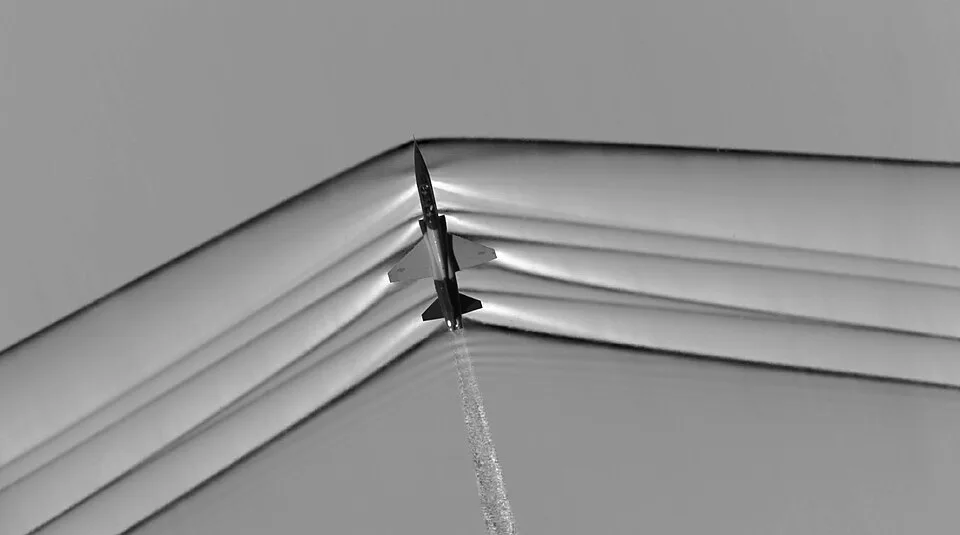
Shock Waves Around a Supersonic Aircraft. Sweeping dark and light bands surround a slender aircraft, with a narrow wake trailing below it.NASA & US Air Force: J.T. Heineck / Ed Schairer / Maj. Jonathan Orso / Maj. Jeremy Vand… · Public domain · via Wikimedia CommonsView source ↗
Prompt
Apply a Schlieren Photography effect with a neutral gray field and sharply defined light-dark bands revealing transparent air currents around the subject. Introduce delicate curling plumes, refractive ripples, and paired bright and dark gradients without opaque smoke, while retaining clear subject edges. Keep the original subject and composition.
You see transparent air currents rendered as [visible, swirling shadows]. Heat waves, sound waves, or gases look like dark and light ripples.
Principle
Light passes through [varying air densities], bending the rays slightly. Asharp physical edge [blocks the bent rays], creating visible shadows.
Example
August Toepler: Schlieren images of sound waves, 1866.
Try it out
Look over ahot toaster against aplain wall; watch the air shimmer and distort the background.
Background
In 1864, German physicist August Toepler invented this method to see the invisible. He wanted to observe sound waves moving through air. Air density changes when it heats up or when sound travels through it. Different densities bend light at different angles. This bending is called refraction1. Toepler used lenses and aprecisely placed knife edge2. The edge blocks light rays that bend away from their normal path. This transforms invisible density changes into high-contrast images. Scientists later used it heavily in aerodynamics to study supersonic airflow.
Distinction
Shadowgraphs project light through fluid onto ascreen without blocking rays. Schlieren uses aknife edge to achieve much higher sensitivity.
Aftermath
It reveals that even empty air contains dynamic, structured fluid mechanics.
Further examples · 11 images
02Supersonic Shock Bands and WakeAn aircraft silhouette sits within sharply defined, angled bands, with a textured wake extending to the right. Schlieren contrast makes the otherwise invisible density changes of supersonic airflow visible.NASA & US Air Force: J.T. Heineck / Ed Schairer / Maj. Jonathan Orso / Maj. Jeremy Vand… · Public domain · Wikimedia Commons03Wind-Tunnel Model With Visible Shock WavesA supported wind-tunnel model appears in silhouette amid curved and diagonal light-and-dark boundaries. The schlieren photograph reveals shock waves through the bending of light across air-density gradients.NASA Langley Research Center / NASA · Public domain · Wikimedia Commons04Aircraft Shock Waves in SchlierenBroad, slanting bands rise from a small dark aircraft silhouette against a grainy gray field. These schlieren bands expose the density gradients associated with supersonic shock waves.Leonard Weinstein / NASA · Public domain · Wikimedia Commons05Color Schlieren of a Heated PlumeBlue and green ribbons rise above a small flame and curl against a circular red background. Color schlieren imaging translates light deflection through heated air into vivid contrasts that reveal the convection plume.Settles1 · CC BY 3.0 · Wikimedia Commons06Rising Plume Becoming TurbulentA thin bright plume rises from a narrow source before breaking into densely curled eddies. Schlieren contrast reveals the transition from smooth flow to turbulence through light bending across gas-density gradients.Gary Settles · CC BY-SA 3.0 · Wikimedia Commons07Supersonic Model in a Schlieren FieldA pointed, finned model and its support appear as black silhouettes within a circular field crossed by diagonal lines. Schlieren imaging exposes shock waves generated by supersonic flow around the model.NASA · Public domain · Wikimedia Commons08Shock Patterns Around Pointed and Blunt BodiesFour experimental photographs compare pointed and blunt bodies, showing angled shocks, curved bow shocks, and textured wakes. The visible schlieren patterns demonstrate how body shape changes the density structure of high-speed airflow.NASA · Public domain · Wikimedia Commons09Shock Waves Around Wind Tunnel ModelsSharp diagonal wave fronts and textured wakes surround silhouetted models in a high-speed airflow. Schlieren imaging reveals air-density gradients as contrasting light and dark bands.NASA Ames Research Center · Public domain · Wikimedia Commons10Projectile Shock Waves and WakeA projectile appears within a circular field, accompanied by diagonal wave fronts and a rippling wake. Schlieren photography makes the density changes surrounding its supersonic passage visible.Ernst Mach (1838–1916) · Public domain · Wikimedia Commons11Wing Sweep and Shock WavesTwo circular photographs compare shock-wave patterns around aircraft models with different wing sweep angles. The schlieren views reveal sharp air-density changes as dark bands around the silhouettes.NASA Ames Research Center · Public domain · Wikimedia Commons
Question
Why is a sharp edge needed in the optical setup?
Show possible answer +Hide answer −
The edge blocks light that has been bent by density changes. This turns aslight optical distortion into adark visible shadow.