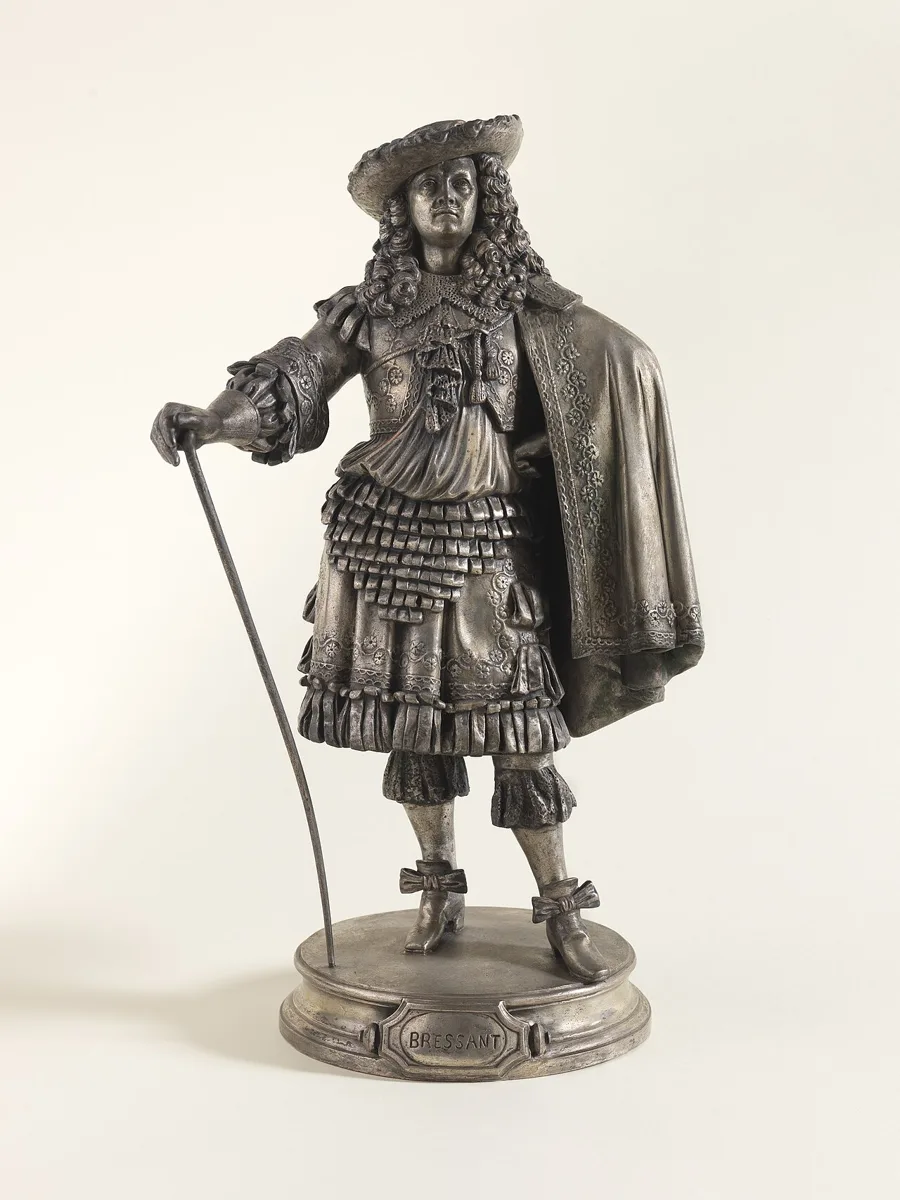
Bressant Photosculpture with Cane. The statuette identified as Bressant presents a costumed actor holding a cane, with a broad hat, curled hair, and an ornamented cape.Willème, Auguste François (Sedan, en 1830 - Roubaix, en 1905), sculpteur · CC0 · via Wikimedia CommonsView source ↗
Prompt
Transform this image into a Photosculpture, rendering the subject as a solid, three-dimensional ivory plaster bust or statuette. Model recognizable facial contours, clothing folds, and pose with hand-finished surfaces, subtle tool marks, crisp silhouettes, and soft directional shadows rather than photographic skin texture. Keep the original subject and composition.
You see a[three-dimensional portrait]bust or statuette, with arecognizable pose and [modeled clothing]. Its solid surface resembles conventional sculpture, not aphotograph.
Principle
Twenty-four cameras around asitter record views whose silhouettes1guide the sculpture’s shape. Apantograph2transfers traced outlines to guide [subtractive cutting3]into aclay blank, followed by hand finishing.
Example
François Willème: Self-Portrait, circa 1860.
Try it out
Photograph astationary figurine from four sides; compare the outlines and notice which surface details they cannot describe.
Background
François Willème introduced photosculpture in France in 1860, combining photography with mechanical tracing and sculpture. His studio arranged 24 cameras around acentral platform to photograph asitter from different directions. After development, the photographs supplied outlines for tracing. Apantograph linked the traced profiles to the shaping of aclay blank. Cutting established the main volume; hand finishing supplied details that silhouettes could not capture. The resulting model could then be molded and reproduced. Photography helped measure the subject, but it did not directly turn light into solid material.
Distinction
Unlike stereoscopic photography, photosculpture produces aphysical object rather than an illusion of depth. Unlike additive 3D printing, its shaping stage removes material.
Aftermath
Photosculpture shows how multiple photographic viewpoints can guide physical reconstruction without recording every surface detail.
Further examples · 11 images
02Bressant Photosculpture in ProfileA side view of Bressant shows the actor's projecting cane, curled hair, draped cape, and staggered feet on a circular base. The photosculpture's complete profile clearly displays the posed body and costume volumes reconstructed through the photographic silhouette process.Willème, Auguste François (Sedan, en 1830 - Roubaix, en 1905), sculpteur · CC0 · Wikimedia Commons03Delaunay Photosculpture, Frontal ViewThe statuette labeled Delaunay depicts a standing actor in historical costume, with one hand at his waist and a cape over one shoulder. This finished photosculpture clearly presents the recognizable pose, portrait likeness, and modeled clothing characteristic of the technique.Willème, Auguste François (Sedan, en 1830 - Roubaix, en 1905), sculpteur · CC0 · Wikimedia Commons04Delaunay Photosculpture, Three-Quarter ViewAn oblique view of Delaunay reveals the projecting chest, bent arm, hanging cape, and sword extending behind the figure. The solid portrait demonstrates photosculpture's reconstruction of a sitter's pose and clothed body from surrounding photographic views.Willème, Auguste François (Sedan, en 1830 - Roubaix, en 1905), sculpteur · CC0 · Wikimedia Commons05Delaunay Photosculpture in ProfileDelaunay appears in profile, with a long cape covering his back and a sword projecting diagonally behind his legs. This view clearly exposes the finished photosculpture's full-body silhouette and three-dimensional costume modeling.Willème, Auguste François (Sedan, en 1830 - Roubaix, en 1905), sculpteur · CC0 · Wikimedia Commons06Standing Portrait in Renaissance CostumeA metallic portrait statuette depicts a man in Renaissance-style theatrical dress, standing with one hand at his waist. The recognizable pose, individual features, and fully modeled clothing clearly display photosculpture’s transformation of photographic views into a finished sculptural likeness.Willème, Auguste François (Sedan, en 1830 - Roubaix, en 1905), sculpteur · CC0 · Wikimedia Commons07Bressant in Costume with a CaneA statuette labeled Bressant portrays a long-haired man in an elaborate historical costume, resting one hand on a tall cane. This theatrical portrait exemplifies photosculpture through its preserved bodily pose and richly finished three-dimensional clothing.Willème, Auguste François (Sedan, en 1830 - Roubaix, en 1905), sculpteur · CC0 · Wikimedia Commons08Provost in Historical CostumeA full-length statuette on a base inscribed Provost depicts a man in a broad hat, long coat, breeches, and buckled shoes. The individualized face, planted stance, and volumetric costume make this a clear example of photosculpture as a finished theatrical portrait.François Willème · CC0 · Wikimedia Commons09Painted Photosculpture of a Cloaked GentlemanA painted portrait statuette depicts a mustached man in a pale waistcoat and trousers, with a dark cloak falling behind his casually posed body. Its lifelike stance and solid, colored clothing demonstrate photosculpture’s production of three-dimensional portrait figures rather than flat photographic likenesses.Willème, Auguste François (Sedan, en 1830 - Roubaix, en 1905), sculpteur · CC0 · Wikimedia Commons10Delaunay Photosculpture, Costume and Sword DetailA close detail of the Delaunay statuette shows a puffed sleeve, relaxed hand, sword hilt, and modeled costume folds. This portion of the photosculpture displays the solid, hand-finished clothing and accessories of the photographically derived portrait.Willème, Auguste François (Sedan, en 1830 - Roubaix, en 1905), sculpteur · CC0 · Wikimedia Commons11Delaunay Photosculpture, Rear Head DetailThe rear of the Delaunay statuette reveals a soft cap, short hair, looped collar, and rounded shoulders. This detail of the finished photosculpture shows the continuous three-dimensional modeling that distinguishes the result from a photographic image.Willème, Auguste François (Sedan, en 1830 - Roubaix, en 1905), sculpteur · CC0 · Wikimedia Commons
Question
Why could 24 silhouettes not fully describe a sitter’s face?
Show possible answer +Hide answer −
Silhouettes describe outer boundaries, not every hollow or surface feature. Details missing from those boundaries still required interpretation and hand finishing.