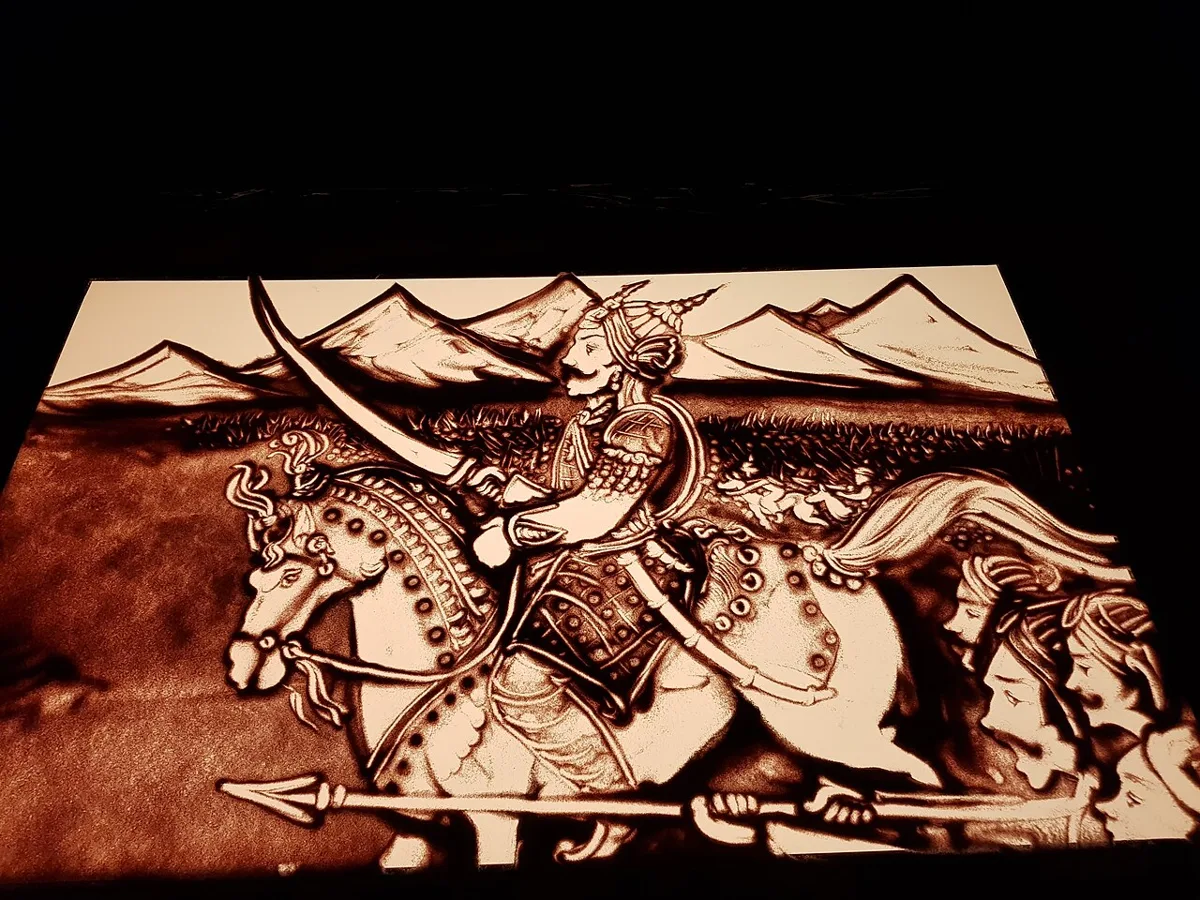
Mounted Warrior in Backlit Sand. An armored rider on horseback crosses a mountainous landscape rendered in brown grains against a luminous ground.Manas Sahoo · CC BY-SA 4.0 · via Wikimedia CommonsView source ↗
Prompt
Transform this image into a Sand Animation frame, shaping the scene from dark granular deposits on a warm glowing lightbox. Use dense opaque silhouettes, translucent thin sand layers, finger-swept highlights, soft crumbling edges, scattered specks, and flowing transitional contours. Keep the original subject and composition.
[Grainy silhouettes]shift across aglowing background, with [soft edges]and scattered specks. Figures seem to dissolve, stretch, and grow into new shapes.
Principle
Sand on alightbox1[blocks transmitted light2], making thicker deposits darker and cleared areas brighter. Small changes photographed frame by frame create apparent movement during playback.
Example
Caroline Leaf: Sand, or Peter and the Wolf, 1969.
Try it out
Spread fine sand on aclear tray above acool light source; photograph five small changes and compare the resulting silhouettes.
Background
Caroline Leaf made Sand, or Peter and the Wolf in 1969 while studying at Harvard. It became an important early example of sand animation. She manipulated sand on an illuminated surface and photographed successive arrangements. This stop-motion3method turns loose grains into moving figures without requiring separate drawings for every frame. Adding sand blocks more light; removing it reveals the bright surface below. Thin, uneven layers produce intermediate tones and visible texture. Because each change alters the existing image, transformations can flow directly from one scene into another.
Distinction
Unlike live sand drawing, this technique builds movement from separately photographed arrangements rather than continuously filmed gestures. Unlike cel animation, it reshapes loose material instead of replacing drawings.
Aftermath
Sand animation shows how changing amaterial’s distribution can turn blocked light into expressive movement.
Further examples · 11 images
02Sand Temple Beneath a Glowing MoonAn ornate temple roof rises beneath a glowing moon and streaked sky. Granular shadows and bright lines cleared through sand reveal the backlit drawing method used in sand animation.Jun123 · CC BY-SA 3.0 · Wikimedia Commons03Sacred Portrait in Illuminated SandA portrait of Jesus appears with a luminous halo, scattered stars, and a cross surrounded by radiating lines. Uneven sand deposits shade the face while cleared grains expose the light beneath, visibly demonstrating sand animation's image-making technique.Jun123 · CC BY-SA 3.0 · Wikimedia Commons04Ganesha Drawn in Backlit SandGanesha appears with an ornate crown, raised palm, lotus, and bowl of sweets against a golden field. Dark piled grains and luminous cleared details make the sand-on-lightbox process unmistakable.Jun123 · CC BY-SA 3.0 · Wikimedia Commons05Woman and Dolphins in Glowing SandA woman's face emerges among sweeping strands, flowers, and two dolphin forms. Grainy shading and fingerlike cleared trails visibly demonstrate the malleable backlit sand medium used for sand animation.Jun123 · CC BY-SA 3.0 · Wikimedia Commons06Woman With Parasol in Backlit SandA woman in patterned clothing stands beside a floral parasol, with a mountain and gateway beyond. Scraped rays, granular tonal fields, and bright decorative outlines clearly show sand manipulated over a luminous surface.Jun123 · CC BY-SA 3.0 · Wikimedia Commons07Dreaming Face and Crescent in SandA closed-eyed face faces a crescent-shaped form amid stars, dots, and sweeping strands. Soft granular shadows and cleared luminous marks visibly display the lightbox sand technique underlying sand animation.Jun123 · CC BY-SA 3.0 · Wikimedia Commons08Buddha and Flower in Backlit SandA serene face, a standing silhouette, and an ornate flower emerge from a glowing golden field. Grainy shading and bright cleared contours reveal the backlit sand medium used in sand animation.Jun123 · CC BY-SA 3.0 · Wikimedia Commons09Warrior and Chariot in SandAn armed figure rides an elaborate chariot above a densely populated scene rendered in reddish-brown grains. Dark sand deposits and luminous cleared lines demonstrate the light-blocking technique of sand animation.Manas Sahoo · CC BY-SA 4.0 · Wikimedia Commons10Facing Profiles and Fantastical Sand FormsTwo facing profiles mingle with a bird, curling waves, and a miniature skyline on a luminous surface. Scattered grains, layered dark deposits, and swept bright lines clearly display the image-making medium of sand animation.Jun123 · CC BY-SA 3.0 · Wikimedia Commons11Shaping a Tower on a LightboxHands work over a glowing sand-covered table bearing a pointed tower and curved architectural details. The visible manipulation of dark grains against transmitted light directly demonstrates the technique used to create sand animation.Jun123 · CC BY-SA 3.0 · Wikimedia Commons
Question
Why does clearing sand from a backlit surface make that area brighter?
Show possible answer +Hide answer −
Removing sand lets more light pass through the surface toward the camera. Adding sand blocks more of that light.