1960s, popularization in photojournalism and cinema
Typeface · News Cycle
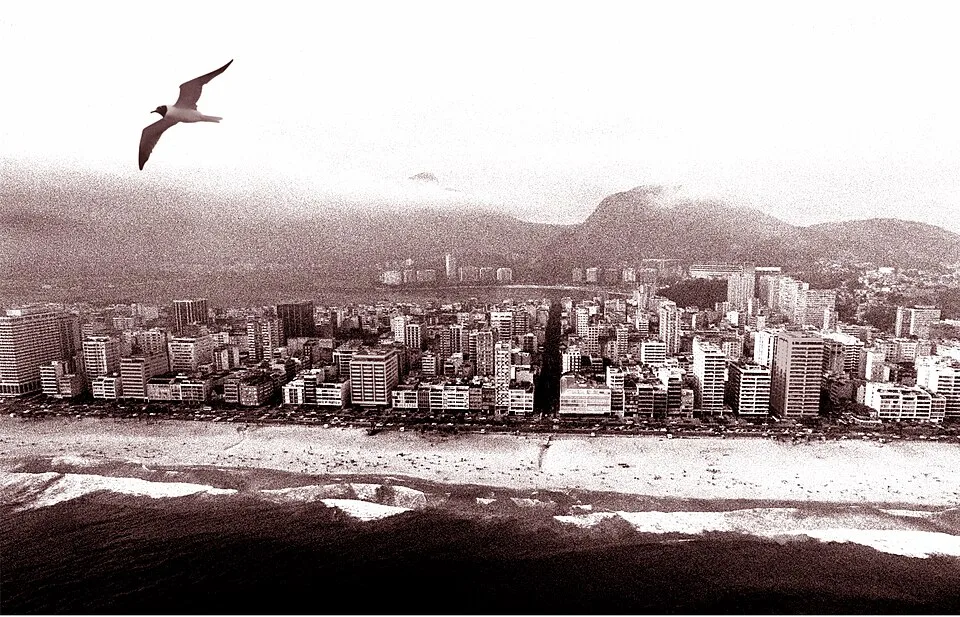
Coastal Skyline in Coarse Grain. A bird crosses above a coastal city rendered in coarse monochrome grain, with white surf bordering a nearly black sea.Sérgio Valle Duarte .mw-parser-output .messagebox{margin:4px 0;width:auto;border-collap… · CC BY 3.0 · via Wikimedia CommonsView source ↗
Prompt
Apply a Push Processing effect with coarse, conspicuous photographic grain, steep contrast, dense blocked shadows, and harsh luminous highlights. Reduce subtle shadow detail, introduce uneven grain clumping and slightly rough tonal transitions, and retain an underexposed, available-light atmosphere rather than a polished digital finish. Keep the original subject and composition.
You see unusually prominent, [coarse grain across the image]. The picture also features [stark contrast with harsh highlights]and deep shadows.
Principle
Photographers deliberately [underexpose the film]in the camera. They then overdevelop1it in the darkroom to compensate for the missing light.
Example
Don McCullin: Vietnam War photojournalism, 1968.
Try it out
Look at an old newspaper photo taken in dark conditions. Notice how the flat grey areas look like tiny swarming dots instead of smooth tones.
Background
Photographers often faced low-light environments where normal exposure required impossibly slow shutter speeds. To avoid blurry photos, they set their cameras to ahigher film speed2than the film's actual rating. This deliberately underexposed the film. To fix the dark image, technicians left the film in the developer chemical for much longer than standard times. This extended chemical reaction forced the faint latent image to appear. However, it also clumped the silver halide crystals3together. This clumping created the signature coarse grain and high-contrast look that defined 1960s gritty photojournalism.
Distinction
Push processing happens during chemical development to fix underexposure. In contrast, dodging and burning happens during printing to adjust local brightness.
Aftermath
It shows that technical flaws like grain can become powerful aesthetic choices that convey raw realism.
Further examples · 7 images
02Coarse-Grained Portrait With Covered EyesSeveral hands cover a person's eyes in a tightly framed black-and-white portrait with coarse grain throughout. The conspicuous granular texture, harsh pale highlights, and dense surrounding shadows strongly demonstrate the characteristic appearance of push processing.Damiano from Sevilla, España · CC BY-SA 2.0 · Wikimedia Commons03Grainy Islands in Brilliant HazeCloud-wrapped islands emerge from a textured sea, with pale skies dissolving into brilliant highlights. Visible grain, compressed dark tones, and harsh highlight transitions clearly evoke the characteristic appearance of push processing.Sérgio Valle Duarte .mw-parser-output .messagebox{margin:4px 0;width:auto;border-collap… · CC BY-SA 3.0 · Wikimedia Commons04Grainy Color in a GalleryA visitor in a red dress studies an abstract painting in a warmly colored gallery. Pronounced grain across the yellow wall and dense shadows provide a clear color example of the pushed-film appearance.Mike Babiarz · CC BY 2.0 · Wikimedia Commons05Boat Beneath a Grainy Dark SkyA wooden boat rests on brilliant sand beneath a dramatically dark sky and sharply modeled clouds. Visible grain combines with severe tonal contrast and dense shadows to demonstrate the characteristic pushed-film look, although the processing history cannot be established from appearance alone.Sérgio Valle Duarte .mw-parser-output .messagebox{margin:4px 0;width:auto;border-collap… · CC BY 3.0 · Wikimedia Commons06Grainy Facade With Deep Tree ShadowsA white geometric facade recedes beside dark trees, with visible grain across the shaded surfaces. The combination of pronounced grain, brilliant architectural highlights, and nearly blocked foliage shadows provides a clear visual example of the push-processing effect.incidencematrix · CC BY 2.0 · Wikimedia Commons07Grainy Gallery Wall With Framed PortraitA framed portrait hangs on a yellow gallery wall between darker paintings, with visible grain across the illuminated plaster. The granular texture, strong warm color cast, and dense shadows provide a convincing visual example of pushed color film.Mike Babiarz · CC BY 2.0 · Wikimedia Commons
Question
Why does push processing increase contrast?
Show possible answer +Hide answer −
Extended development affects the bright areas of the negative much faster than the dark areas. This uneven chemical action stretches the difference between light and dark.