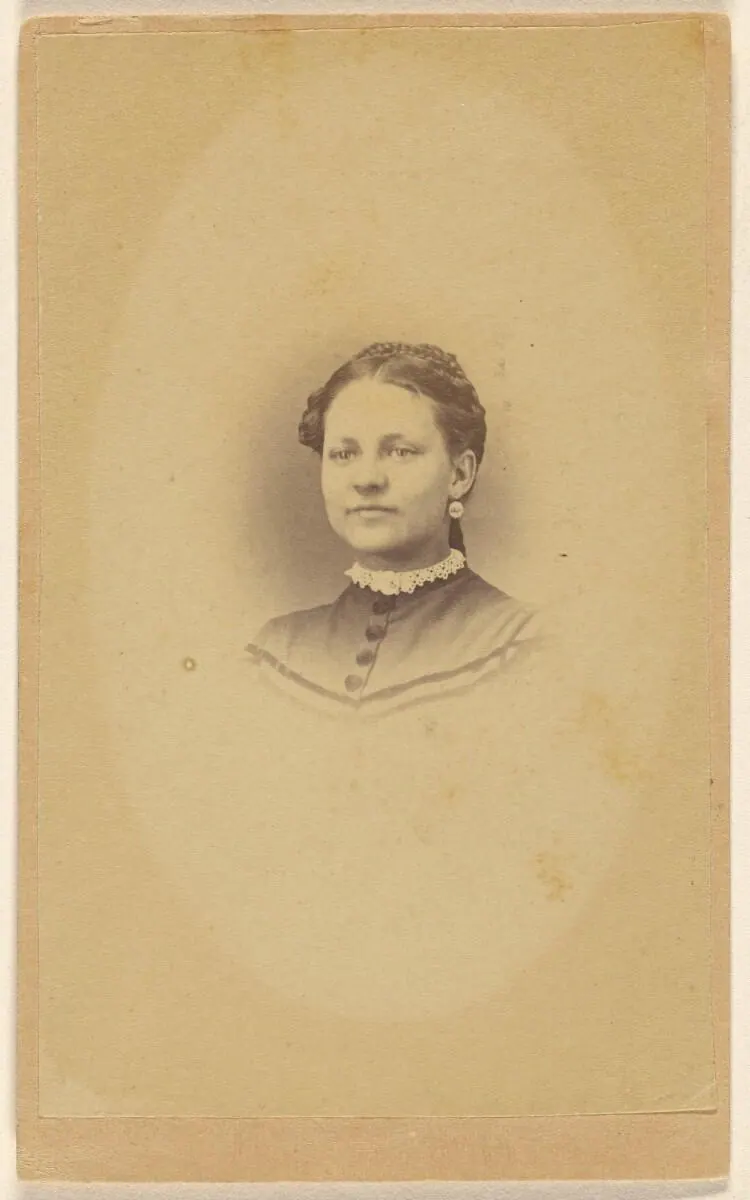
Portrait vignette / vignetting. Studio and portrait cards in the 19th century
Typeface · Goudy Bookletter 1911
Unknown photographer: Unidentified woman, printed in vignette and quasi-oval style, 1865–1870.Unknown photographer / J. Paul Getty Museum. Getty Open Content; historical work in the public domain.View source ↗
Prompt
Apply a Portrait Vignette effect with a softly feathered oval image area centered on the main subject. Fade surrounding details gradually into warm ivory photographic paper, using gentle sepia tones, fine grain, and luminous midtones without a hard oval outline or dark corners. Keep the original subject and composition.
The head or upper body is positioned within a[soft oval area]. The [background fades into the lighter paper].
Principle
Aprint mask1causes the [exposure to fade at the edges]. Digital vignettes2can also darken or color image edges.
Example
Getty: Unidentified woman, 1865–1870.
Try it out
Compare aportrait with alight, faded edge and dark corners. Experiment with avignette effect digitally and observe how the viewer's eye is drawn to it.
Background
Early photographic print design; here adocumented example from 1865–1870. Portrait cards and studio photography in the 19th century. Detailed mechanism: Amasked or shaded print allows the image to fade softly into the unprinted paper. Later, dark or colored digital vignettes also appeared. Historical light portrait vignettes and optical dark image corners are related phenomena, but technically different.
Distinction
Historical bright portrait vignettes and optical dark image corners are related phenomena, but technically different.
Aftermath
Vignette control, soft masks and portrait focus.
Further examples · 7 images
02Walter Russell Hall (portrait) with vignette drawn by Helena Forde, Sydney, 1874A man's portrait is centered within an oval frame surrounded by botanical illustrations. The photo edges blend into a light background, exemplifying how 19th-century vignettes integrated photography with decorative art.Helena Scott · Public domain · Wikimedia Commons03William H. R. Simpson (vignette)This image shows a man in a military uniform and busby hat. The lower portion and corners fade softly into the white paper, illustrating a classic light portrait vignette from the 1860s.Unknown photographerUnknown photographer · Public domain · Wikimedia Commons04[Vignetted portrait, woman holding a baby]A woman holds a baby, with the lower edges of their clothing disappearing into the unprinted paper. It demonstrates the technical use of a print mask to isolate the central subjects.Alfred Capel-Cure · CC0 · Wikimedia Commons05[Vignetted portrait of two children]Two children are positioned within a soft oval area against a dark backdrop. The sharp contrast between the dark interior and the light, faded edges highlights the optical focus of the vignette.Alfred Capel-Cure · CC0 · Wikimedia Commons06Portrait Vignette, applied to “Traditional worker with coconut rope (edited)”A traditional worker holding coconut rope is framed within a soft, light oval. The image edges gradually fade into the cream-colored background, replicating a 19th-century photographic vignette.Original: Curved.kiwix
Derivative work: Radomianin (photo); processed for the Atlas · CC BY-SA 4.0 · Wikimedia Commons07Portrait Vignette, applied to “Achim Freyer Nestroy-Theaterpreis 2015 e”A portrait of Achim Freyer is centered in an oval mask. The outer portions of the frame transition into a light tone, mimicking the historical technique of shading during the printing process.Manfred Werner - Tsui (photo); processed for the Atlas · CC BY-SA 3.0 · Wikimedia Commons