Hand-coloring / hand-tinting. Photography has existed since early times, refined in Japan from the 1860s onwards.
Typeface · Petit Formal Script
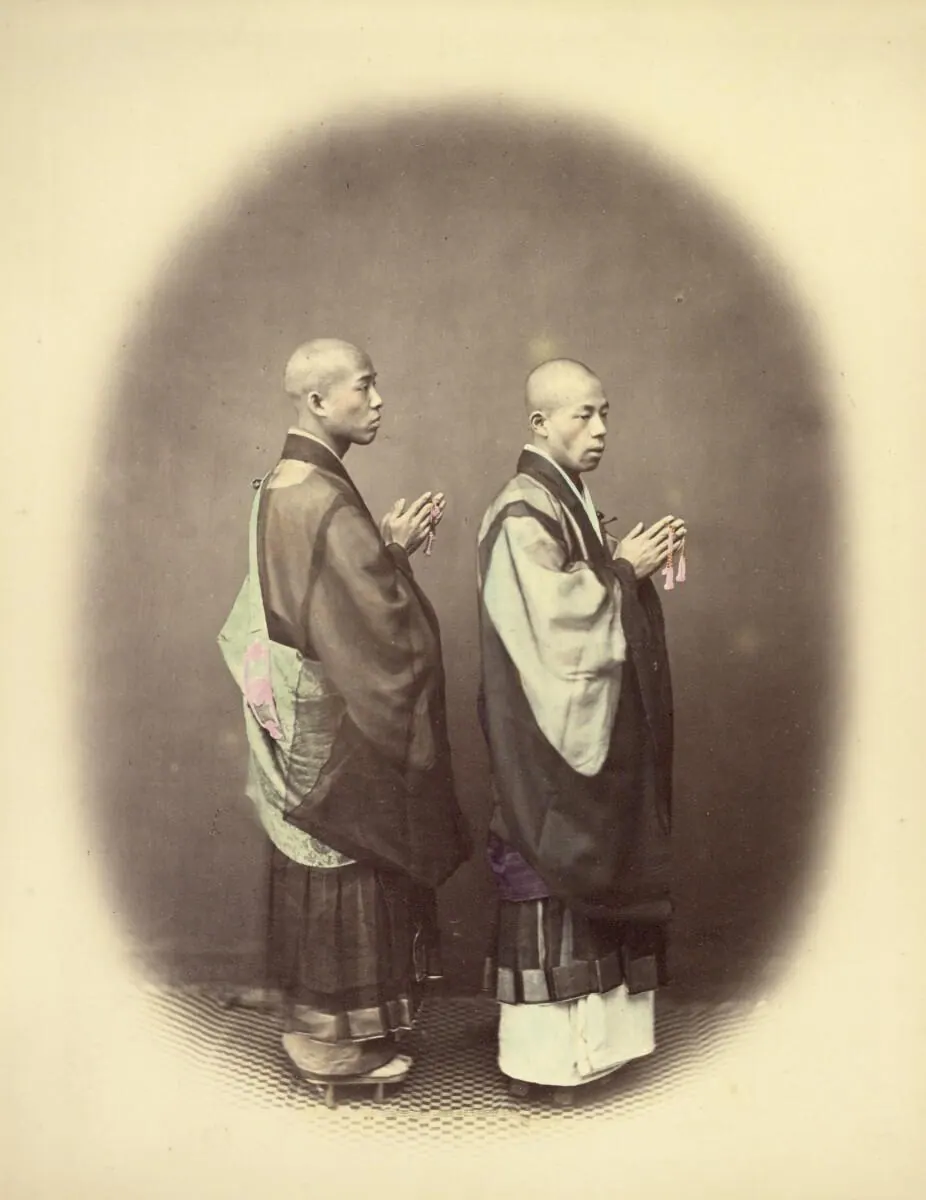
Felice Beato: Priests or Zen Shu, 1866–1867. Historical hand-colored albumen print.Felice Beato; Japanese colorists unnamed / J. Paul Getty Museum. Getty Open Content; historical work in the public domain.View source ↗
Prompt
Apply a historical Hand Coloring effect over a gray-brown monochrome print. Add delicate, selective watercolor-like washes of muted rose, pale blue, ochre, and green, with slight brush variation and occasional pigment pooling. Let photographic detail remain visible beneath translucent color and lightly textured paper. Keep the original subject and composition.
[Delicate, selective color]lies on agrey-brown background. Fabrics and faces sometimes appear as if painted in watercolor.
Principle
Colorists paint ablack and white print [with pigments or dyes1]. The photograph itself contains [no photographically captured color].
Example
Felice Beato: Priests or Zen Shu, 1866–1867.
Try it out
Color just one item of clothing in ablack and white image. Let the tonal values2and paper texture show through the color.
Background
Hand-coloring dates back to the early decades of photography; professionally refined in Japan in the 1860s. Colored portraits and travel albums; Felice Beato's studio in Japan from 1863. Detailed mechanism: Ablack and white print is subsequently hand-colored with pigments or dyes. Color is created by hand, not through acolor-sensitive photograph. Hand-coloring is adistinct historical look and not an early color photography process.
Distinction
Hand coloring is adistinct historical look and not an early color photography process.
Aftermath
Colorization, selective color and hybrid photo-drawing.
Further examples · 12 images
02RPPC hand tinted postcard of a woman arranging flowersA woman arranges flowers while wearing a mint-green garment against a muted, monochromatic background. The selective application of dye over the monochrome print illustrates how manual coloring isolates subjects while maintaining original paper textures.Heinrich Traut for the Rotophot Company. · Public domain · Wikimedia Commons03Smiling woman, hand colored albumen print from Japan, Honolulu Museum of ArtWater-based pigments are applied to the woman's clothing and lips over a monochromatic base. The underlying photographic tones and paper texture remain visible through the transparent layers of red and green color.Hiart · Public domain · Wikimedia Commons04Circa 1880 Sedan chair (hand-colored albumen print, Japan)Selective dyes highlight the flowers and the central figure's kimono. The background and figures on the periphery retain the original monochromatic sepia appearance, demonstrating the manual application of color to specific areas.Photographic Heritage · Public domain · Wikimedia Commons05C. 1890 people with flowers in Japan (hand-colored albumen print)Pigments have been added to the flowers and the clothing of the central figures. The flat, non-photographic nature of the pinks and blues illustrates how colorists manually interpreted the scene after the print was made.Photographic Heritage · Public domain · Wikimedia Commons06Circa 1880 Two women bowing, "ojigi" (hand-colored albumen print, Japan)Transparent red and blue tints are applied to the garments. The localized color contrasts with the neutral tones of the wooden gate and thatched roof, showcasing the 19th-century Japanese studio style of hand-tinting.Unknown authorUnknown author · Public domain · Wikimedia Commons07Circa 1880 Enoshima Caves (hand-colored albumen print, Japan)Pink and purple dyes are applied to the small figures in this landscape. The selective color draws attention to the subjects while the surrounding rock formations and sky remain in their original photographic state.Unknown authorUnknown author · Public domain · Wikimedia Commons08Circa 1880 Greengrocer in Japan (hand-colored albumen print)The vegetables and produce are individually tinted with green and purple washes. This demonstrates the detailed labor involved in coloring complex still-life elements within a photographic composition.Unknown authorUnknown author · Public domain · Wikimedia Commons09Sacred Bridge at Nikko (hand-colored albumen print, Japan)The bridge is painted with a distinct reddish-brown pigment that differs from the photographic grain of the trees. This selective application creates a focal point not present in the original black and white capture.Photographic Heritage · CC BY 2.0 · Wikimedia Commons10Fuji Shiraito Falls (hand-colored albumen print, Japan) (15340920033)Subtle green tints are applied to the foliage surrounding the waterfall. The contrast between the hand-painted leaves and the uncolored white water illustrates the additive nature of this historical process.Unknown authorUnknown author · Public domain · Wikimedia Commons11Circa 1880 Transplanting Rice (hand-colored albumen print, Japan)The clothing of the workers and the green rice paddies are tinted with dyes. The wash-like quality of the color shows how pigments were layered over the albumen print's silver image.Photographic Heritage · Public domain · Wikimedia Commons12Gongen shrine in Hakone (hand-colored albumen print, Japan) (15773294310)Green and brown pigments are applied to the towering trees and foliage. The color application is painterly, with visible variations in hue that do not correspond to photographic light sensitivity.Photographic Heritage · CC BY 2.0 · Wikimedia Commons