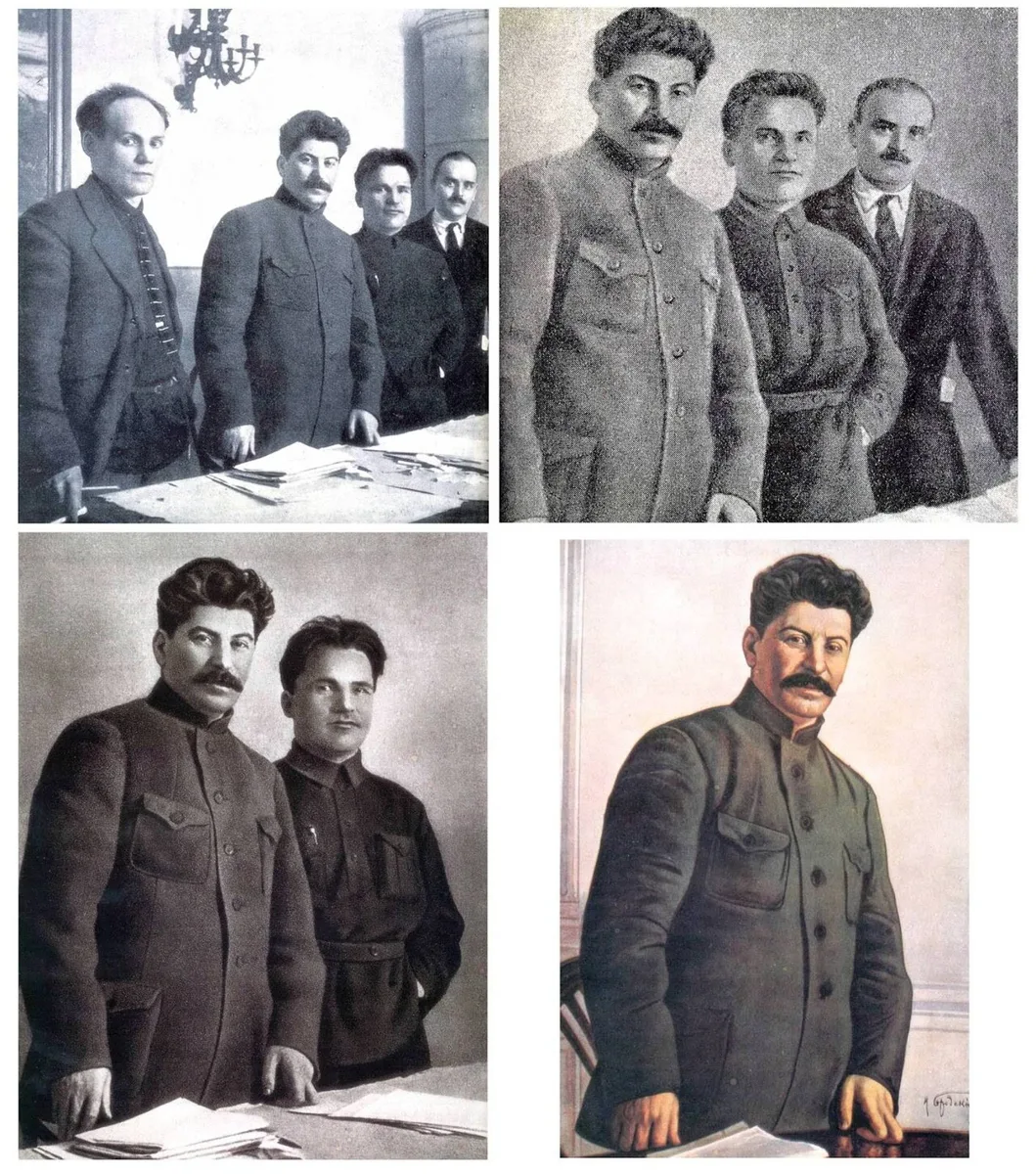
Stalin's Companions Progressively Removed. Four versions of a group portrait progressively reduce Stalin's companions until he stands alone beside the table.Unidentified Soviet photographer. · Public domain · via Wikimedia CommonsView source ↗
Prompt
Apply a Political Retouching effect resembling an altered archival photograph, with monochrome grain, airbrushed background patches, scraped emulsion marks, and awkwardly repeated wall or ground textures. Suggest an erased peripheral presence through a faint ghost outline and unnaturally blank patch. Keep the original subject and composition.
You see ahistorical photograph where aperson is missing, leaving an [unnaturally empty space]. Sometimes, background textures like walls or water look slightly smudged or painted over.
Principle
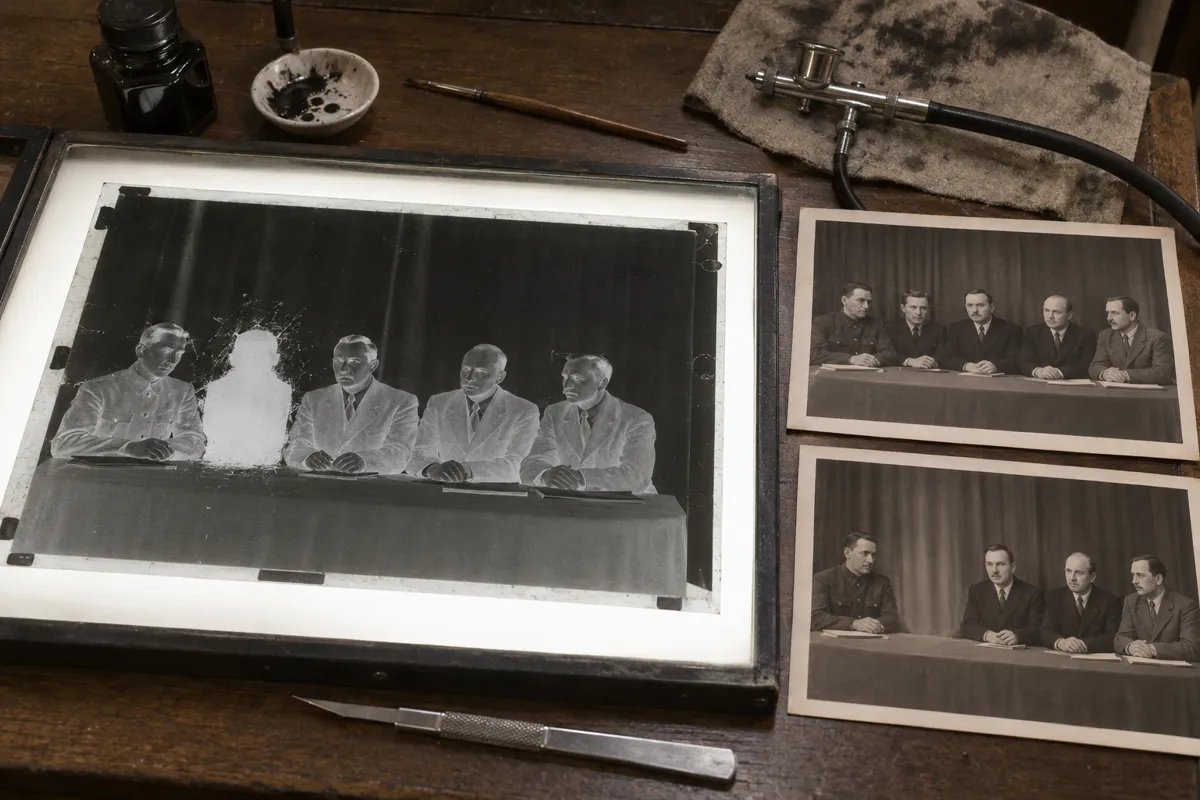
Technicians used scalpels to [scrape away the emulsion1]on the negative to remove afigure. They then used an airbrush2and ink to [paint in afake background].
Example
Soviet state censors: The Vanishing Commissar (Nikolai Yezhov removed from Stalin photo), circa 1940.
Try it out
Look closely at the water or wall behind adictator in a1930s photo to spot blurry, painted textures.
Background
During the 1930s, the Soviet government systematically altered photographs to rewrite history. When political figures fell out of favor, they were executed and erased from the visual record. Skilled retouchers worked directly on photographic negatives and prints. They used sharp tools to physically scrape away the image of the condemned person. Next, they carefully applied ink with an airbrush to reconstruct the missing background. This subtractive and additive process required immense skill to match the film grain3. The altered photos were then re-photographed and published as the new official truth.
Distinction
Unlike double exposure which adds ghostly figures, political retouching subtracts real people to create afalse reality. It leaves behind painted, opaque backgrounds rather than transparent overlaps.
Aftermath
It shows how photographic truth can be manipulated by those in power using manual darkroom techniques.
Further examples · 7 images
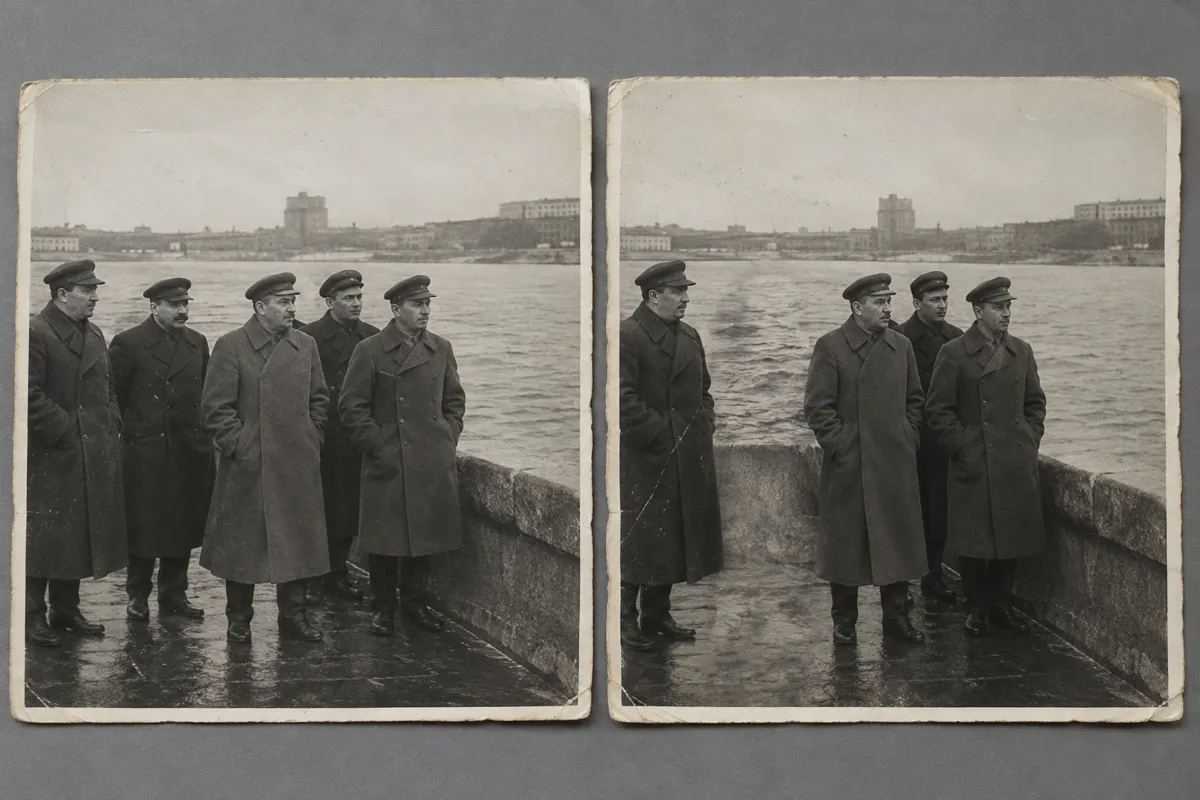
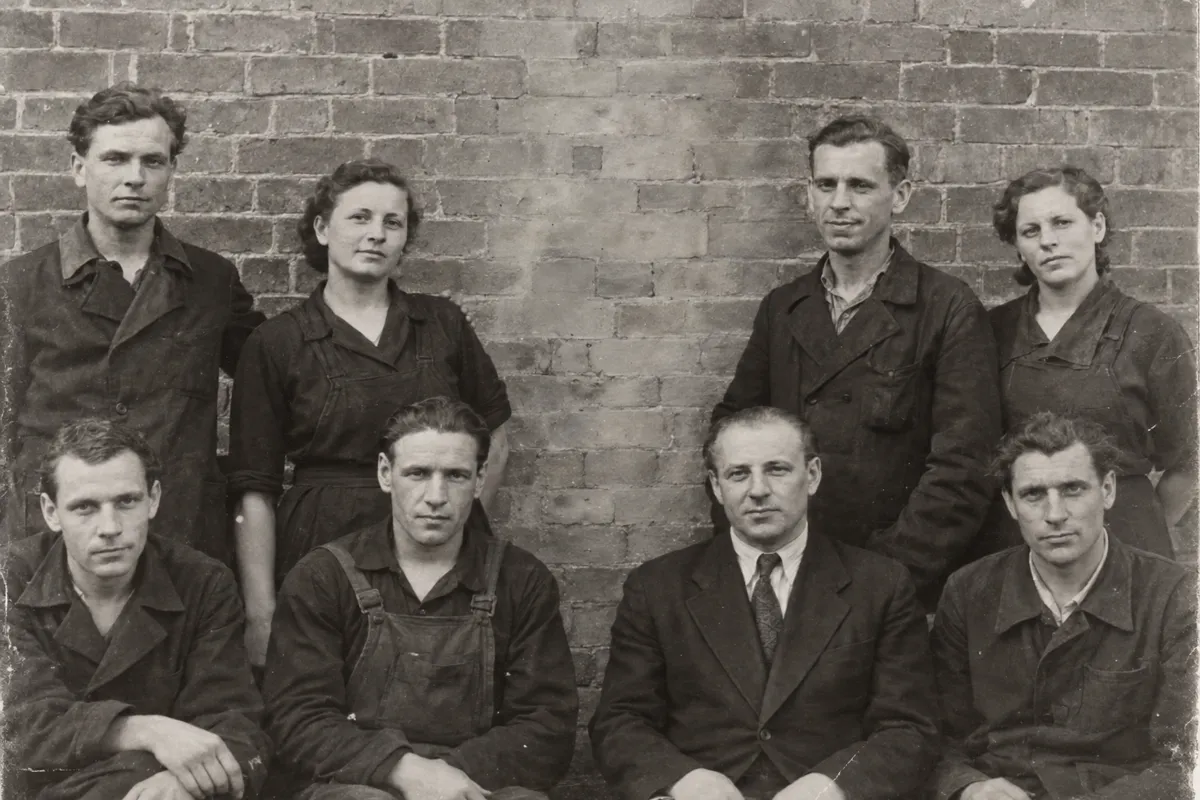
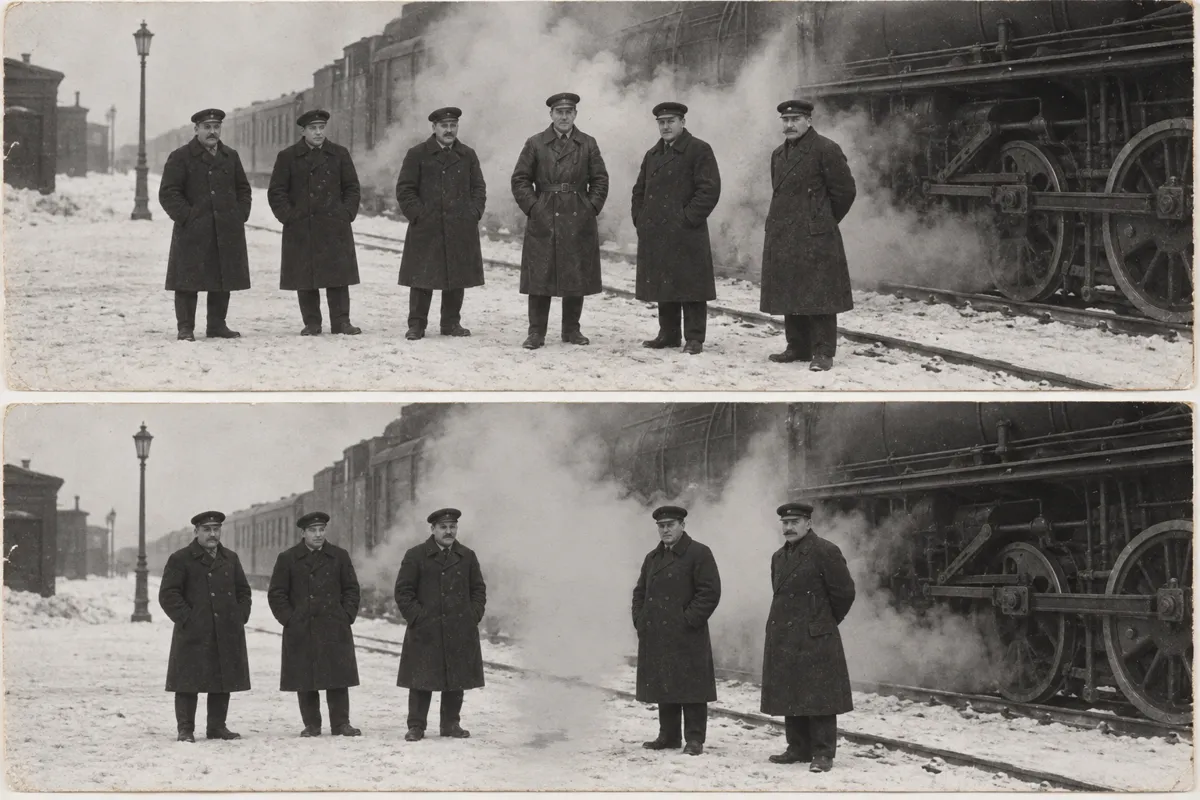
02Group Portrait Transformed Into Stalin AloneA four-panel arrangement contrasts Stalin alone with versions showing one, two, and three companions. The repeated pose and table reveal how political retouching transforms a group photograph into an isolated leader portrait.Cantons-de-l'Est · Public domain · Wikimedia Commons03Obscured Figures on a Reviewing PlatformOfficials stand on a wooden reviewing platform, with conspicuous dark strokes obscuring figures toward the right. This localized obliteration visibly demonstrates intervention in a political photograph, although the replacement background remains unfinished.Unknown authorUnknown author · Public domain · Wikimedia Commons04AI illustration: Side-by-side comparison of Stalinist era photographic censorshipThis diptych presents a side-by-side comparison of an original state photograph and a version where a high-ranking official has been removed. The altered image shows an unnatural gap beside the primary figure, demonstrating how individuals were systematically excised from history.Illustration generated for the Atlas (AI)05AI illustration: Group portrait with visible airbrushed background restorationA group portrait of workers features a suspicious vertical band of smudged brickwork in the center of the composition. This blurred texture indicates where a figure was airbrushed out to align with changing political alliances within the group.Illustration generated for the Atlas (AI)06AI illustration: Tools and negatives used for historical image manipulationA technician's workbench is shown with a negative where the emulsion has been scraped away, alongside the finished prints. The presence of scalpels and airbrushes provides a clear look at the physical tools used to perform political retouching.Illustration generated for the Atlas (AI)07AI illustration: Removal of a political figure replaced by steamTwo versions of a railway scene show a figure standing by a locomotive who completely disappears in the second frame. The space where the man stood is filled with a cloud of steam that lacks the grain and detail of the surrounding environment.Illustration generated for the Atlas (AI)
Question
Why did retouchers alter the negative instead of just painting on a printed photo?
Show possible answer +Hide answer −
Altering the negative allowed them to print many identical, seamless copies of the fake image. It hid the physical brushstrokes better than painting on afinal print.