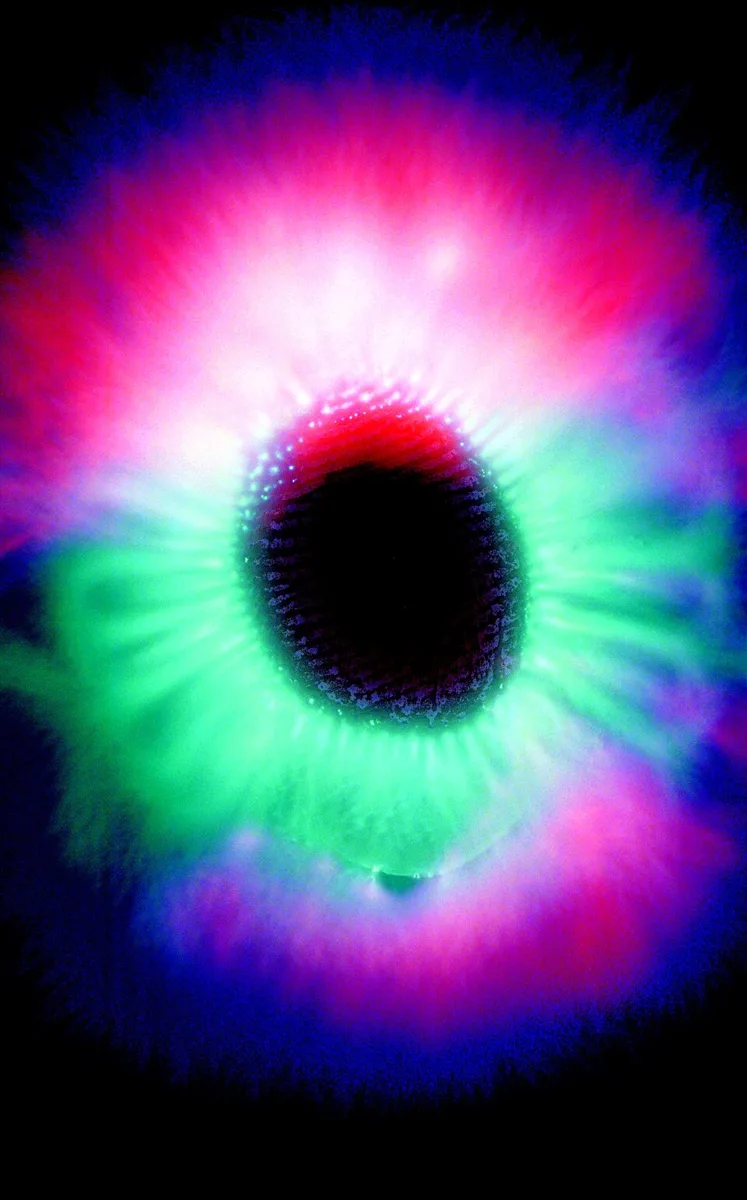
Multicolored Corona Around an Oval. A dark oval is surrounded by a brilliant halo of green, pink, and blue light with finely radiating streaks.Sérgio Valle Duarte .mw-parser-output .messagebox{margin:4px 0;width:auto;border-collap… · CC BY 4.0 · via Wikimedia CommonsView source ↗
Prompt
Apply a Kirlian Photography effect with a dark field and a jagged electric corona hugging the subject silhouette. Add branching violet and cyan sparks, fine white discharge filaments, scattered luminous points, and high-contrast surface detail with minimal ambient illumination. Keep the original subject and composition.
You see an object surrounded by a[glowing, jagged halo of light]against adark background. Often, leaves or fingertips appear in high contrast with branching, electric sparks forming an aura.
Principle
High-voltage electrical currents pass through an object placed directly on photographic film or plates. This creates a[corona discharge1in the air], which exposes the film [without using acamera lens].
Example
Semyon and Valentina Kirlian: Glowing leaf photographs, 1939.
Try it out
Rub aballoon on your hair in adark room and watch for tiny static sparks to visualize similar miniature electrical discharges.
Background
In 1939, Russian inventor Semyon Kirlian and his wife Valentina accidentally discovered this technique. They noticed avisible flash when apatient received electrotherapy2. They placed aphotographic plate near electrodes and captured glowing silhouettes of hands and leaves. The images map the moisture and electrical conductivity3of the subject. Amoist leaf creates strong discharges, while adry leaf produces afaint glow. Some people wrongly claimed these auras showed living energy or asoul. Actually, the glowing borders just show electrical sparks reacting to humidity and pressure changes.
Distinction
It differs from standard photograms. Photograms use external light to cast shadows. Kirlian photography uses electricity to generate light directly around the object.
Aftermath
It demonstrates how invisible physical variables like moisture and static electricity can create striking visual patterns on photographic film.
Further examples · 9 images
02Radiating Color CoronaBright points along a dark oval's perimeter open into feathery streams of white, green, pink, and blue. This edge-bound electrical corona is a characteristic manifestation of Kirlian photography.Sérgio Valle Duarte .mw-parser-output .messagebox{margin:4px 0;width:auto;border-collap… · CC BY 4.0 · Wikimedia Commons03White Corona Along a Rounded EdgeA dark rounded silhouette is edged with a chain of bright white flares and delicate outward-pointing filaments. The localized sparks tracing its perimeter clearly reveal the corona discharge characteristic of Kirlian photography.No machine-readable author provided. Joe wiki assumed (based on copyright claims). · Public domain · Wikimedia Commons04Coin Rims with Electrical CoronasTwo partially visible coins carry bright fringes of light, with fine radial spikes surrounding their rims. These electrically generated edge halos demonstrate Kirlian photography using metal objects as subjects.No machine-readable author provided. Joe wiki assumed (based on copyright claims). · Public domain · Wikimedia Commons05Paired Coins with Violet Corona DischargesTwo coins on a deep blue field are encircled by sharp violet-pink filaments, accompanied by a millimeter scale. The radial corona discharges around their conductive edges provide a clear demonstration of Kirlian photography.The original uploader was Chemikus69 at German Wikipedia. (Original text: Chemikus69) · CC BY-SA 2.0 de · Wikimedia Commons06Monochrome Corona Around Rounded FormsTwo dark rounded forms are bordered by broad white halos and fine streaks, with irregular discharge patterns between them. These luminous contact outlines show the corona discharge captured by the Kirlian process, although some detail is lost in the bright exposure.No machine-readable author provided. Joe wiki assumed (based on copyright claims). · Public domain · Wikimedia Commons07Kirlian Hand Impression in Violet and PinkA hand-shaped impression emerges from darkness through violet outlines and brilliant pink patches along the fingers and palm. These uneven, sparkling contact traces clearly demonstrate the electrical corona discharge characteristic of Kirlian photography.C4r0 · CC BY-SA 3.0 · Wikimedia Commons08Blue Corona Discharge Beside a ProbeAn intense blue-white discharge illuminates a cluster of rounded forms beside a pointed probe, with blue fringes tracing the outer contours. The visible edge coronas and electrical excitation demonstrate the discharge phenomenon used in Kirlian imaging.Andrei Sergueev · CC BY-SA 3.0 · Wikimedia Commons09Blue Corona Around an Irregular SilhouetteBroken blue-white arcs trace an irregular, dark silhouette against a nearly black field. The localized luminous edging shows the corona discharge recorded in Kirlian photography, although the underlying object is indistinct.No machine-readable author provided. Joe wiki assumed (based on copyright claims). · Public domain · Wikimedia Commons
Question
Why do living plants produce brighter Kirlian images than dead ones?
Show possible answer +Hide answer −
Living plants contain much more water than dead plants. This higher moisture content conducts electricity better, creating stronger sparks.