1930s engineering use; established in the nineteenth century
Typeface · Antic Slab
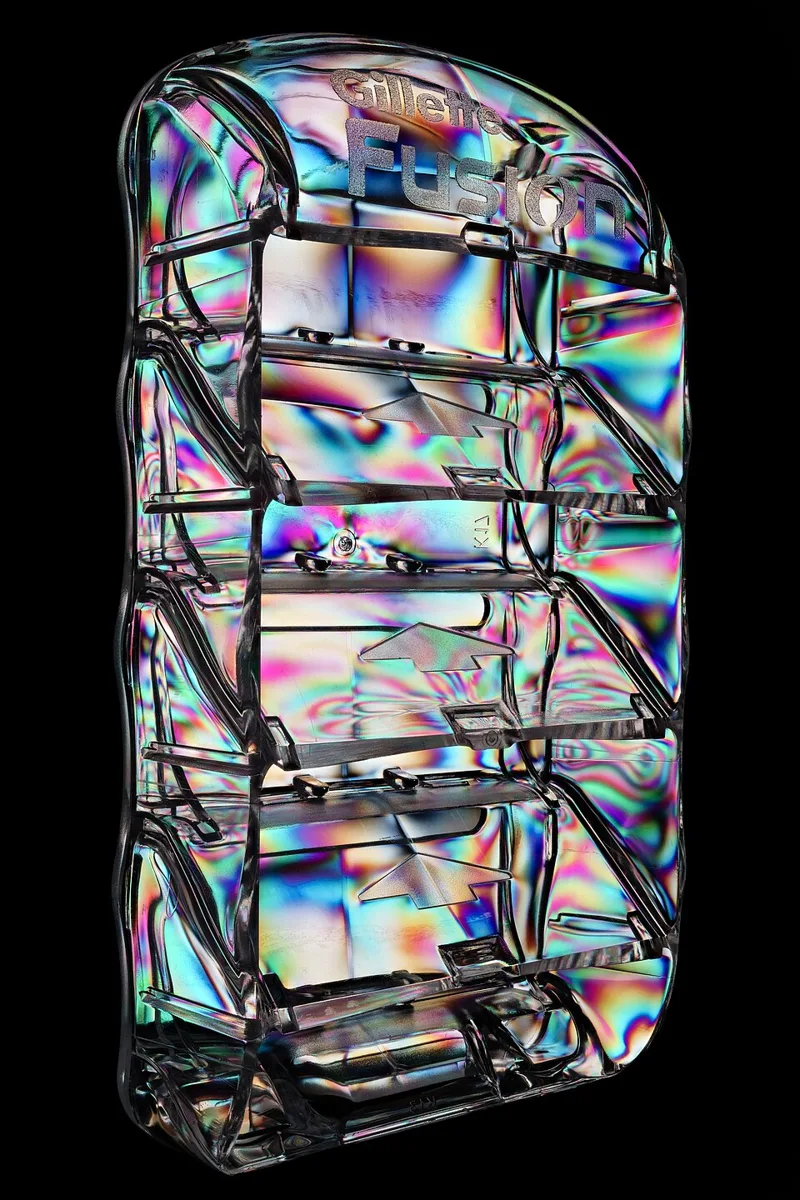
Stress Fringes in a Plastic Housing. Rainbow bands fill a transparent moulded plastic housing, bending around its ribs, compartments, and curved edges against black.Colin · CC BY-SA 4.0 · via Wikimedia CommonsView source ↗
Prompt
Apply a Photoelasticity effect by making the subject resemble transparent stressed plastic viewed between crossed polarizers. Add curved rainbow interference bands, dense colored fringes around corners and contact points, glassy edges, and near-black unstressed regions against a darkened background. Keep the original subject and composition.
Transparent plastic shows [rainbow fringes]against adark background when viewed between [crossed polarisers1]. Curved bands crowd around holes, corners, and loaded contact points.
Principle
[Stress-induced birefringence2]makes two perpendicular polarisation components travel at different speeds through the material. Asecond polariser lets these components interfere, producing coloured bands in white light.
Example
Ernest George Coker and Louis Napoleon George Filon: ATreatise on Photo-Elasticity, 1931.
Try it out
View aclear plastic ruler against awhite LCD screen through polarised sunglasses; rotate the glasses, then gently bend the ruler.
Background
Photoelasticity became an important engineering tool before computer stress analysis. Its optical basis was known in the nineteenth century, but transparent models supported increasingly systematic measurements. Coker and Filon's 1931 treatise helped consolidate the method. Engineers loaded models between polarisers to reveal patterns invisible in ordinary light. Stress changes how the material transmits different polarisations. In suitable flat models, fringe order measures the difference between principal stresses3, provided thickness and material response are known. White light produces coloured fringes; monochromatic light produces alternating bright and dark bands.
Distinction
Unlike diffraction rainbows, these colours arise from stress-dependent birefringence, not light spreading around edges or through fine grooves. They are not pigments within the plastic.
Aftermath
Photoelasticity shows how an invisible mechanical state can become avisible optical pattern, but interpreting that pattern requires calibration.
Further examples · 11 images
02Photoelastic Colours in a Cassette ShellA transparent head-cleaning cassette displays luminous rainbow bands around its dark reels, screw holes, and rectangular casing. Polarised illumination reveals stress-induced birefringence in the moulded shell, with fringes following changes in its structure.Colin · CC BY-SA 4.0 · Wikimedia Commons03Photoelastic Fringes Around Radial SlotsA circular transparent component with radial slots displays vivid coloured bands around its outer ring and dark, rounded openings. The fringes bend around the slot ends, demonstrating how photoelasticity reveals stress patterns near geometric discontinuities.Colin · CC BY-SA 4.0 · Wikimedia Commons04Stress Contours Around Holes and RibsA close view of a clear moulded container reveals dense rainbow contours around circular holes, reinforcing ribs, and rounded corners. These photoelastic fringes map variations in residual stress, becoming tightly curved near structural details.Multicherry · CC BY-SA 4.0 · Wikimedia Commons05Photoelastic Protractor and Set SquareA transparent protractor and triangular set square glow with broad rainbow bands against a dark background. Crossed-polariser viewing makes their residual stresses visible as interference fringes that follow rims, corners, and the triangular cutout.Ingo Dierking · CC BY 4.0 · Wikimedia Commons06Rainbow Stress Fringes in Drafting ToolsTwo transparent set squares and part of a ruler display bright rainbow bands, with sharply curved contours around their triangular openings. Stress-induced birefringence produces these photoelastic fringes, exposing uneven residual stresses in the plastic drafting tools.Ingo Dierking · CC BY 4.0 · Wikimedia Commons07Stress Colours in Plastic CutleryTransparent plastic cutlery glows with rainbow bands against a black background. Viewed between crossed polarisers, residual stresses in the moulded utensils produce coloured photoelastic fringes.Ingo Dierking · CC BY 4.0 · Wikimedia Commons08Photoelastic Fringes Under CompressionOpposing metal contacts press a transparent specimen, producing bright, curved coloured fringes around the loading region. These localised interference bands reveal stress-induced birefringence where the applied forces enter the material.Takis lazos · CC BY-SA 4.0 · Wikimedia Commons09Residual Stress in a Cassette HousingA clear cassette housing displays pastel rainbow bands around its reels, corners, and moulded details. Polarised illumination reveals residual manufacturing stresses through photoelastic interference colours in the plastic.Colin · CC BY-SA 4.0 · Wikimedia Commons10Polarised Stress Colours in Moulded PlasticA clear cylindrical plastic object with rows of tapered projections shows fine rainbow streaks across its rim, walls, and projection bases. The coloured bands within the transparent material reveal photoelastic birefringence associated with residual manufacturing stresses.Colin · CC BY-SA 4.0 · Wikimedia Commons11Concentric Stress Bands and Extinction CrossA square transparent plate shows subdued green and pink concentric bands crossed by a dark four-armed pattern. The coloured fringes and extinction cross demonstrate stress-induced birefringence under polarised observation.Takis lazos · CC BY-SA 4.0 · Wikimedia Commons
Question
Does every rainbow band represent a different absolute stress?
Show possible answer +Hide answer −
No. In acalibrated flat model, fringe order indicates the difference between principal stresses, rather than either stress alone.