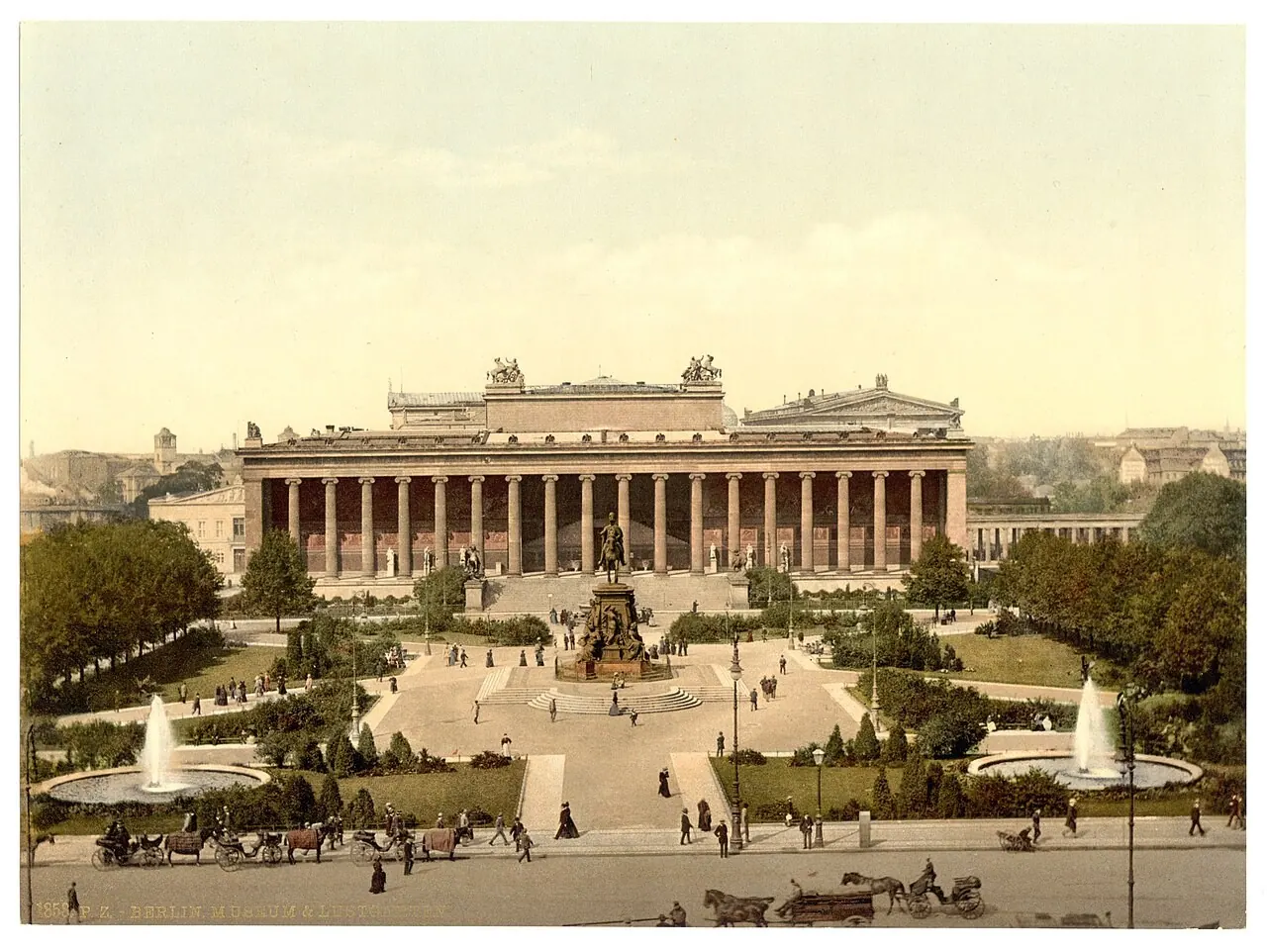
Developed in the 1880s; peak period 1890s to early 1900s
Typeface · Abril Fatface
Museum in Berlin, photochrom print, circa 1890–1905.Library of Congress / Photochrom Print Collection / Public DomainView source ↗
Prompt
Apply a Photochrom effect, combining precise photographic luminance detail with boldly placed lithographic color layers. Use saturated blue, ochre, brick red, and muted green where appropriate, slightly simplified color boundaries, fine irregular ink texture, and subtle registration offsets on warm matte paper. Keep the original subject and composition.
Look for colors that seem to be interpreted rather than observed.
Background
Hans Jakob Schmid developed the process in the 1880s for the Swiss company Orell Füssli. Licensees such as the Detroit Photographic Company disseminated the colored views from the 1890s onward. Photographic capture and lithographic color printing combined technical accuracy with sophisticated color design. Tourist views, in particular, made this hybrid form economically attractive before everyday color photography became readily available.
Distinction
Photochrom is neither an original color photograph nor simply ahand-painted print. The color information was created during the printing process. Therefore, colored historical images should not be uncritically interpreted as exact documents of the original object colors.
Aftermath
An image can be photographically precise and color-wise constructed.
Further examples · 11 images
02General view with the cathedral, San Raphael (i.e. San Raffaele), ItalyA river reflects a town and church in San Raphael, Italy. The artificial teal of the water and uniform orange of the roofs demonstrate lithographic color application over a photographic base.Photochrom Print Collection · Public domain · Wikimedia Commons03Douglas, harbor with steamers, Isle of ManSteamers sit at the harbor in Douglas, Isle of Man, against a hilly backdrop. The selective use of red for the ship funnels highlights the interpreted nature of the color design.Photochrom Print Collection · Public domain · Wikimedia Commons04Hohenzollern, leaving the harbor, Venice, Italy LOC 4755191880The yacht Hohenzollern is moored in a calm harbor in Venice. The image combines fine photographic detail of the rigging with a smooth, painterly sky typical of the Photochrom process.The Library of Congress from Washington, DC, United States · No restrictions · Wikimedia Commons05Groudle Glen, the mill, Isle of ManA watermill with a large wooden wheel stands beside a stream in Groudle Glen. The saturated greens of the foliage and deep brown tones of the wood exemplify late 19th-century colorization.Photochrom Print Collection · Public domain · Wikimedia Commons06Groudle Glen and Hotel, Isle of ManA rustic bridge crosses a stream leading toward a hillside building in Groudle Glen. The combination of detailed botanical texture and stylized, soft-toned water effects marks this as a Photochrom print.Photochrom Print Collection · Public domain · Wikimedia Commons07Tunis mosque 1899People gather on the steps and under the arches of a mosque in Tunis. The distinct white and ochre tones of the garments show how lithographic stones defined specific color areas.Unknown authorUnknown author · Public domain · Wikimedia Commons08Detroit Photographic Company (0847)An ivy-covered church stands behind a brick wall along a street. The dense, uniform green of the vines contrasted with the reddish-brown bricks illustrates the process's reliance on color interpretation.Unknown authorUnknown author · Public domain · Wikimedia Commons09Statue of Liberty, New York Harbor c1905The Statue of Liberty stands on an island in New York Harbor. The monochromatic teal sky and water provide a simplified color field that emphasizes the central photographic monument.Detroit Photographic Co. · CC0 · Wikimedia Commons10Russia. МО. Троицкий собор Свято-Троицкой Сергиевой Лавры 1896 PZ-8937 52700-52759u e1The Trinity Cathedral at the Holy Trinity-St. Sergius Lavra features golden domes and decorated walls. Subtle pink and green washes over the architecture demonstrate the sophisticated color design of the era.unknown · Public domain · Wikimedia Commons11CharkowA bridge spans a river in Kharkiv with a large church in the distance. The varied, localized colors of the buildings show the complexity achievable through multiple lithographic stones.Unknown authorUnknown author · Public domain · Wikimedia Commons
Question
Where does the color of a photochrom come from?
Show possible answer +Hide answer −
From lithographic multicolor printing; the underlying camera negative may be black and white.