H 058 / 3211890s

Lippmann Interference Photography

Lippmann interference photography. Introduced in 1891; a scientific milestone, not a mass production procedure
Typeface · Prata

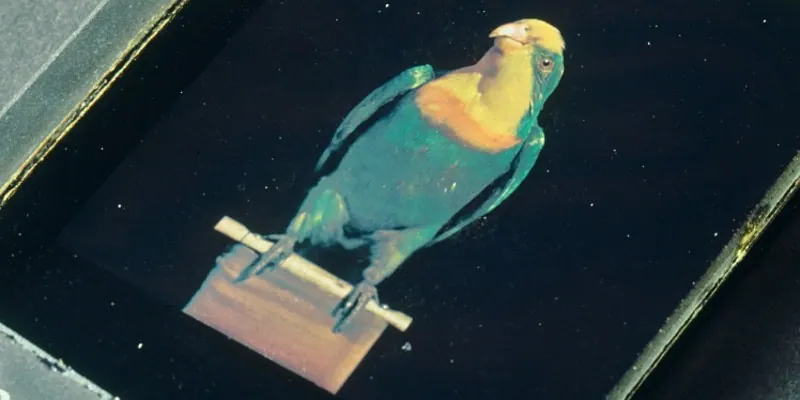
Richard Neuhauss: Parrot, circa 1899. Lippmann interference color photography.
Richard Neuhauss: Parrot, circa 1899. Lippmann interference color photography.Dr. Richard Neuhauss (1855-1915) / Public domain; Wikimedia CommonsView source ↗

Prompt

Apply a Lippmann Interference Photography effect, rendering fine photographic detail as luminous structural color on a reflective glass plate. Suggest angle-dependent hues through subtle color shifts across the surface, selective spectral brilliance, dark reflective undertones, and subdued colors outside the viewing sweet spot. Keep the original subject and composition.

Identify

Historical color images with strong angle-dependent viewing.

Principle

Standing light waves1 leave behind thin layers that reflect specific wavelengths.

Example

Richard Neuhauss: Parrot, around 1899.

Try it out

Explain the difference between dyes and interference colors2.

Background

In 1891, Gabriel Lippmann presented his interference-based color photography. A reflective background creates standing waves during the exposure; the resulting fine structure reflects selected colors. Long exposures and demanding viewing requirements limited its practical application. In 1908, Lippmann received the Nobel Prize in Physics for this invention. This story broadens our understanding of color: it doesn't necessarily have to be stored using pigments or dyes.

Distinction

This process is a scientific milestone and was not a common everyday look. An ordinary screen photograph only indirectly conveys the original color reproduction. Lippmann plates should not be confused with lithographic photochrom prints.

Aftermath

Color can be stored as a physical structure.

Further examples · 7 images

Gabriel Lippmann Le Cervin 1891-1899
02 Gabriel Lippmann Le Cervin 1891-1899This landscape shows a mountain path with trees overlooking the Matterhorn. It illustrates the ability of the interference method to reproduce natural greens and blues in a single-layer recording.Gabriel Lippmann · Public domain · Wikimedia Commons
Bouquet de Fleurs-laboratoire de physique de la faculté des sciences de Lille par Auguste Ponsot vers 1905
03 Bouquet de Fleurs-laboratoire de physique de la faculté des sciences de Lille par Auguste Ponsot vers 1905A floral arrangement in a vase is shown with vibrant orange and yellow hues. The varied floral tones exemplify the high color fidelity achieved through Lippmann's interference-based light wave structure.Auguste Ponsot (entre 1905 et 1907) · CC0 · Wikimedia Commons
Lippmann Saas Fee
04 Lippmann Saas FeeA color landscape of Saas Fee produced using the interference process. The muted, slightly unnatural palette and specific surface texture are characteristic of early Lippmann plates.Gabriel Lippmann · Public domain · Wikimedia Commons
Lippmann Still life
05 Lippmann Still lifeThis still life displays the unique color palette and metallic sheen characteristic of the interference process. The red hues are generated by standing waves in the emulsion rather than chemical pigments.Gabriel Lippmann · Public domain · Wikimedia Commons
Lippmann Venice
06 Lippmann VeniceA view of Venice captured on a Lippmann plate. The visible cracks and specific color rendering demonstrate the physical nature of the structural colors stored within the glass-based emulsion.Gabriel Lippmann · Public domain · Wikimedia Commons
Gabriel Lippmann - Photographie interférentielle
07 Gabriel Lippmann - Photographie interférentielleA bouquet of flowers captured using Lippmann's interference method. The image displays the characteristic metallic luster and saturated hues resulting from standing light waves rather than pigments.Gabriel Lippmann · Licence Ouverte · Wikimedia Commons

Question

Does the Lippmann process require red, green, and blue dyes?

Show possible answer +

No. The color is based on interference at a fine structure in the developed material.

Sources