H 163 / 3211960s

Pen Plotter Art

1960s; Georg Nees and Frieder Nake exhibited computer drawings in 1965.
Typeface · Fragment Mono

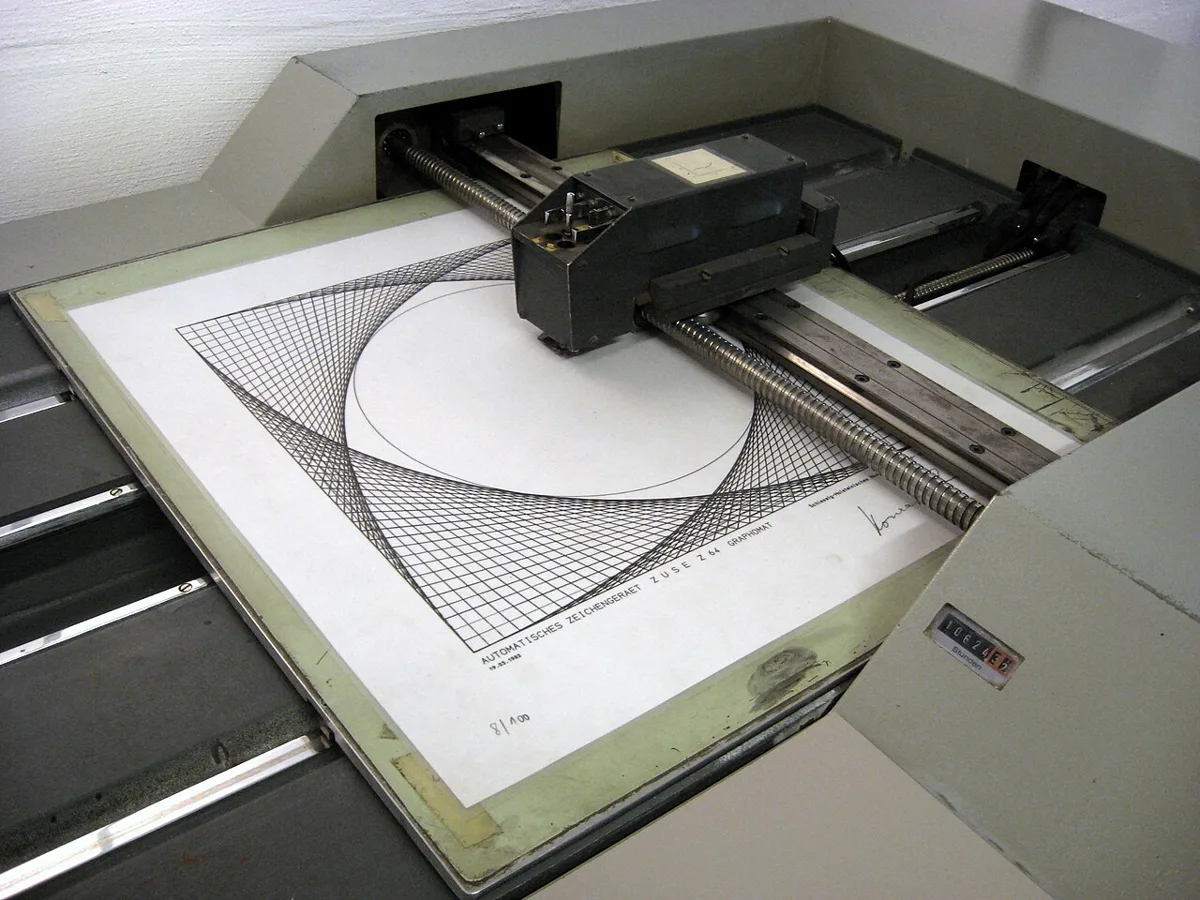
Pen-Plotted Geometric Envelopes. A flatbed plotter holds a drawing of intersecting straight lines surrounding a broad curved opening.
Pen-Plotted Geometric Envelopes. A flatbed plotter holds a drawing of intersecting straight lines surrounding a broad curved opening.Tomasz Sienicki [user: tsca, mail: tomasz.sienicki at gmail.com] · CC BY 3.0 · via Wikimedia CommonsView source ↗

Prompt

Transform this image into Pen Plotter Art, rebuilding forms with fine, uniform ink strokes on warm white paper. Use geometric grids, repeated contours, crosshatching, and controlled positional irregularities; create dark areas through overlapping lines rather than painted gradients. Include subtle paper fibers. Keep the original subject and composition.

Identify

Fine ink lines form geometric grids, repeated shapes, and controlled irregularities on paper. Overlapping strokes create dense patches without continuous painted shading.

Principle

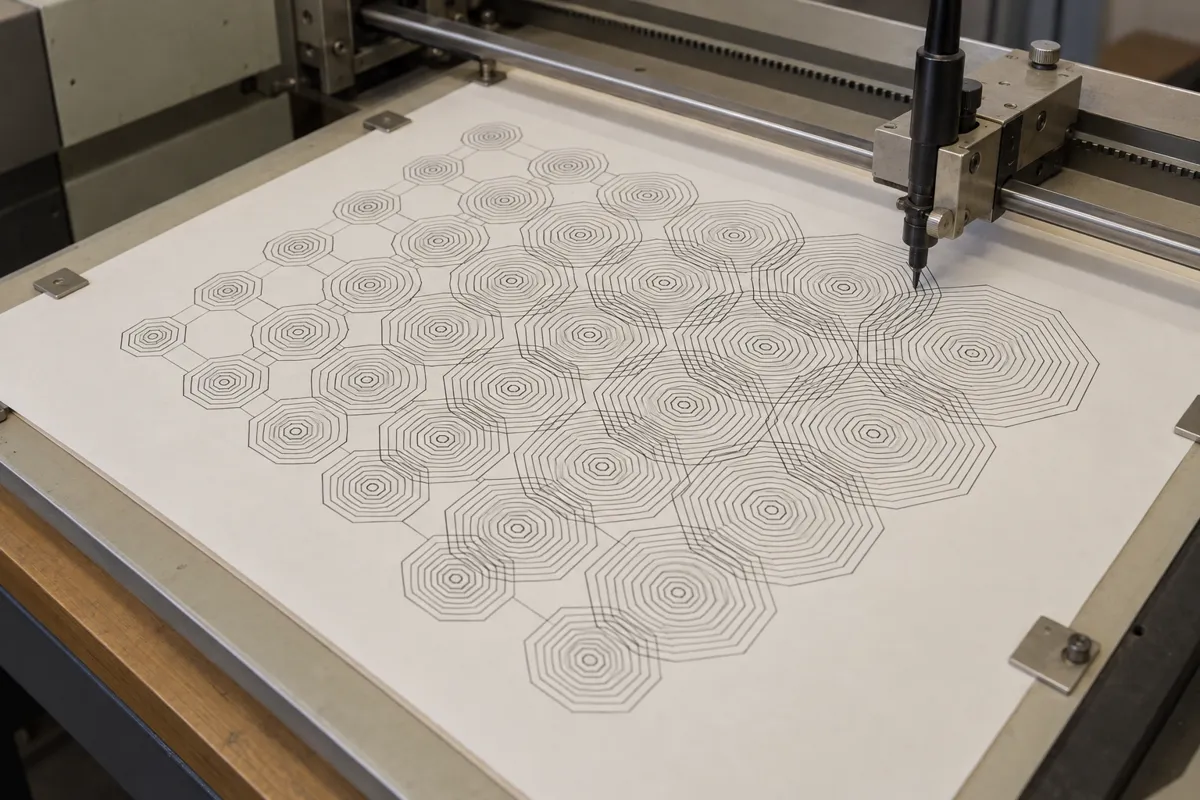
A computer sends movement commands to a mechanical plotter1, which moves a pen relative to paper. Programmed rules and sometimes pseudorandom numbers2 determine the pen paths.

Example

Frieder Nake: Hommage à Paul Klee, 1965.

Try it out

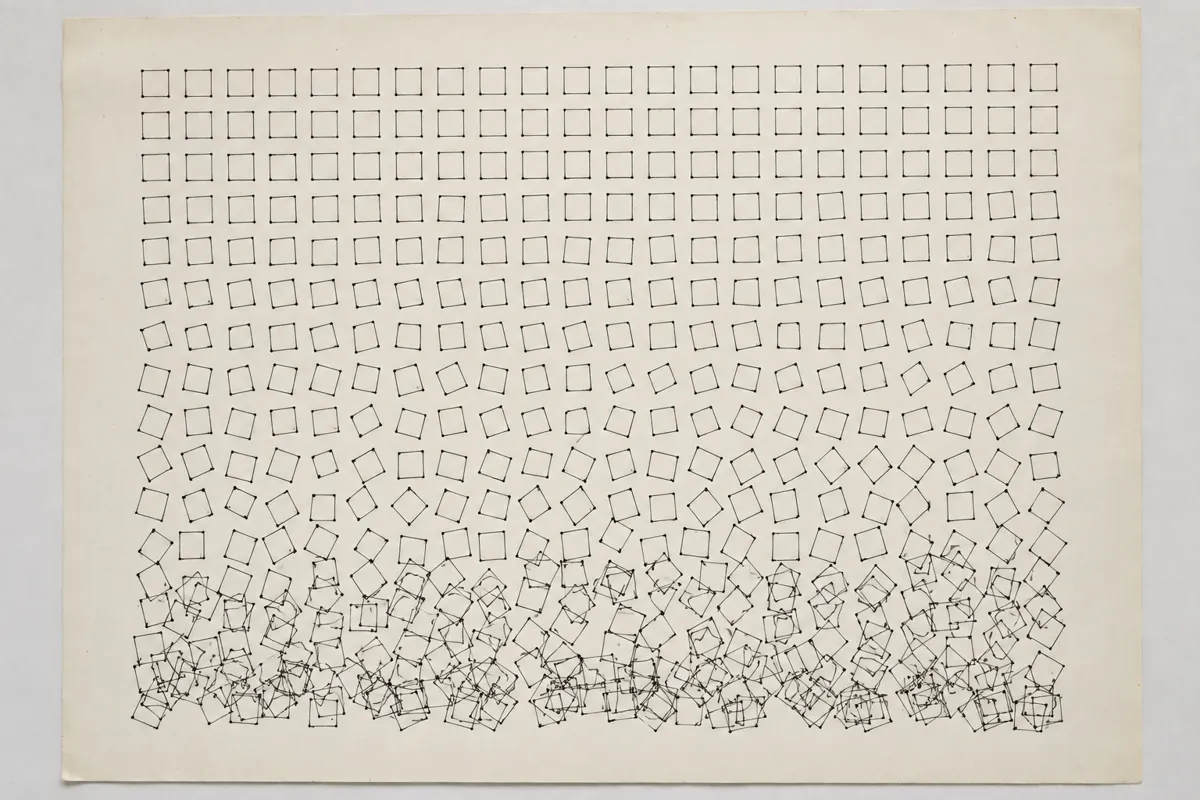
Draw a grid of squares, using dice to choose each square's tilt; notice how fixed rules produce varied results.

Background

In 1965, Georg Nees and Frieder Nake exhibited computer-generated drawings made with pen plotters in Germany. These machines also served engineering and technical drafting. Artists wrote programs that translated geometric rules into coordinates3 and drawing instructions. The plotter lowered its pen to draw and lifted it to move without marking. Repetition made the underlying system visible, while pseudorandom numbers introduced variation within chosen limits. Ink accumulated on paper through individual strokes, not photographic exposure. The artist designed the procedure rather than guiding every line by hand.

Distinction

Unlike raster printing, pen plotting traces paths with a moving drawing tool rather than building images from rows of dots. Not all plotter drawings use randomness.

Aftermath

Pen plotter art shows how an artist can shape an image by designing rules, constraints, and opportunities for variation.

Further examples · 7 images

Plotted Fan of Angular Lines
02 Plotted Fan of Angular LinesA sheet mounted in a plotter bears a fan of fine straight lines and repeated angular outlines. The visible pen-path demonstration shows mechanically controlled line drawing rather than continuous painted shading.Sergey Rodovnichenko from Moscow, Russia · CC BY-SA 2.0 · Wikimedia Commons
AI illustration: Algorithmic transformation from order to chaos
03 AI illustration: Algorithmic transformation from order to chaosA grid of squares transitions from a rigid structure into a chaotic cluster of overlapping shapes at the bottom of the page. This work demonstrates the use of programmed algorithms to introduce controlled irregularities into geometric patterns.Illustration generated for the Atlas (AI)
AI illustration: Mechanical plotter executing a geometric composition
04 AI illustration: Mechanical plotter executing a geometric compositionA mechanical plotter arm is shown in the process of drawing nested octagonal patterns on a sheet of paper. This clearly illustrates the physical translation of computer movement commands into precise ink lines.Illustration generated for the Atlas (AI)
AI illustration: Geometric line work forming a parabolic curve
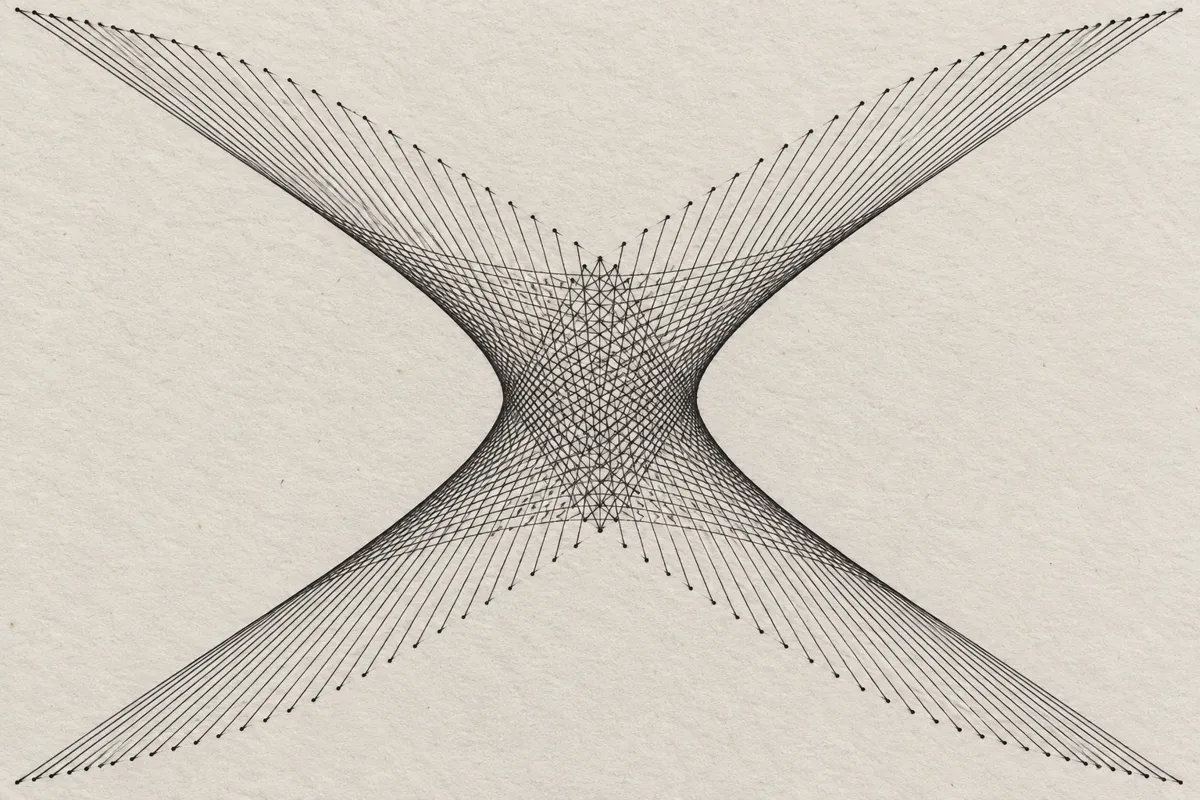
05 AI illustration: Geometric line work forming a parabolic curveA symmetrical arrangement of fine black lines creates a moiré-like effect across a textured paper surface. The precision and consistency of the radiating strokes reflect the path-following capabilities of a computer-controlled pen.Illustration generated for the Atlas (AI)
AI illustration: Topographic blue ink plotter drawing
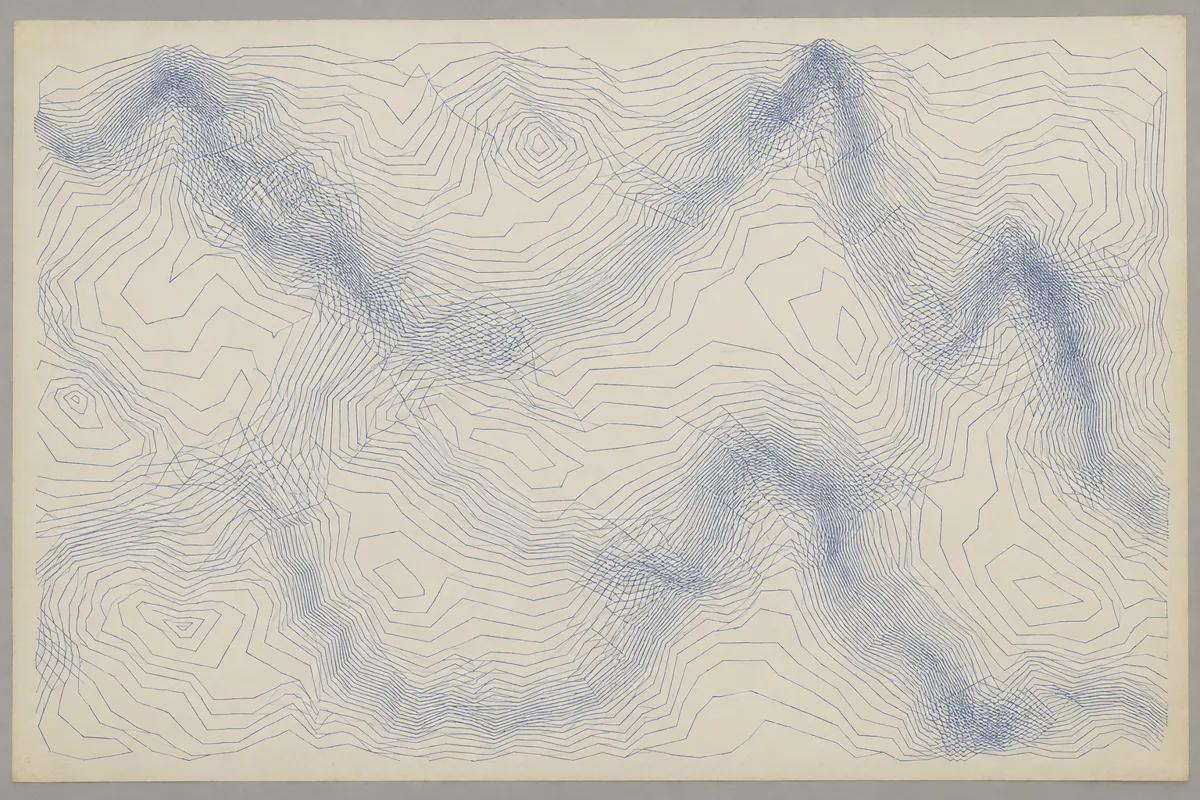
06 AI illustration: Topographic blue ink plotter drawingBlue ink lines form complex topographic waves that create dense, shaded regions through overlapping strokes. The absence of traditional tonal shading highlights the plotter's reliance on line density to suggest depth.Illustration generated for the Atlas (AI)
AI illustration: Algorithmic growth pattern of branching ink forms
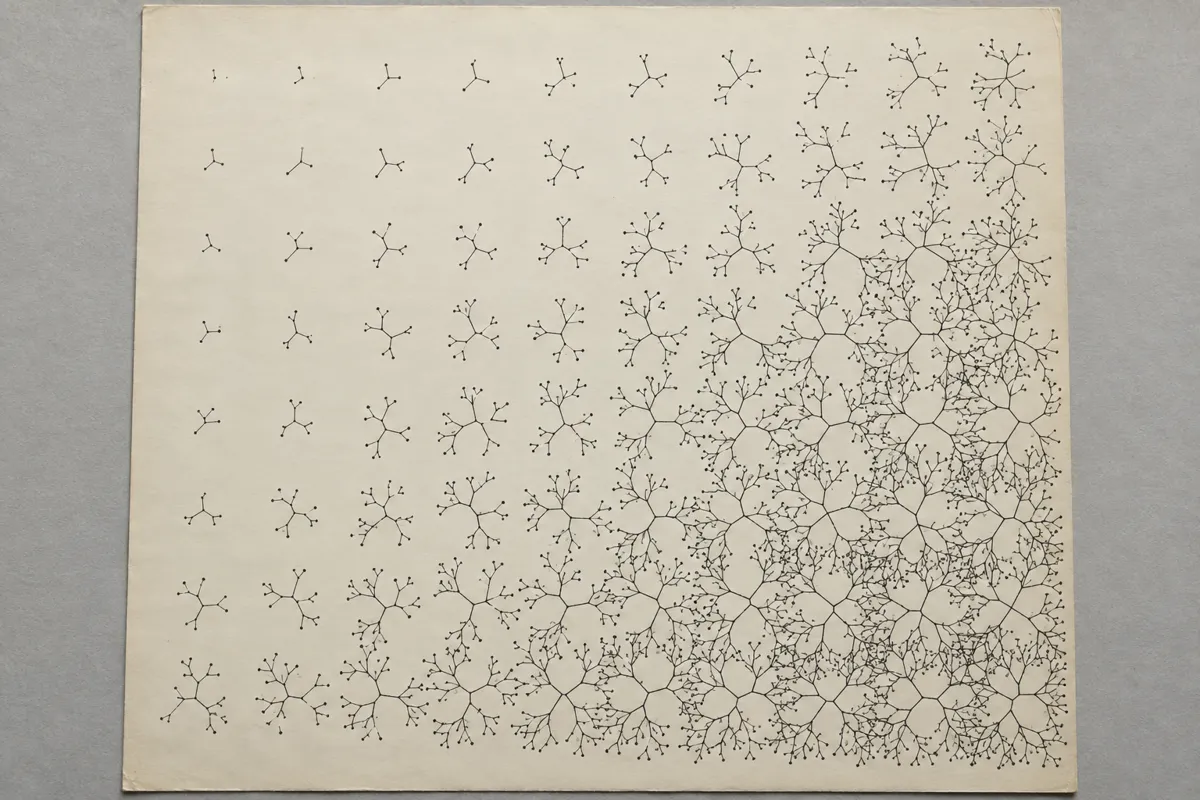
07 AI illustration: Algorithmic growth pattern of branching ink formsA series of branching structures evolves in complexity across the grid, ranging from simple stems to dense thickets. This piece exemplifies the application of programmed rules to generate organic forms via mechanical repetition.Illustration generated for the Atlas (AI)

Question

Why can a plotter drawing look irregular even when a computer controls every movement?

Show possible answer +

A program can use pseudorandom numbers to vary positions, angles, or lengths within defined limits. Irregularity can therefore be deliberately structured.

Sources