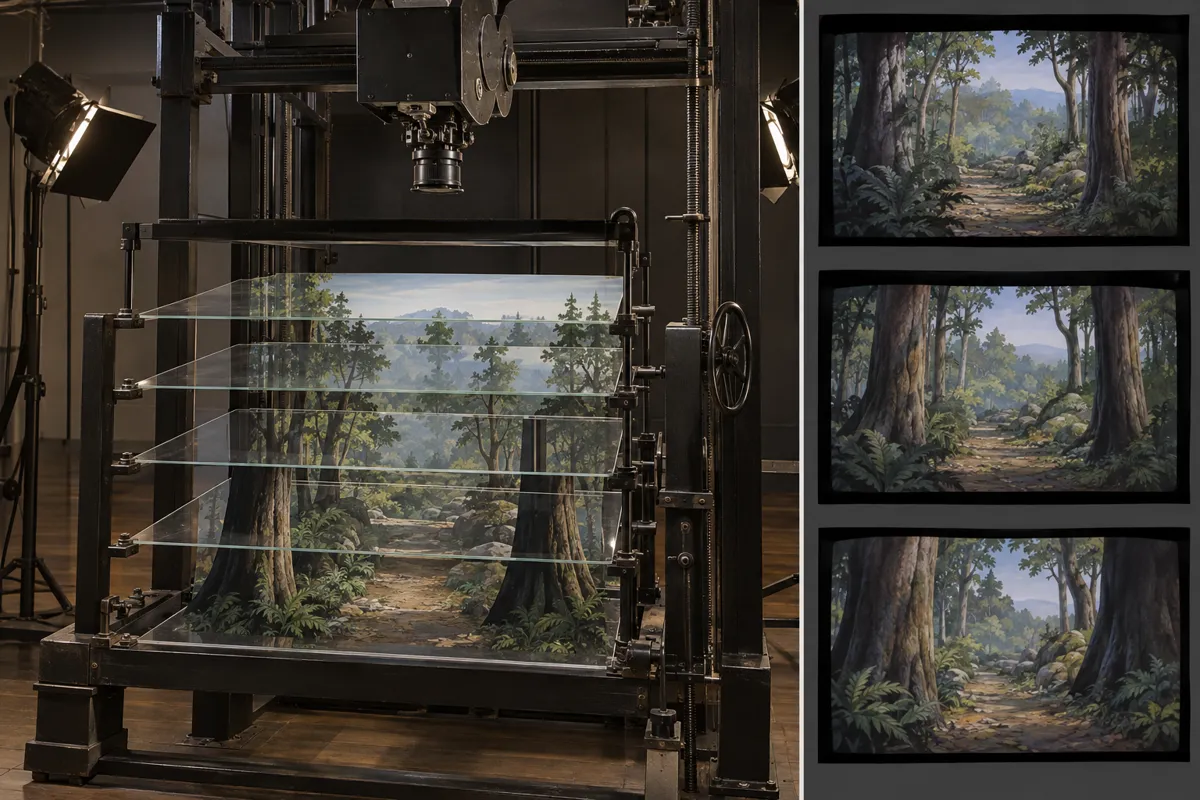
AI illustration: Multiplane camera setup with forest landscape layers.Illustration generated for the Atlas (AI)View source ↗
Prompt
Apply a Multiplane Camera effect by rendering the scene as painted animation layers on spaced glass panels. Give foreground shapes crisp cutout edges, middle layers delicate brushwork, and distant scenery softer colors and atmospheric haze. Emphasize overlapping planes and subtle depth separation. Keep the original subject and composition.
You see a[two-dimensional animated scene]where the background appears deep. Elements move at different speeds as the camera pushes forward.
Principle
Artwork is [painted on separate glass panels]spaced at different distances from the lens. Moving the camera creates [realistic motion parallax1].
Example
Walt Disney Studios: The Old Mill, 1937.
Try it out
Hold one hand near your face and the other arm extended. Move your head sideways to see how they shift differently.
Background
Early animation looked very flat. When characters moved across the screen, the background remained static2and lacked natural depth. In the 1930s, animators needed away to simulate areal, three-dimensional world. They built towering wooden or steel frames to hold several layers of glass artwork. The camera pointed downward from the top. Lights illuminated each layer independently to prevent unwanted shadows. By moving the glass panes at different speeds, operators created an illusion of depth called parallax. Walt Disney Studios popularized this massive machine with their 1937 short film. It revolutionized how audiences experienced animated spaces.
Distinction
Unlike asimple zoom that enlarges aflat image, amultiplane camera changes the relative spacing between objects. This mimics how our eyes naturally perceive distance.
Aftermath
It proves that separating flat visual elements into physical layers can trick the brain into seeing adeep, immersive world.
Further examples · 7 images
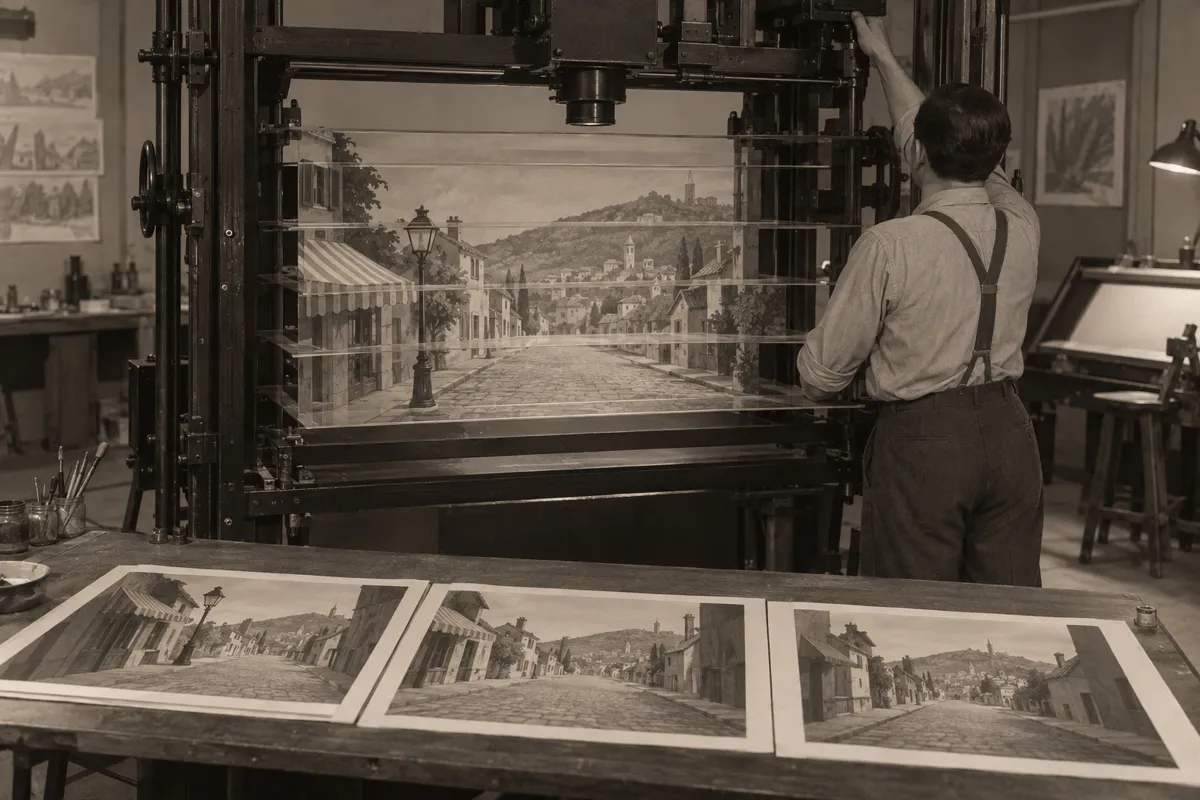
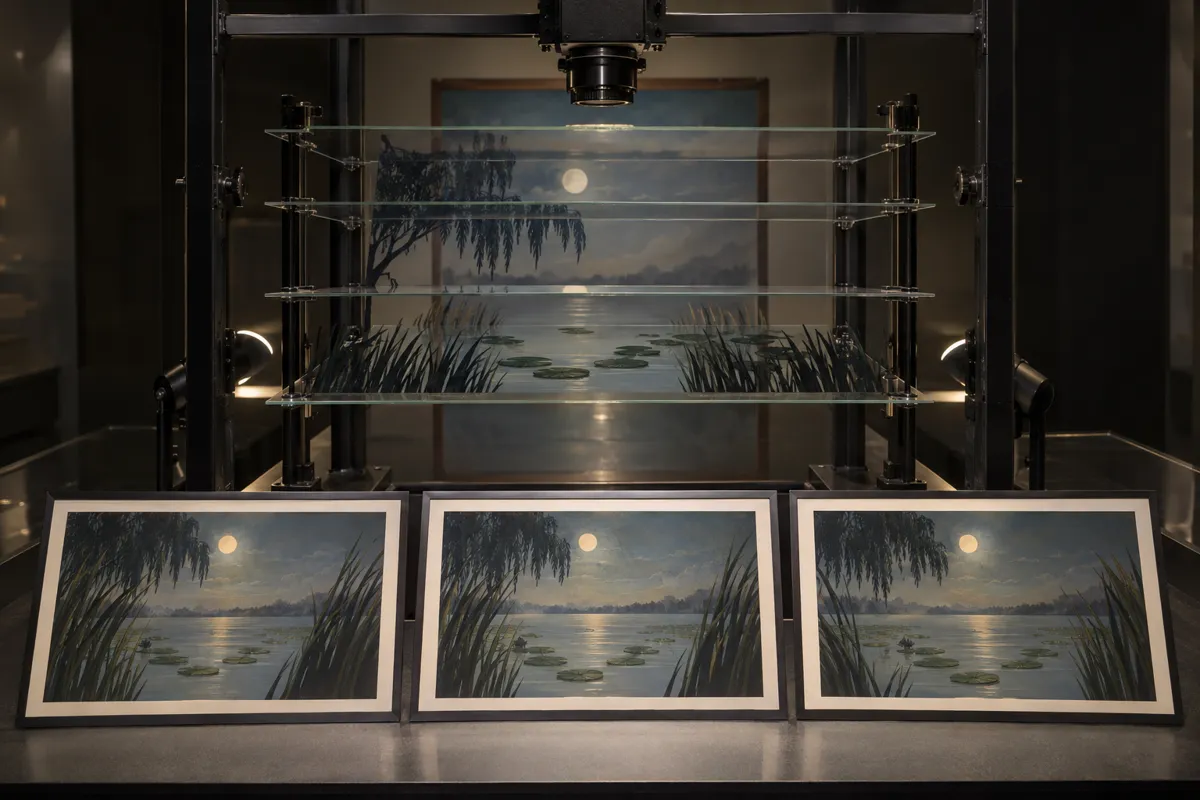
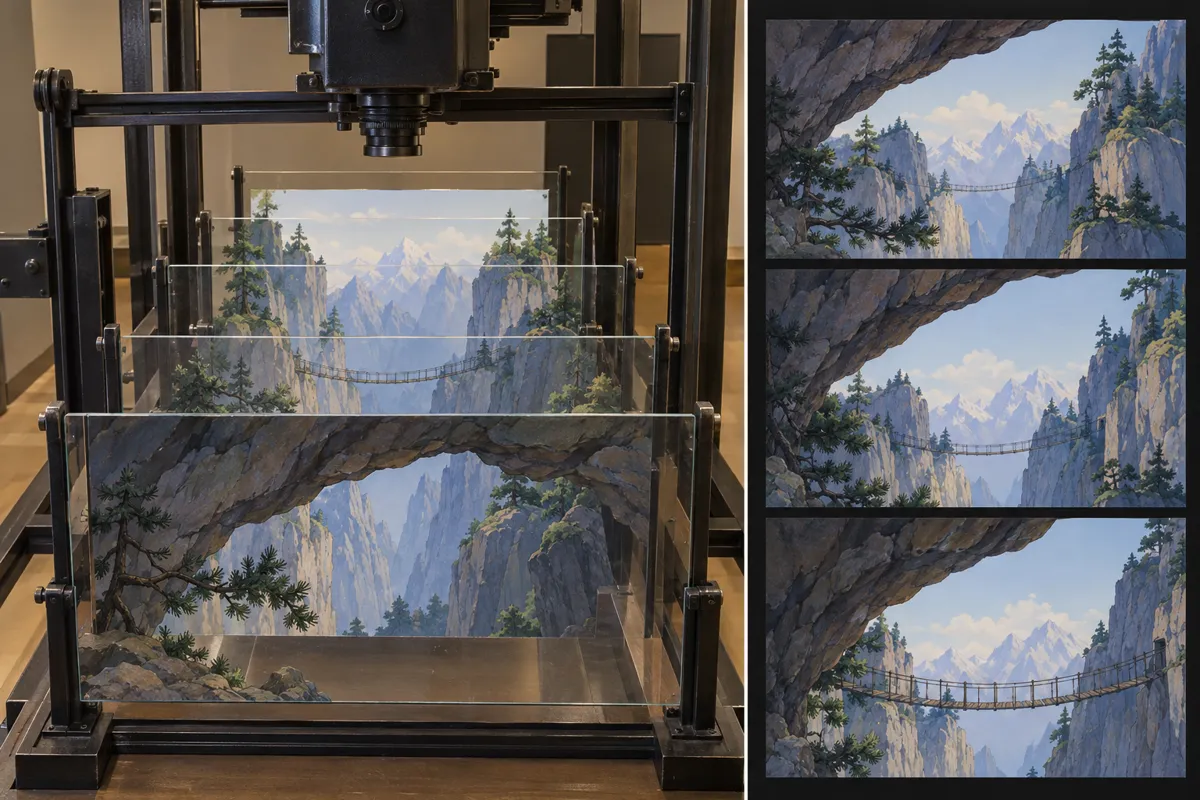
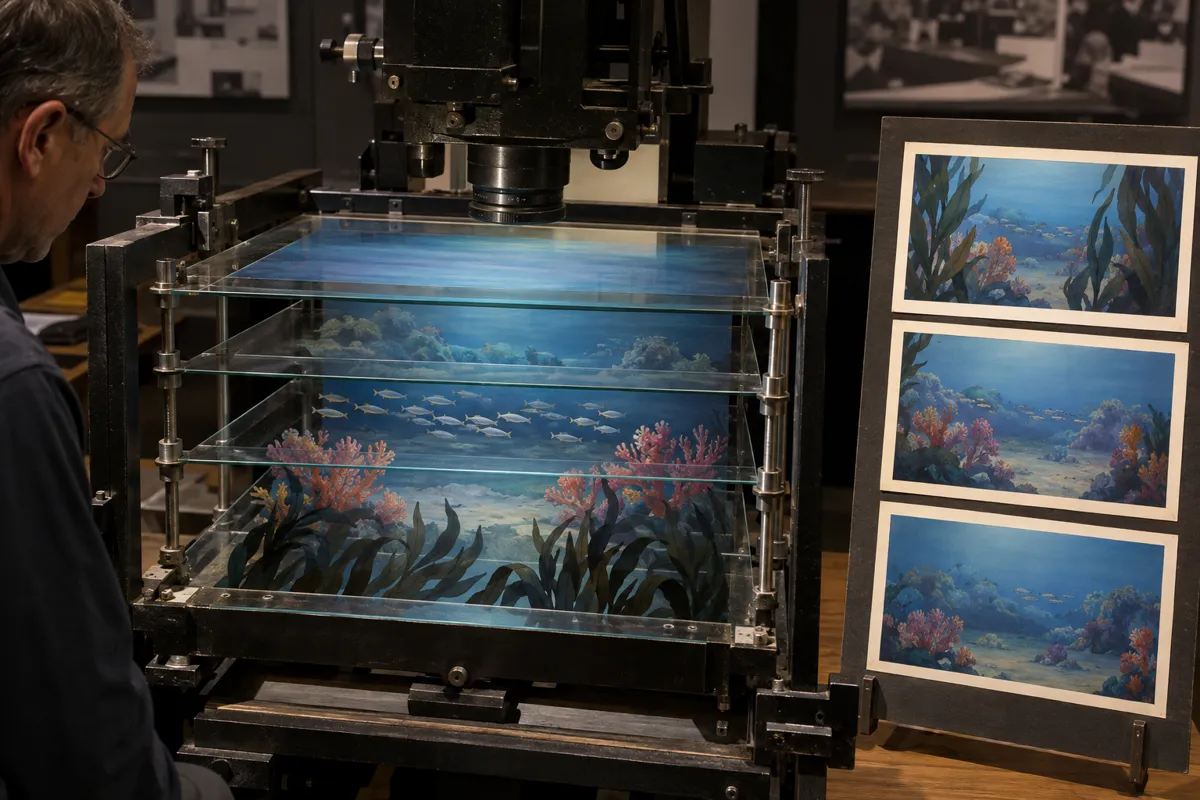
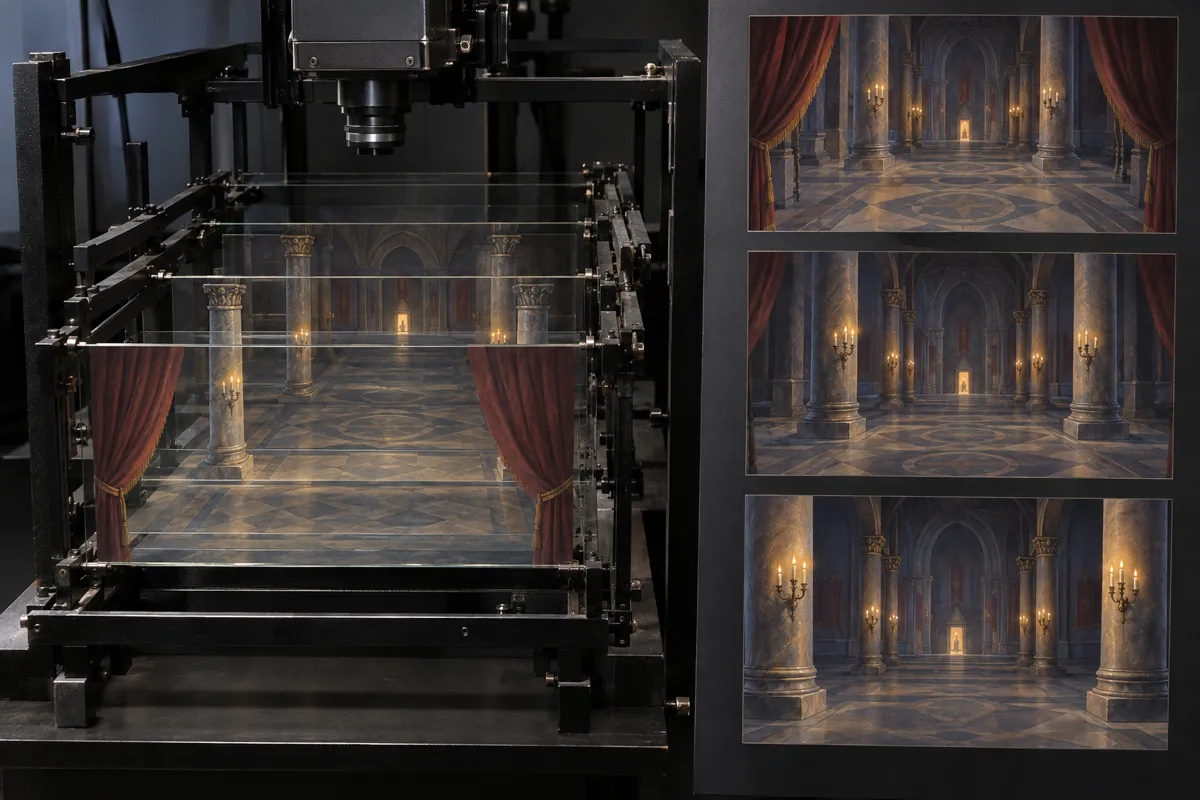
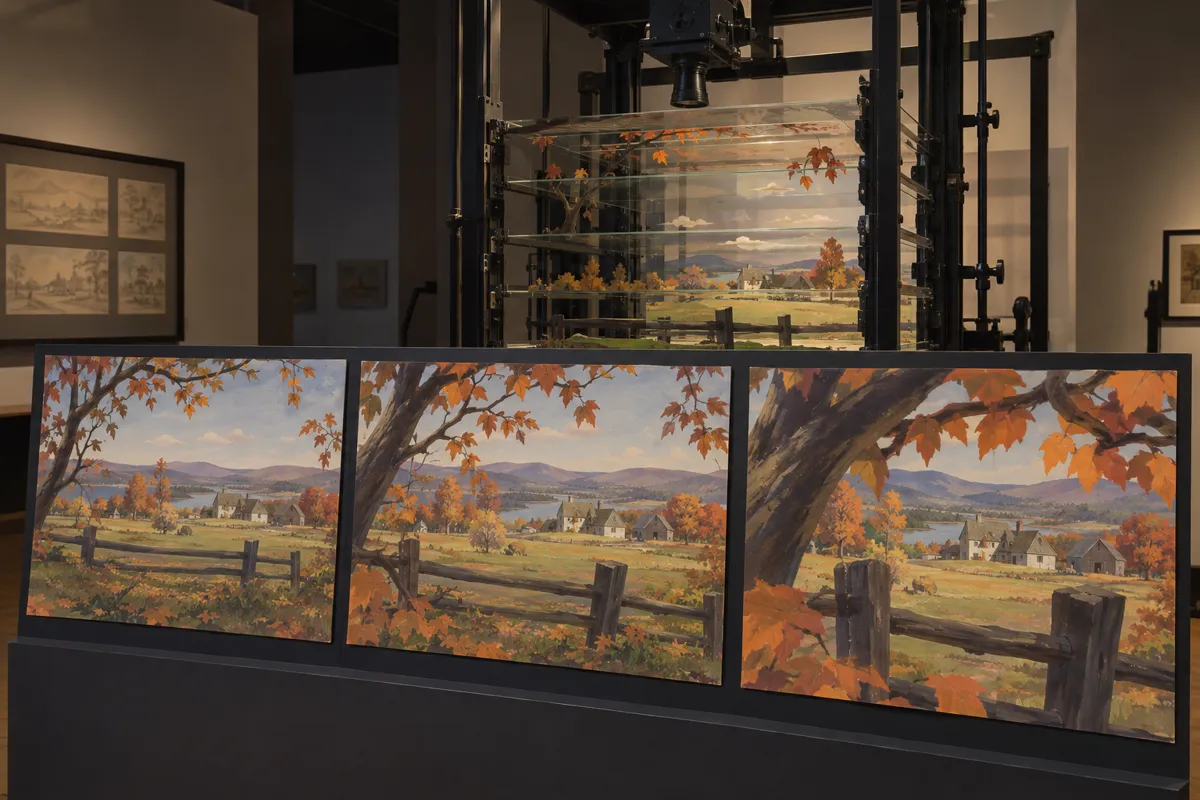
02AI illustration: Traditional animation stand with village scenery layersA technician operates a large-scale animation stand where a town street scene is divided across multiple horizontal glass levels. The presence of the final frames on the foreground desk illustrates how the mechanical movement of these layers simulates a realistic tracking shot.Illustration generated for the Atlas (AI)03AI illustration: Multiplane layer breakdown of a moonlit pondThis display features a moonlight pond scene painted on separated glass sheets positioned beneath a downward-facing camera lens. The accompanying sequence of images shows how the foreground reeds move faster than the distant moon to create a sense of scale.Illustration generated for the Atlas (AI)04AI illustration: Parallax effect demonstrated with mountain bridge sceneryAn elaborate camera rig frames a mountainous landscape, with a foreground stone arch and a midground rope bridge placed on distinct glass planes. The side-by-side frames capture the shifting relationship between the near archway and the distant peaks as the camera moves.Illustration generated for the Atlas (AI)05AI illustration: Underwater animation layers on a multiplane rigAn animator inspects an underwater scene where kelp, coral, and fish are separated onto four distinct layers for cinematography. The vertical array of prints shows the composite image as it appears through the lens, emphasizing the depth achieved through physical spacing.Illustration generated for the Atlas (AI)06AI illustration: Interior castle layout for multiplane camera movementThis interior castle scene is meticulously divided into layers, with foreground curtains and midground pillars spaced to allow for a dynamic camera push. The three reference frames clearly show how the foreground elements pass the lens more quickly than the background altar.Illustration generated for the Atlas (AI)07AI illustration: Autumn landscape parallax demonstrationA series of landscape paintings are displayed in front of a multi-tiered glass frame system used to capture autumn scenery. The different perspectives in the prints demonstrate how the tree in the immediate foreground shifts relative to the distant farmhouse.Illustration generated for the Atlas (AI)
Question
Why did animators paint elements on glass instead of paper?
Show possible answer +Hide answer −
Glass is transparent, allowing the camera to see through multiple stacked layers at once. This lets the bottom background remain visible behind the foreground objects.