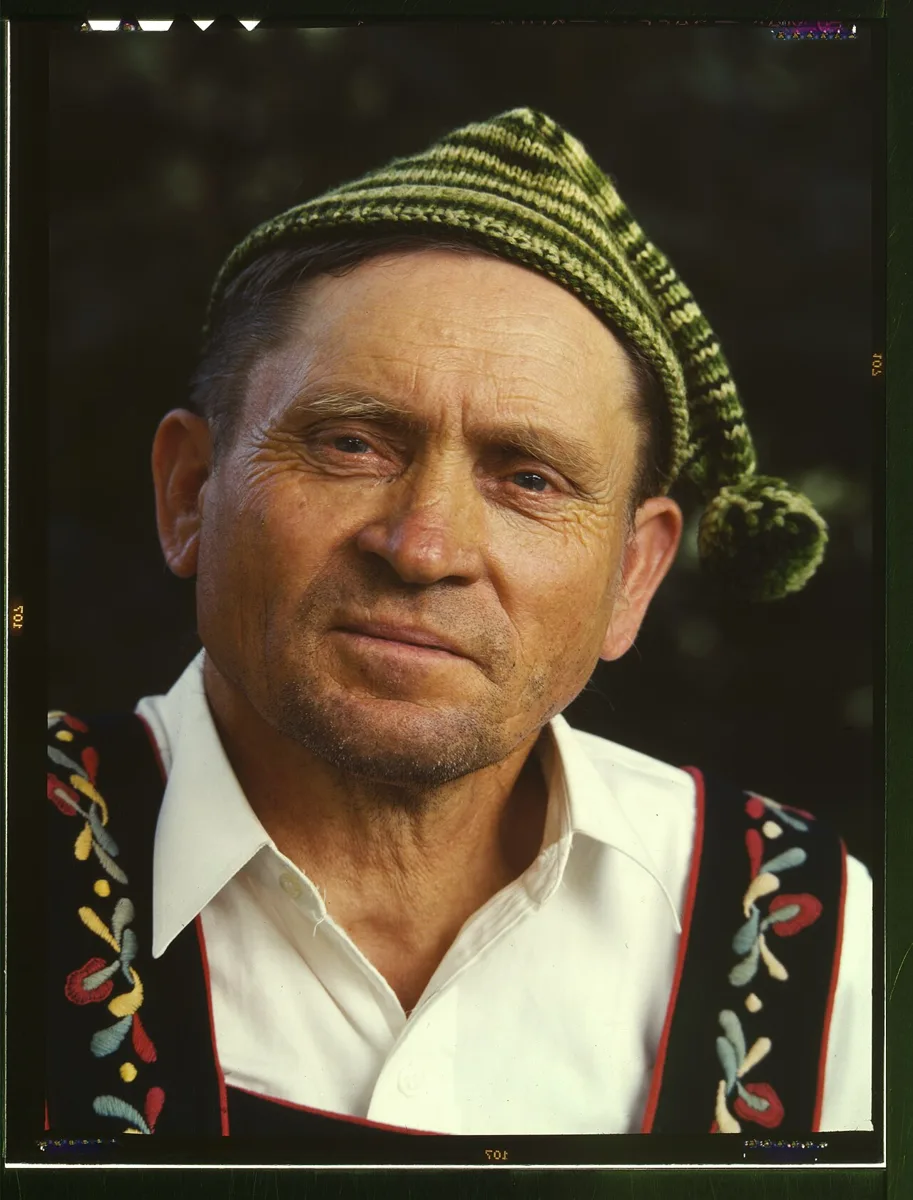
Portrait in an Embroidered Vest. A man wears a striped green cap and an embroidered dark vest over a bright white shirt.Arthur Rothstein · Public domain · via Wikimedia CommonsView source ↗
Prompt
Apply a vintage three-layer color transparency effect with rich reds, brilliant yellows, deep blues, warm natural skin tones, and strongly defined shadows. Add fine film grain, dense blacks, crisp edges, and clean sunlit highlights without faded colors or heavy bloom. Keep the original subject and composition.
You see [rich, vivid colors]with deep contrast and warm skin tones. Reds and yellows pop brilliantly. Shadows stay sharply defined.
Principle
The film holds three [black-and-white emulsion layers]sensitive to red, green, and blue light. Complex development [adds color dyes chemically later].
Example
Steve McCurry: Afghan Girl, 1984.
Try it out
Find ahigh-saturation digital filter. Compare its look to avintage Kodachrome photo to spot true deep reds and crisp shadows.
Background
Kodachrome was introduced in 1935 by Eastman Kodak. It was the first successful mass-market color film. The raw film itself contained no color dyes. It used asubtractive color process1built on three layers of silver halide crystals2. Each layer recorded adifferent primary color of light during exposure. The actual color dyes were chemically added during ahighly complex development stage3. Because the dyes were added later, the film layers were extremely thin. This thinness produced beautifully sharp images with almost invisible grain. Its unique chemical dyes also created incredible archival stability.
Distinction
Unlike Autochrome which used amosaic of dyed potato starch, Kodachrome used amulti-layered subtractive process for much sharper images.
Aftermath
It teaches us that separating light recording from dye creation allows for sharper, more stable colored images.
Further examples · 11 images
02London Traffic and Brilliant AdvertisingDark motorcars cross a busy London street lined with colorful advertisements and red double-decker buses. Brilliant reds and yellows stand out against densely shaded architecture, clearly illustrating Kodachrome’s rich color and strong contrast.Chalmers Butterfield · CC BY 2.5 · Wikimedia Commons03Franklin Roosevelt in Rich ColorFranklin D. Roosevelt appears in a closely framed color portrait wearing a dark suit against a shadowed background. Warm facial tones, cool blue clothing highlights, and deep, detailed shadows exemplify Kodachrome’s distinctive portrait rendering.Leon Perskie · CC BY 2.0 · Wikimedia Commons04Franklin Roosevelt in Warm ColorFranklin D. Roosevelt appears against a dark background, his warmly lit face contrasting with a blue-gray suit and white collar. The richly differentiated skin tones, restrained blue shadows, and deep blacks exemplify Kodachrome portraiture.Leon Perskie · CC BY 2.0 · Wikimedia Commons05Children Beside an Oak Ridge Fire TruckChildren wearing red, white, and blue paper hats stand beside a brilliant orange-red Oak Ridge fire truck. Saturated reds, natural skin tones, and sharply defined sunlit shadows clearly demonstrate Kodachrome’s distinctive color rendering.Ed Westcott doe-oakridge · Public domain · Wikimedia Commons06Construction Worker Beneath a Blue SkyA helmeted construction worker leans over a reddish steel beam beneath an intensely blue sky. The saturated blue, warm metal and skin tones, and deep directional shadows strongly exemplify Kodachrome color.Alfred Palmer · Public domain · Wikimedia Commons07Patriotic Hats Against a Red Fire TruckChildren in patriotic paper hats gather against the orange-red body of an Oak Ridge fire truck. Brilliant reds and blues retain distinct detail alongside warm skin tones and crisp shadows, making the Kodachrome effect especially evident.doe-oakridge · Public domain · Wikimedia Commons08Child with Placard Beside a Fire TruckA barefoot child wearing a paper hat and handwritten placard stands beside other children and a red fire truck. The vivid red paint, deep blue hat, and sharply separated sunlight and shade clearly display Kodachrome’s characteristic contrast and saturation.doe-oakridge · Public domain · Wikimedia Commons09Victory Procession in ParisMilitary vehicles pass cheering crowds along a tree-lined avenue toward the Arc de Triomphe. Warm earth tones, densely shaded foliage, and clearly separated sunlit details show the characteristic contrast of early Kodachrome color.Jack Downey, U.S. Office of War Information · Public domain · Wikimedia Commons10Children Beneath Tropical PalmsTwo children sit beneath palm fronds near red flowers, with polished automobiles parked behind them. The yellow clothing, vivid blossoms, blue sky, and sharply defined tropical shadows provide a clear demonstration of the Kodachrome color aesthetic.Britt Fuller from Tallahassee, United States of America · CC0 · Wikimedia Commons11London Traffic and Colorful AdvertisingDark motorcars cross a busy London street lined with illuminated signs, red advertisements, and double-decker buses. The luminous reds and yellows amid densely shaded architecture provide a clear example of Kodachrome’s rich urban color palette.Chalmers Butterfield · CC BY 2.5 · Wikimedia Commons
Question
Why did Kodachrome processing completely end in 2010?
Show possible answer +Hide answer −
The chemical development process was so complex and toxic that only specialized labs could do it. As digital photography grew, the chemicals were discontinued.