Lenticular print. 1964: LOOK parallax panoramagram as a media example
Typeface · Bungee Shade
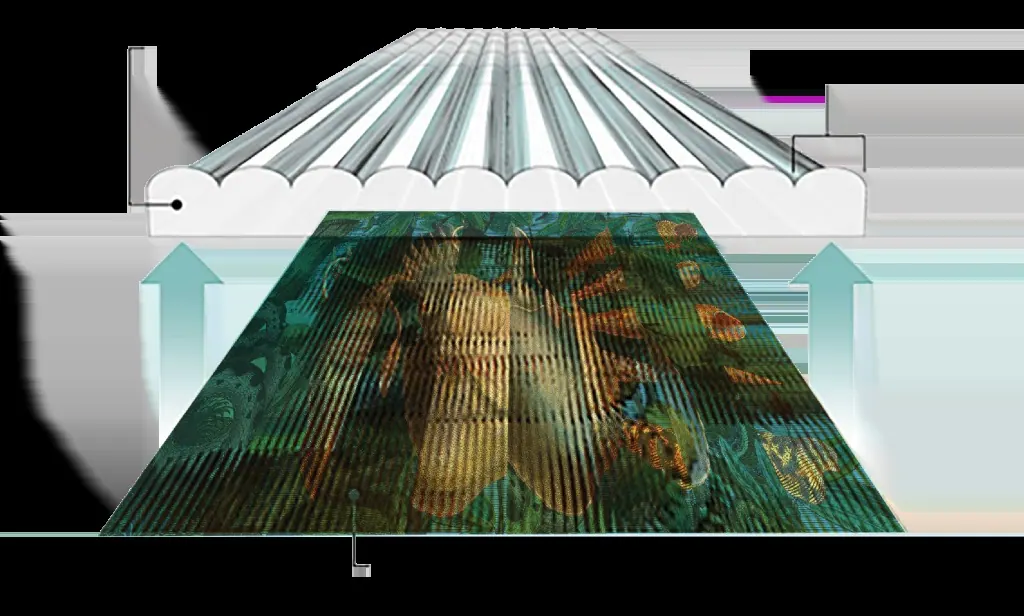
Lenticular principle: Production illustration from Smithsonian Exhibits, 2020.Smithsonian Exhibits, didactic illustration.View source ↗
Prompt
Apply a Lenticular Print effect with fine vertical lens ridges, glossy plastic reflections, interlaced image strips, and restrained lateral ghosting along depth boundaries. Suggest alternating viewpoints through slightly offset peripheral contours and layered spatial separation while keeping the central image legible. Keep the original subject and composition.
Arthur Rothstein: LOOK-Parallax-Panoramagram, 1964.
Try it out
Tilt alenticular card; separate the illusion of movement from the illusion of depth.
Background
Lenticular printing combines apre-printed stripe pattern with alens surface. Depending on the viewing angle, adifferent part of the nested images reaches the eye. This creates image changes, short animations, or different perspectives for asense of depth. The Museum of Fine Arts Houston preserves Arthur Rothstein's LOOK parallax panoramagram from February 25, 1964; it serves as the specific historical reference point. Smithsonian Exhibits explains the same basic idea for contemporary exhibition graphics. It requires neither ascreen nor electronic reproduction. The illustration explains the modern production process, not the historical LOOK object. When learning, always check whether multiple temporal states or multiple spatial views have been nested together.
Distinction
Asingle photograph of the print only partially shows its change in perspective.
Aftermath
Wobbly images and spatial lenticulars share an optical principle, but pursue different perceptual goals. Viewing angle and distance are part of the design.
Further examples · 9 images
02Бравый солдат Швейк значок переливной стереоA portrait of the Good Soldier Švejk alternates between a blue hat and a red hat. This demonstrates how lenticular lenses isolate different interlaced image strips based on the viewing angle.EgorovaSvetlana · Public domain · Wikimedia Commons03Бэмби Великий князь значок переливной стереоTwo views of Bambi show a transition between a close-up of a stag and a full-body view of a fawn. The visible horizontal scan lines are the rasterized strips positioned beneath the lens film.EgorovaSvetlana · CC BY-SA 4.0 · Wikimedia Commons04Кот в сапогах значок переливной стереоPuss in Boots is shown transforming from a human character into an anthropomorphic cat in a hat. It illustrates the use of lenticular printing to create simple two-frame animations or character changes.EgorovaSvetlana · Public domain · Wikimedia Commons05Добрыня Никитич и Змей Горыныч значок переливной стереоA knight on a horse alternates with a multi-headed dragon. This side-by-side comparison shows how a single physical card can store two distinct nested images through a printed stripe pattern.EgorovaSvetlana · Public domain · Wikimedia Commons06Каникулы Бонифация значок переливнойA circular badge features characters from the cartoon Boniface's Holidays that change as the viewer shifts. The effect relies on cylindrical lenses to direct light from specific pre-printed stripes to the eye.EgorovaSvetlana · Public domain · Wikimedia Commons07Close up of the surface of a lenticular printThis extreme close-up reveals the physical texture of the transparent plastic lens sheet. The parallel ridges act as individual magnifying cylinders that isolate the interlaced image data beneath them.World Imaging · CC BY-SA 4.0 · Wikimedia Commons08How a lenticular lens worksA technical diagram shows how red and teal image strips are projected to different eye positions through curved lenses. It explains the optical geometry required to achieve image changes and spatial depth.Unknown · CC BY-SA 3.0 · Wikimedia Commons09NIMSLO 3D Quadra-Kamera IMGP9296The Nimslo 3D camera features four distinct lenses to capture offset perspectives simultaneously. These multiple viewpoints are necessary for creating the parallax required for depth-based lenticular prints.Johann H. Addicks - addicks@gmx.net · GFDL 1.2 · Wikimedia Commons
Question
Why does a lenticular lens move even though nothing changes on the paper?
Show possible answer +Hide answer −
Your viewing angle selects different already printed image strips through the lenses.