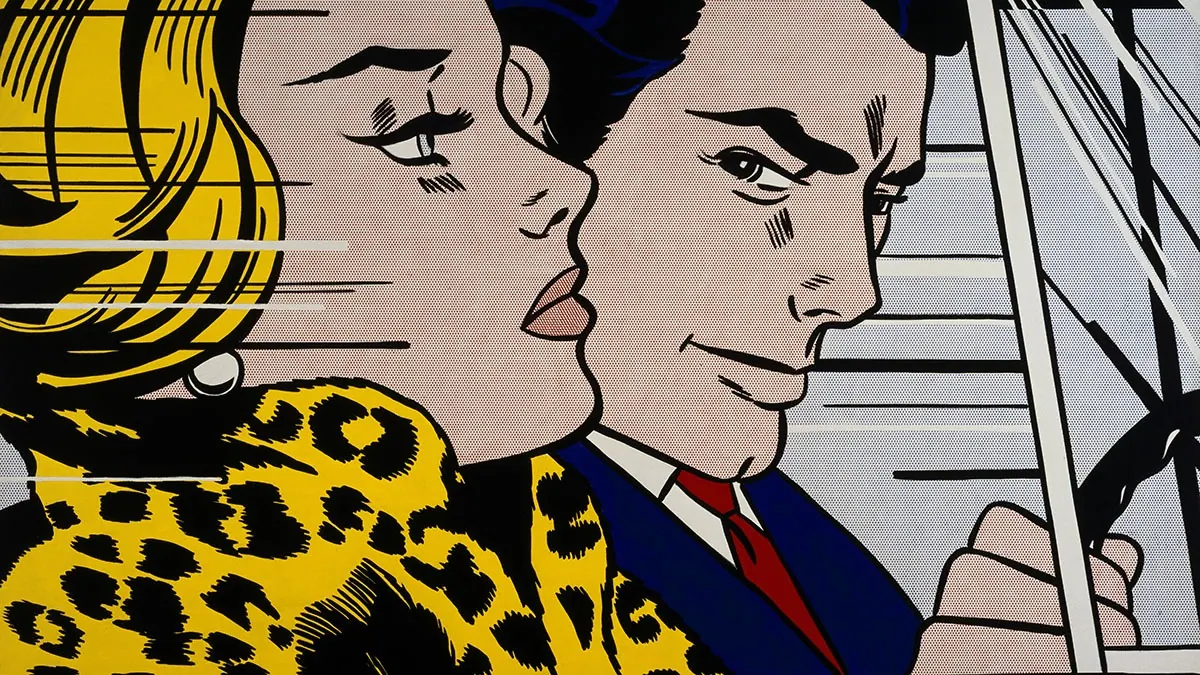
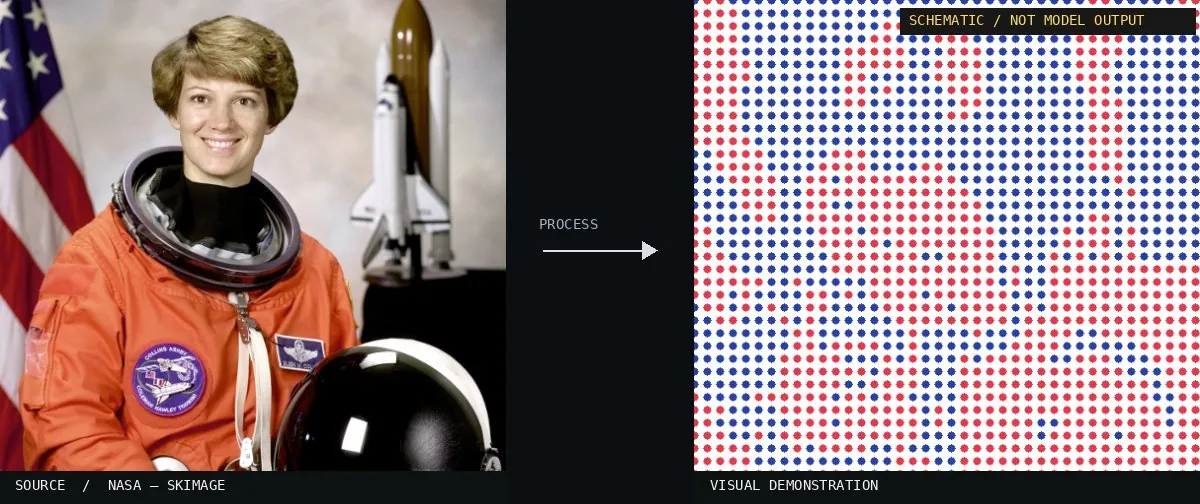
Apply a Ben-Day Dots effect with evenly spaced, consistently sized dots filling selected tonal regions, bold black contours, and flat cyan, magenta, yellow, and red areas. Add overlapping dot colors, slight print misregistration, and lightly textured off-white paper without smooth gradients. Keep the original subject and composition.
In 1879, Benjamin Day developed aprocess for creating pre-made dot patterns on printing plates. The National Galleries of Scotland explicitly distinguish this from photographic halftones with varying dot sizes. In the early 1960s, Roy Lichtenstein made these patterns adefining element of his painting. From 1962 onward, he used aperforated metal screen for dots that he had previously painted by hand. This painterly appropriation is therefore not an automatic mechanical enlargement of acomic strip. In this exercise, you will first keep the dot size constant and then deliberately change its size depending on the brightness. This will make the difference between surface patterns and photographic tonal modulation visible.
Distinction
Ben-Day dots are not simply another name for photographic halftone screen.
Further examples · 12 images
02SelinaFlying001aThe blue background is composed of a uniform grid of small dots. It illustrates the application of flat, evenly spaced dot patterns to create a secondary color field in commercial illustration.SimonKirby · CC0 · Wikimedia Commons03Benday DotsThis diagram displays the interaction of overlapping cyan and magenta dots. It demonstrates how primary colors in a fixed grid create secondary color tones through optical mixing.Pbroks13 · CC BY 3.0 · Wikimedia Commons04La Cara de Barcelona - 001This sculpture by Roy Lichtenstein features large-scale red dots on a white surface. It translates the two-dimensional printing technique into a three-dimensional medium using fixed patterns.Mutari · Public domain · Wikimedia Commons05Ben-Day Dots, applied to “Ana rosa metro station, São Paulo, Brazil”The photo shows the Ana Rosa metro station interior. The left side uses uniform dot grids, while the right side transitions into variable-sized halftone dots to represent varying light levels.Wilfredor (photo); processed for the Atlas · CC BY-SA 4.0 · Wikimedia Commons06Ben-Day Dots, applied to “Nubian houses”This image displays colorful Nubian houses. Constant Ben-Day dots fill the flat color fields on the left, whereas the right side uses dot diameter to simulate shadow and depth.Summering2018 (photo); processed for the Atlas · CC BY-SA 4.0 · Wikimedia Commons07Ben-Day Dots, applied to “Lago Fallère, Valle d'Aosta (2415m) 002”The landscape of Lago Fallère is rendered with graphic dots. The left portion maintains strict dot size within color areas, contrasting with the variable halftone sizes used on the right.Agnes Monkelbaan (photo); processed for the Atlas · CC BY-SA 4.0 · Wikimedia Commons08Ben-Day Dots, applied to “Erfurt - Thüringer Zoopark - Rhea americana 01”A Rhea bird's head is shown split between two techniques. The left side utilizes fixed-size Ben-Day dots for flat tones, while the right side adjusts dot scale to create gradients.H. Zell (photo); processed for the Atlas · CC BY-SA 3.0 · Wikimedia Commons09Ben-Day Dots — machine versionSchematic or classical approach — not a trained AI model output.Atlas of Visual Effects10Pop art woman from ChatGPTA stylized woman with blue hair is depicted in a comic book aesthetic. The skin and background utilize uniform grids of red and blue Ben-Day dots to create tone and texture through a simulated halftone printing process.ChatGPT · Public domain · Wikimedia Commons11Giantess comic book girlA regular grid of small, uniform dots covers the entire composition. This digital overlay imitates the mechanical printing process used in mid-century comic books to create tonal variations.Strange Anomaly · CC BY 4.0 · Wikimedia Commons12DALL - E - Panting in Pop Art style by Roy Lichtenstein, Rhinoceros wearing a business suit screaming aloud while seeing the stock price craA regular grid of orange dots creates tonal variation in the yellow background. This illustrates the digital simulation of mechanical halftone dots used in Pop Art to suggest mass-production printing.DALL-E 2 · Public domain · Wikimedia Commons
Question
What is the most important difference to the photographic halftone screen?
Show possible answer +Hide answer −
Ben-Day uses predefined surface patterns; aphotographic grid encodes local tonal values, for example, via variable dot sizes.