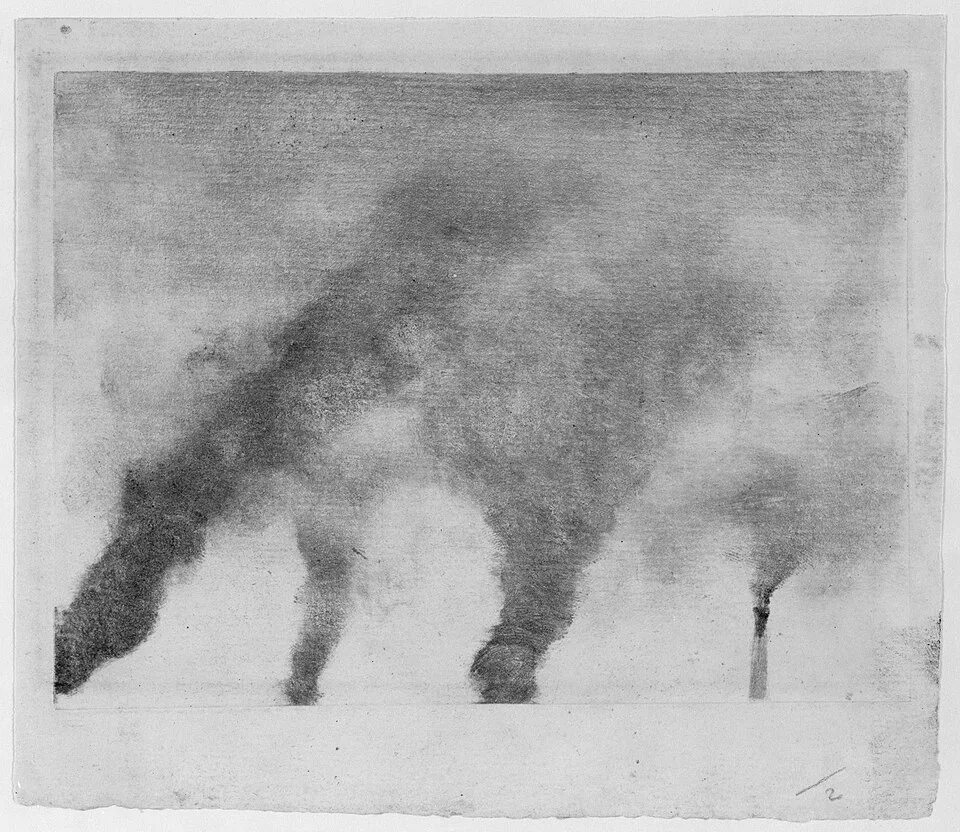
Four Smoke Plumes on Paper. Four dark, tapering plumes spread into a translucent gray veil across pale paper.Edgar Degas · CC0 · via Wikimedia CommonsView source ↗
Prompt
Apply a Fumage effect by rebuilding tonal forms from translucent soot deposits on warm ivory paper. Use smoky gray veils, curling black wisps, feathered edges, granular carbon specks, and rubbed highlights, letting recognizable details emerge from layered cloudlike stains. Keep the original subject and composition.
You see swirling, [translucent gray and black patterns]on alight background. These shapes often resemble clouds, ghosts, or [organic textures].
Principle
Soot from alit candle or lamp is [deposited onto asurface]like paper or canvas. The artist then fixes or alters this carbon layer.
Example
Wolfgang Paalen: Dictated by aCandle, 1938.
Try it out
Hold apiece of sturdy paper safely above aburning candle and watch the black soot gather into strange shapes.
Background
Fumage was popularized in 1937 by Wolfgang Paalen, aSurrealist artist seeking new ways to bypass conscious control. It relies on an additive process1where aflame's carbon residue2forms unpredictable, delicate marks. Paalen moved ablank canvas or paper over alit candle, letting the rising smoke dictate the initial forms. Later, he often used abrush to manipulate the soot or painted over it to reveal hidden figures. This technique fit perfectly with the Surrealist goal of tapping into the subconscious. The delicate soot layer remains fragile until sprayed with afixative varnish3.
Distinction
Unlike sfumato, which uses soft brushstrokes to blur painted edges, fumage builds actual physical layers of burnt carbon. Sfumato is an optical blending technique, while fumage relies on direct soot deposition.
Aftermath
It shows how unpredictable natural elements like fire can become collaborative tools in art.
Further examples · 9 images
02Soot Veils on Cream PaperGray-black plumes rise and merge across a cream-colored sheet, leaving pale openings between them. The graduated carbon veils and irregular smoky contours exemplify the deposited-soot effects of fumage.Edgar Degas · CC0 · Wikimedia Commons03Converging Soot CloudsBroad gray clouds spread above several narrow, dark trails on a pale ground. The transitions from concentrated black deposits to translucent haze clearly show the distinctive surface effects of fumage.Edgar Degas · CC0 · Wikimedia Commons04Soot Curls with Floating ColorTranslucent black curls weave through red, yellow, and blue organic shapes against a white ground. The prominent soot veils, rounded deposits, and feathered trails clearly demonstrate fumage enriched with painted color.Humberto Antonio Muniz · CC BY-SA 3.0 · Wikimedia Commons05Colored Shapes Emerging from SootBright interlocking forms emerge from soft gray veils, with isolated dark curls extending into the white margins. The translucent smoky deposits and feathered carbon trails clearly reveal fumage beneath and around the added color.Humberto Antonio Muniz · CC BY-SA 3.0 · Wikimedia Commons06Soot Veils on a Pale GroundTranslucent gray veils, dark rounded deposits, and curling trails drift across a pale surface. These soft, uneven accumulations visibly exemplify the smoke-deposited carbon patterns characteristic of fumage.Unknown author · CC0 · Wikimedia Commons07Colored Forms Among Smoke FilamentsAngular pink, blue, and yellow forms mingle with delicate black wisps on a warm, pale background. The smoky filaments surrounding and crossing the painted shapes show fumage incorporated into a colored composition.Humberto Antonio Muniz · CC BY-SA 3.0 · Wikimedia Commons08Smoky Loops and Painted AbstractionYellow and blue shapes float among black smoky loops and translucent gray drifts. These soft carbon-like traces remain visibly distinct from the painted passages, showing fumage combined with color.Humberto Antonio Muniz · CC BY-SA 3.0 · Wikimedia Commons09Smoke Traces in Multicolored AbstractionA dense field of orange, turquoise, pink, and yellow contains dark wisps, cloudy knots, and looping smoky contours. These visible soot-like passages show fumage integrated into a heavily developed painted abstraction.Humberto Antonio Muniz · CC BY-SA 3.0 · Wikimedia Commons
Question
Why must an artist handle a finished fumage piece with extreme care?
Show possible answer +Hide answer −
The deposited soot is highly unstable and will easily smear if touched. It must be carefully sealed with afixative spray.