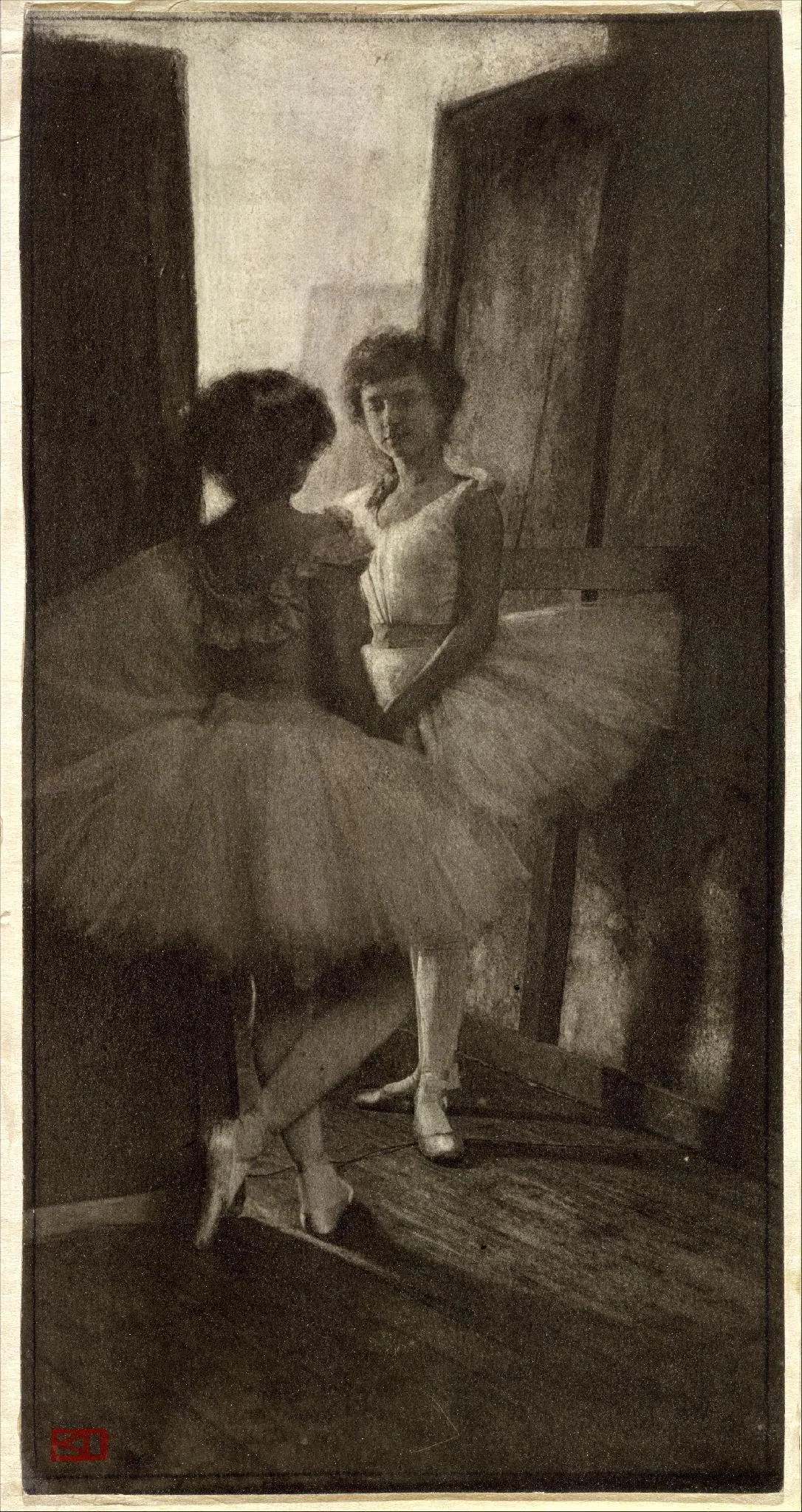
Gum bichromate / gum dichromate print. Developed in 1855, revived in the Pictorialism of the 1890s
Typeface · Alegreya
Robert Demachy: Dans les coulisses, circa 1897. Historical gum bichromate print.Robert Demachy / The Metropolitan Museum of Art via Wikimedia Commons. Public domain / Commons.View source ↗
Prompt
Apply a Gum Bichromate effect with matte, chalky pigments, coarse paper fibers, visible brushstrokes, and softly eroded photographic detail. Build earthy brown, charcoal, and muted ochre layers with uneven density, hand-worked highlights, painterly shadows, and irregular brushed borders rather than a glossy photographic surface. Keep the original subject and composition.
[Grainy, chalky, or painterly surfaces]. Brushstrokes and pigments significantly alter the character of aphotograph.
Principle
A[light-sensitive pigment layer]made of gum arabic1forms the print. [Washing and hand-finishing control]the visible tonal values2.
Example
Robert Demachy: Dans les coulisses, around 1897.
Try it out
Digitally simulate the look using matte pigment paint and paper texture. Compare visible brushwork with even blurring.
Background
Invented in 1855, revived in the 1890s; Demachy influential from 1894 onwards. Pictorialist art photography around 1900. Detailed mechanism: Pigment, gum arabic, and light-sensitive dichromate are applied to paper, exposed through anegative, and developed in water. Manual processing alters the print. The painterly effect can arise in the printing material itself; it does not necessarily have to be amanipulated photograph.
Distinction
The painterly effect can occur in the printed material; it does not have to be amanipulated photograph.
Aftermath
Painterly filters, texture overlays, and alternative photographic printing processes.
Further examples · 9 images
02Coating paper for gum bichromate process.jpg lub Applying emulsion in gum bichromate photographyA hand applies a dark emulsion onto a white sheet with a wide brush. This demonstrates the manual coating of paper with gum arabic and pigment before light exposure.Dtpgreg1 · CC0 · Wikimedia Commons03Hans Watzek LandschaftA monochrome landscape features a stone wall and dense trees under a cloudy sky. The grainy, stippled texture illustrates the chalky surface characteristic of the gum bichromate technique.Hans Watzek · Public domain · Wikimedia Commons04Kallitype with gum bichromate (8258734667)A wooden door is framed by thick ivy in a high-contrast print. The rough edges and deep, matte blacks show how the pigment layer creates a painterly, non-photographic finish.stacey svendsen from a little bit of everywhere · CC BY 2.0 · Wikimedia Commons05Les pommiers, Cantons de l'EstThis landscape shows a figure near bare trees in a misty field. Visible brushwork in the sky and soft tonal transitions highlight the manual manipulation possible during development.Nathalie Ampleman est originaire de Montréal au Québec. Elle habite depuis 2007 dans les Cantons de l’Est. Photographe d · CC BY-SA 3.0 · Wikimedia Commons06Hb 3343412A tall, slender tree stands in front of a house and woods in a sepia-toned print. The diffused light and textured paper emphasize the Pictorialist aesthetic of the 1890s revival.Hugo Henneberg · Public domain · Wikimedia Commons07(Barcelona) Bichromated gum on paper - Untitled portrait by Agusti Pisaca - Museu Nacional d'Art de CatalunyaA portrait of a child looking upward displays a heavily textured, almost canvas-like surface. The irregular pigment distribution demonstrates the hand-finished quality of the dichromate development process.Didier Descouens · Public domain · Wikimedia Commons08PrimaveraAn orange-toned profile portrait shows a woman with delicate, soft-focus features. The vibrant pigment choice and sketch-like background illustrate the creative control typical of Robert Demachy's influential work.Robert Demachy · Public domain · Wikimedia Commons09A ModelDemachy’s portrait shows high contrast and a textured, matte finish. The dark, saturated blacks and the lack of fine photographic detail illustrate the tactile nature of the gum bichromate technique.Robert Demachy · Public domain · Wikimedia Commons