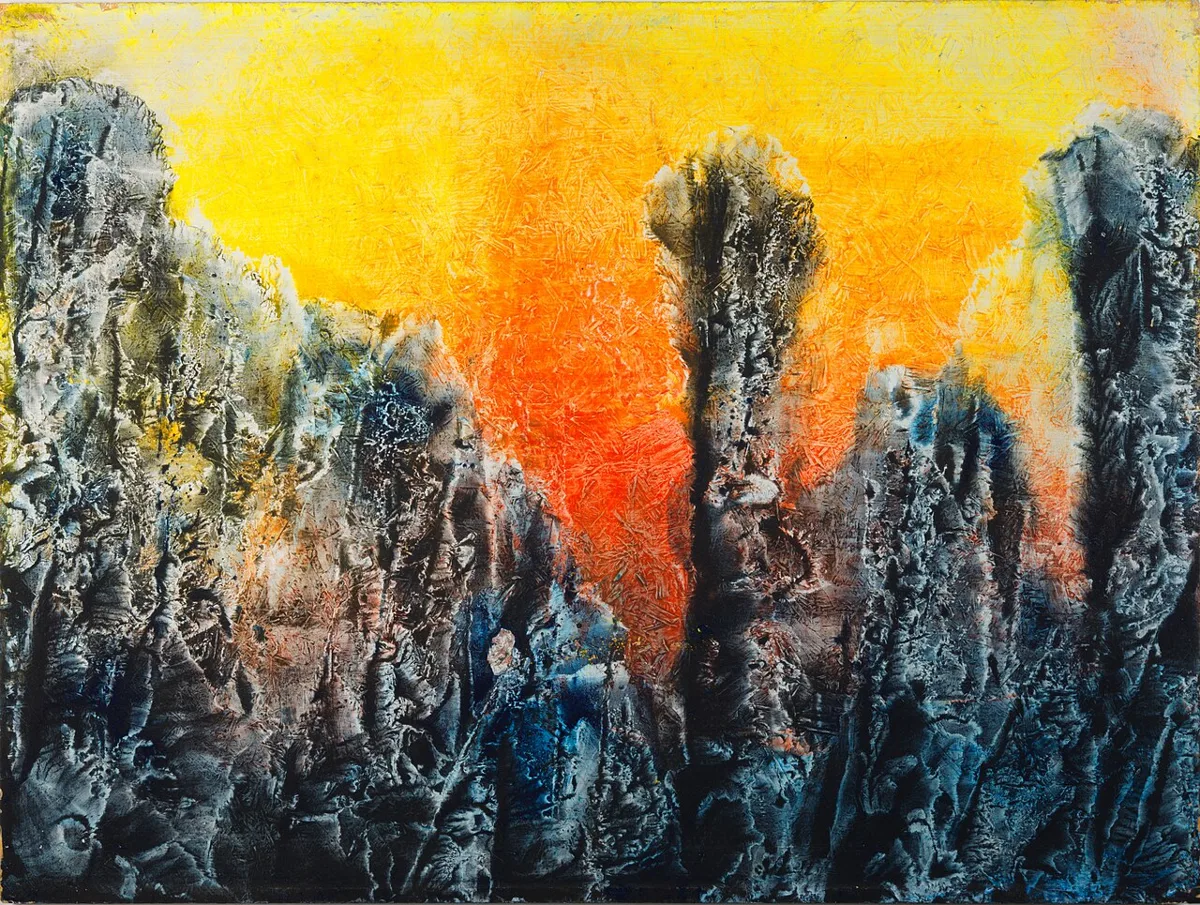
Surrealist Landscape Made With Decalcomania. A painted landscape features towering, pillar-like rock formations with intricate, spongy textures against a yellow and orange sky.H. Grobe · CC BY-SA 4.0 · via Wikimedia CommonsView source ↗
Prompt
Apply a Decalcomania effect with pressed-paint textures, branching vein networks, spongy cellular patches, and irregular pools of thick pigment. Use earthy greens, ochres, cream, and dark brown, with glossy ridges and torn-looking transfer edges suggesting surfaces pulled apart. Keep the original subject and composition.
You see unpredictable, [spongy textures]in paint or ink. These patterns often resemble [organic shapes], strange vegetation, or alien landscapes.
Principle
Thick ink or paint is pressed between two smooth surfaces. When peeled apart, the suction1creates [branching, vein-like ridges]and random pools.
Example
Max Ernst: Europe After the Rain II, 1940-1942.
Try it out
Squeeze wet watercolor or gouache2between two sheets of smooth paper, press down, and pull them apart to see the textures.
Background
Decalcomania started as an 18th-century decorative craft for transferring engravings to ceramics. In 1936, surrealist artist Óscar Domínguez adapted it to create spontaneous art. He spread dark gouache on smooth paper, covered it with another sheet, and pressed them. Peeling them apart revealed strange, random textures. Surrealists loved this because it removed conscious control, letting the subconscious find meaning in the random shapes. Max Ernst later used oil paint on canvas to create highly detailed, ruined landscapes. The technique relies on fluid dynamics3and suction, forming complex ridges as the wet medium splits.
Distinction
Unlike aRorschach inkblot, which folds paper for perfect symmetry, decalcomania creates asymmetrical, highly detailed surface textures.
Aftermath
It shows how giving up control to physical forces can spark human imagination.
Further examples · 9 images
02Decalcomania Used for Alien VegetationA surreal painting displays strange, organic pillars and spongy ground textures in hues of green, blue, and yellow. This is a perfect example of decalcomania, where pressed and peeled paint creates unpredictable, vegetation-like patterns.H. Grobe · CC BY-SA 4.0 · Wikimedia Commons03Abstract Decalcomania Texture in PaintingAn abstract artwork reveals a central mass of highly textured, spongy paint resembling a strange, decaying organic form. The technique is clearly visible in the branching, unpredictable ridges formed by peeling apart painted surfaces.H. Grobe · CC BY-SA 4.0 · Wikimedia Commons04Blue Alien Landscape Created via DecalcomaniaA landscape painting depicts icy blue and green tones with strange, textured rock formations resembling a cavern or an alien world. The artwork is a classic demonstration of decalcomania, utilizing the pulled paint effect to generate complex geological textures.H. Grobe · CC BY-SA 4.0 · Wikimedia Commons05Decalcomania Textures in an Abstract LandscapeA vibrant painting shows a glowing orange central shape above blue, textured, mountain-like forms and dark, spongy borders. The intricate, branching ridges in the paint perfectly illustrate the use of decalcomania to form organic, unpredictable shapes.H. Grobe · CC BY-SA 4.0 · Wikimedia Commons06Viscous Fingering Fluid Mechanics DemonstrationA brightly colored macro photograph shows fractal-like, branching structures spreading outward in a thin fluid film. This captures viscous fingering, the fluid mechanics phenomenon that physically creates the characteristic vein-like ridges of decalcomania.Claire Trease, Kingston University · CC BY-SA 4.0 · Wikimedia Commons07Viscous fingering demonstrating the physics of decalcomaniaA close-up view reveals iridescent, branching, vein-like fractal ridges and pools formed in a fluid medium. This is a classic scientific demonstration of viscous fingering, the exact physical phenomenon that creates decalcomania textures when two coated surfaces are peeled apart.Claire Trease, Kingston University · CC BY-SA 4.0 · Wikimedia Commons08Basic Demonstration of Decalcomania With White PaintA small blob of white paint is squeezed under a transparent surface, revealing intricate, branching ridges and pools. This serves as a basic, clear physical demonstration of the decalcomania technique's pressing and peeling process.AborontsOgley009293 · CC0 · Wikimedia Commons09Experiment Showing Formation of Branching RidgesA scientific chart includes a graph and three sequential images showing branching patterns forming in a fluid as plates separate. This is a scientific demonstration of the physical forces that create the exact textures seen in decalcomania.Cgay · CC BY-SA 3.0 · Wikimedia Commons
Question
Why do the patterns often look like veins or branches?
Show possible answer +Hide answer −
As the surfaces pull apart, air enters the sticky paint. The fluid resists stretching, breaking into branching channels called viscous fingering.