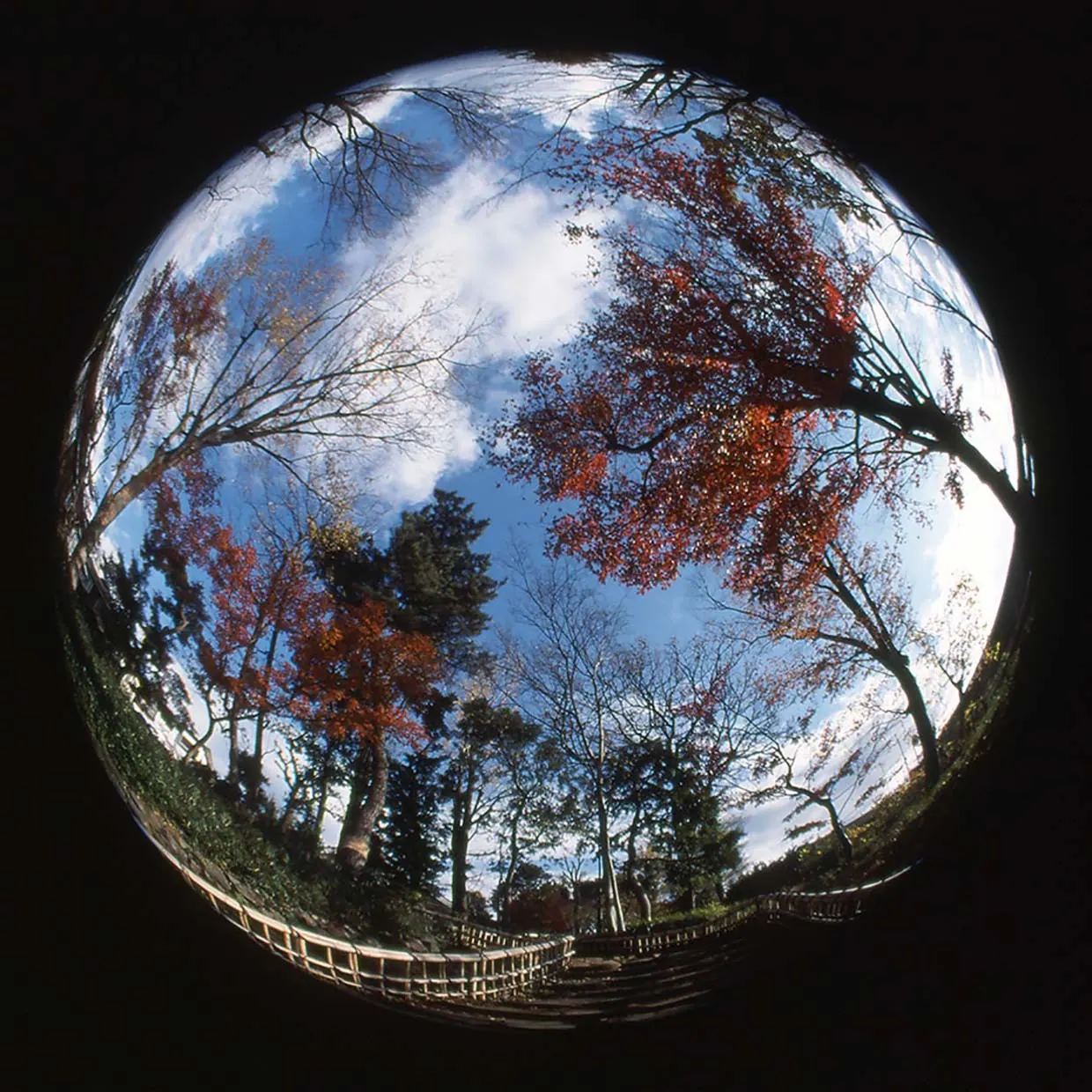
Apply a Fisheye Lens effect with pronounced barrel distortion, straight lines bowing toward the frame edges, an enlarged central region, and compressed peripheral details. Suggest an extremely wide field of view through curved spatial geometry, subtle corner darkening, and mild edge softness. Keep the original subject and composition.
[Very wide viewing angle1]; [straight lines curve towards the edge].
Principle
The [projection2deliberately does not depict large angles]as straight lines.
Example
Kouichi Ohshita: OP fisheye example, 1999.
Try it out
Compare ahorizon in the center of the image and one near the edge.
Background
Fisheye lenses had precursors in scientific and meteorological applications. In 1962, Nikon offered acorresponding lens for the 35mm system with the Fisheye-Nikkor 8mm f/8. Later music, sports, and fashion photography popularized the extreme spatial distortion as astylistic device. Today, the effect can be created optically or digitally. To understand this, it helps to distinguish between angle of view and projection geometry.
Distinction
Afisheye lens is not simply avery short, straight wide-angle lens. Depending on its construction, it produces either acircular image or aframe-filling rectangle. The curvature also depends on where aline lies within the image.
Aftermath
Aprojection determines how we understand space as an image.
Further examples · 10 images
02Adelsdorf Kirche Altarraum-20210801-RM-160111This interior view shows the altar area of a church in Adelsdorf. The full-frame fisheye effect is visible as the horizontal floor and vertical walls curve significantly toward the frame edges.Ermell · CC BY-SA 4.0 · Wikimedia Commons03Fisheye lens Photography In Iran-Kashan City-Mostafa Meraji-2016-free Pictures-Canon EF 8-15mm lens 12An ornate tiled corridor in Kashan is captured within a circular black frame. The circular projection demonstrates a 180-degree field of view, transforming straight architectural lines into deep curves.Mostafameraji · CC0 · Wikimedia Commons04Circular fisheye view of Oude Kerk Amsterdam Daniel D. Teoli Jr.A bridge and the Oude Kerk in Amsterdam are depicted in a circular composition. The lens compresses the expansive outdoor scene, including the sky and water, into a distorted hemispherical perspective.Danielteolijr · CC BY-SA 4.0 · Wikimedia Commons05Fisheye lens Photography In Iran-Kashan City-Mostafa Meraji-2016-free Pictures-Canon EF 8-15mm lens 20The image captures a room with blue wainscoting and arched wall niches in a circular format. The extreme projection geometry allows for the simultaneous depiction of the floor, ceiling, and all four walls.Mostafameraji · CC0 · Wikimedia Commons06Fisheye lens Photography In Iran-Kashan City-Mostafa Meraji-2016-free Pictures-Canon EF 8-15mm lens 22A multi-level shopping arcade with a glass skylight is viewed through a circular fisheye lens. The railing in the foreground appears to wrap around the frame, illustrating barrel distortion.Mostafameraji · CC0 · Wikimedia Commons07Fisheye lens Photography In Iran-Kashan City-Mostafa Meraji-2016-free Pictures-Canon EF 8-15mm lens 04This interior of a shop features pottery and a stone staircase within a circular boundary. The fisheye lens captures the tight corner space by bending the stairs and ceiling beams toward the center.Mostafameraji · CC0 · Wikimedia Commons08Fisheye lens Photography In Iran-Kashan City-Mostafa Meraji-2016-free Pictures-Canon EF 8-15mm lens 19A brick room with a central pool is shown using a circular projection. The vaulted ceiling and rectangular pool edges are rendered as arcs, typical of non-rectilinear wide-angle optics.Mostafameraji · CC0 · Wikimedia Commons09Fisheye lens Photography In Iran-Kashan City-Mostafa Meraji-2016-free Pictures-Canon EF 8-15mm lens 21The photograph displays a symmetrical courtyard with a fountain and complex ceiling geometry. The fisheye effect emphasizes the radial symmetry of the architecture by curving the pillars and arches.Mostafameraji · CC0 · Wikimedia Commons10Fisheye lens Photography In Iran-Kashan City-Mostafa Meraji-2016-free Pictures-Canon EF 8-15mm lens 02A brick tunnel and a lattice wall are visible within a circular frame. The extreme wide-angle perspective makes the narrow corridor appear to expand and curve around the viewer.Mostafameraji · CC0 · Wikimedia Commons
Question
Why can the horizon still appear straight in a fisheye lens?
Show possible answer +Hide answer −
Aline running through the center of the image can appear straight in typical fisheye projections.