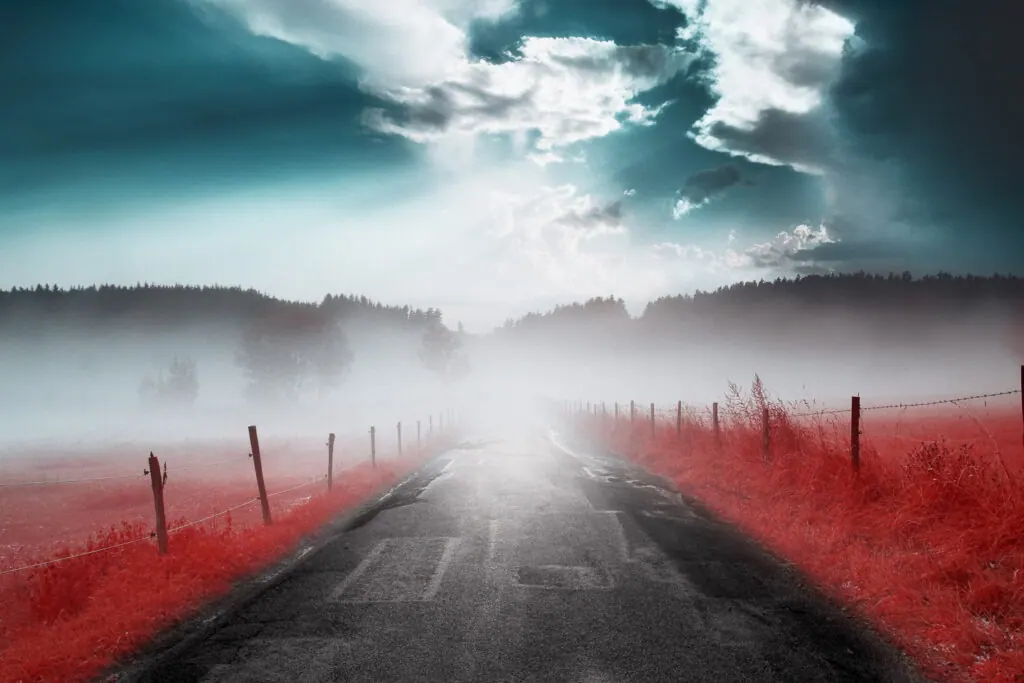
False-color infrared. 1960s aerial and experimental color photography; earlier technical precursors
Typeface · Krona One
Yann Philippe: Contemporary digital infrared photograph taken with Kolari IR Chrome. Aerochrome-like look.Yann Philippe / Kolari VisionView source ↗
Prompt
Apply a False-Color Infrared effect, rendering existing vegetation crimson or magenta, skies deep cyan to blue, and water nearly black. Give other surfaces unusual pale pink, cool gray, or turquoise tones, with crisp tonal separation and subtle photographic grain. Keep the original subject and composition.
Yann Philippe: digital IR-chrome false-color landscape.
Try it out
Explain: What information does red convey when it is not the color of areal object?
Background
False-color infrared combines measurement and design. Film types for aerial photography translate spectral differences in such away that vegetation appears striking. Later, this unusual color world was also used artistically. Kodak describes different reactions of healthy plants and various vegetation types. Digital full-spectrum cameras and special filters can produce related looks. The decade assignment refers to the established application in aerial photography and visual culture, not to asingle date of invention.
Distinction
Red here is arepresentational color and not atemperature indicator. Analog infrared color film, digital channel mapping, and aconventional color filter are different methods. Ared tree alone does not prove an infrared photograph. The modern digital example shown approximates the Aerochrome color world; it is not ahistorical Aerochrome film print.
Aftermath
An unnatural color can convey real, invisible information.
Further examples · 9 images
02Ribeira da Janela Valley on Madeira Island, view from Levada, Infrared False-Color Film (10-79.c)A mountainous valley landscape on Madeira Island is captured using false-color infrared film. The dense vegetation appears in vibrant red and magenta tones, illustrating how chlorophyll reflects near-infrared light into the red visible spectrum.Wrev · CC BY-SA 4.0 · Wikimedia Commons03False Color 8 4 3 (vegitation red) 2015-2020 MonthThis satellite animation displays land patterns where vegetation is mapped to the red channel against dark soil and bright clouds. It demonstrates the technical application of false-color imagery for monitoring vegetation changes over time.Timateus · CC BY-SA 4.0 · Wikimedia Commons04Fidschi Inseln RotumaThis satellite view shows the island of Rotuma with vegetation rendered in a distinct magenta hue. It demonstrates the mapping of near-infrared light to the red channel, typical in remote sensing.NASA · Public domain · Wikimedia Commons05Redplanet iii (49809819028)The landscape features trees and shrubs appearing in various shades of red and orange against blue rocks. This highlights high infrared reflectance in plants using a digital color-swap technique.Hypatia Alexandria from Santa Fe · CC BY 2.0 · Wikimedia Commons06Redplanet ii (49810373796)Vegetation in the foreground and hills is transformed into a vibrant red-orange. This rendering illustrates the contrast between metabolically active plants and inorganic geological features in the infrared spectrum.Hypatia Alexandria from Santa Fe · CC BY 2.0 · Wikimedia Commons07Redplanet iv (49809823413)The image displays autumn-colored foliage that is actually a result of infrared capture. It captures the characteristic appearance of healthy deciduous plants when mapped to visible red wavelengths.Hypatia Alexandria from Santa Fe · CC BY 2.0 · Wikimedia Commons08Perranporth beachInfraredCoastal cliffs covered in plant life are shown in brilliant, saturated red against a yellowed sky. This exemplifies the artistic application of false-color infrared film to a beach landscape.chris lovelock · CC BY 2.0 · Wikimedia Commons09Infrared blossoms (30409170371)The blossoms and leaves are rendered in striking pink and red tones. This close-up shows how internal plant structures reflect infrared light, resulting in a surreal palette compared to human vision.Alex Defender from Moscow, Russia · CC0 · Wikimedia Commons
Question
Does red in an infrared false-color image automatically mean "hot"?
Show possible answer +Hide answer −
No. It could represent the strong reflection of near-infrared light by vegetation.