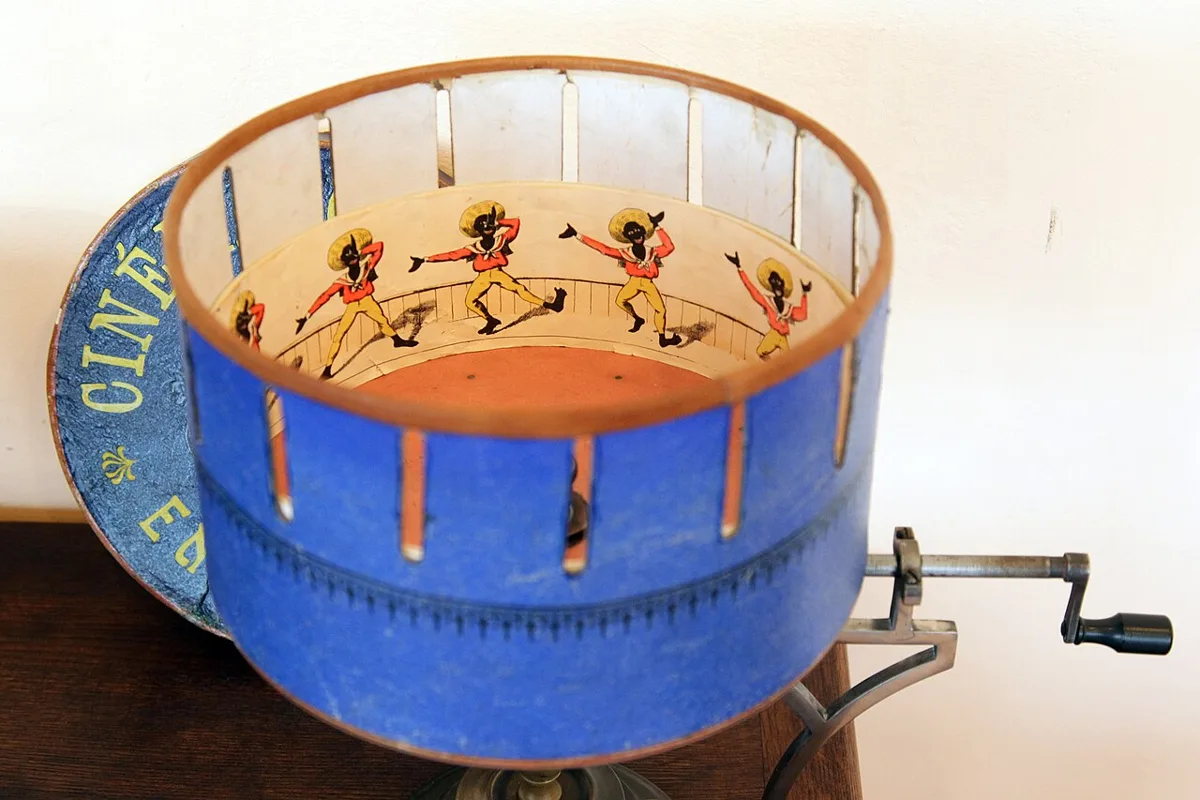
1834, William George Horner's device; popular in the 1860s
Typeface · Ewert
Blue Zoetrope with Dancing Figures. A blue hand-cranked drum has narrow vertical slits above an inner strip of figures in successive poses.Runner1616 · CC BY-SA 3.0 · via Wikimedia CommonsView source ↗
Prompt
Apply a Zoetrope effect with narrow dark vertical viewing slits, a subtly curved paper-strip appearance, and successive pose echoes concentrated around moving details. Use muted ink colors, aged paper grain, crisp intermittent silhouettes, and restrained lateral motion blur to suggest a spinning drum. Keep the original subject and composition.
Through aspinning drum's [narrow slits], drawings appear to perform a[repeating movement]. The picture strip shows successive poses, often of people or animals.
Principle
The slits provide [brief glimpses]of successive drawings, reducing the blur that continuous viewing would produce. Apparent motion1links these separate views into perceived movement.
Spin azoetrope and compare looking through its slits with looking over its rim: notice when the drawings become readable.
Background
William George Horner described his rotating drum device in 1834, calling it the Daedaleum. It became widely popular as the zoetrope in the 1860s. Apaper strip lines the drum's inner wall, with drawings arranged in sequence below the viewing slits. Looking through the passing slits reveals successive drawings across the drum. Each opening briefly interrupts the otherwise blurred view. Several people can watch from different sides without amirror. The sequence usually forms aloop3, returning smoothly from its last pose to its first.
Distinction
Aphenakistiscope usually uses aslotted disc viewed in amirror. Azoetrope uses adrum and needs no mirror.
Aftermath
The zoetrope shows how separate still images can produce perceived movement when their presentation is carefully timed.
Further examples · 11 images
02Decorated Zoetrope with Horse and RiderAn ornate cylindrical drum contains a sequence of horse-and-rider silhouettes beneath evenly spaced viewing slits. The visible strip and slotted wall demonstrate how a zoetrope separates successive poses into brief views that merge into apparent motion.Photograph by Clem Rutter, Rochester, Kent. (www.clemrutter.net). · CC BY-SA 3.0 · Wikimedia Commons03Animal Performer Zoetrope Animation StripA long, narrow strip presents successive poses of a dark animal-like performer beneath a small ball. The extended sequence clearly displays the phased drawings used inside a zoetrope to create a repeating animated action.Unknown artistUnknown artist · Public domain · Wikimedia Commons04Zoetrope Drum With Picture StripA hand rests beside a broad black drum with narrow viewing slits and an illustrated strip lining its interior. The visible pairing of slits and sequential pictures demonstrates how a zoetrope separates drawings into brief views during rotation.Scott Blake · CC BY-SA 3.0 · Wikimedia Commons05Horse and Rider ZoetropeA slotted black drum on a wooden base contains successive drawings of a horse and an acrobatic rider. Its exposed picture sequence and viewing slits clearly demonstrate the components that produce zoetrope animation.Unknown author · CC BY-SA 2.0 · Wikimedia Commons06Zoetrope Strip with Balancing FiguresA worn paper strip depicts small black-and-red figures balancing on balls in changing poses. These successive drawings form animation material for a zoetrope, where intermittent viewing turns their separate positions into repeating movement.Unknown author · CC BY 4.0 · Wikimedia Commons07Zoetrope Drum with Curled Picture StripsAn overhead view reveals a battered slotted drum holding curled picture strips, including a sequence of green barrel-like forms. The visible slits and sequential illustrations identify the zoetrope’s animation mechanism, although the strips are loosely stored rather than neatly mounted.Unknown author · CC BY 4.0 · Wikimedia Commons08Fisherman and Fish Zoetrope StripA paper strip repeats a seated fisherman and a large green fish in changing positions. The successive phases provide a zoetrope animation sequence, designed to appear as movement when viewed intermittently inside a spinning drum.Unknown author · CC BY 4.0 · Wikimedia Commons09Ladder and Pool Zoetrope StripA printed strip shows figures on ladders above green-edged pools, with their poses changing across the paper. These staged positions supply successive frames for a zoetrope’s repeating animation.Unknown author · CC BY 4.0 · Wikimedia Commons10Club-Carrying Figure Zoetrope StripA worn strip shows a black-and-green figure carrying a raised club, with arms and legs shifting between drawings. The ordered poses constitute a zoetrope picture sequence intended to produce apparent movement through intermittent slit viewing.Unknown author · CC BY 4.0 · Wikimedia Commons11Dancing Couple Animation StripA long illustrated strip presents a dancing couple in successive poses. These phased drawings form the image sequence used in a zoetrope to produce repeating movement.Unknown artistUnknown artist · Public domain · Wikimedia Commons
Question
Why does looking over the rim usually reveal blur rather than clear animation?
Show possible answer +Hide answer −
Without the slits, each drawing remains visible as it travels across your view. The slits limit that travel during each glimpse.