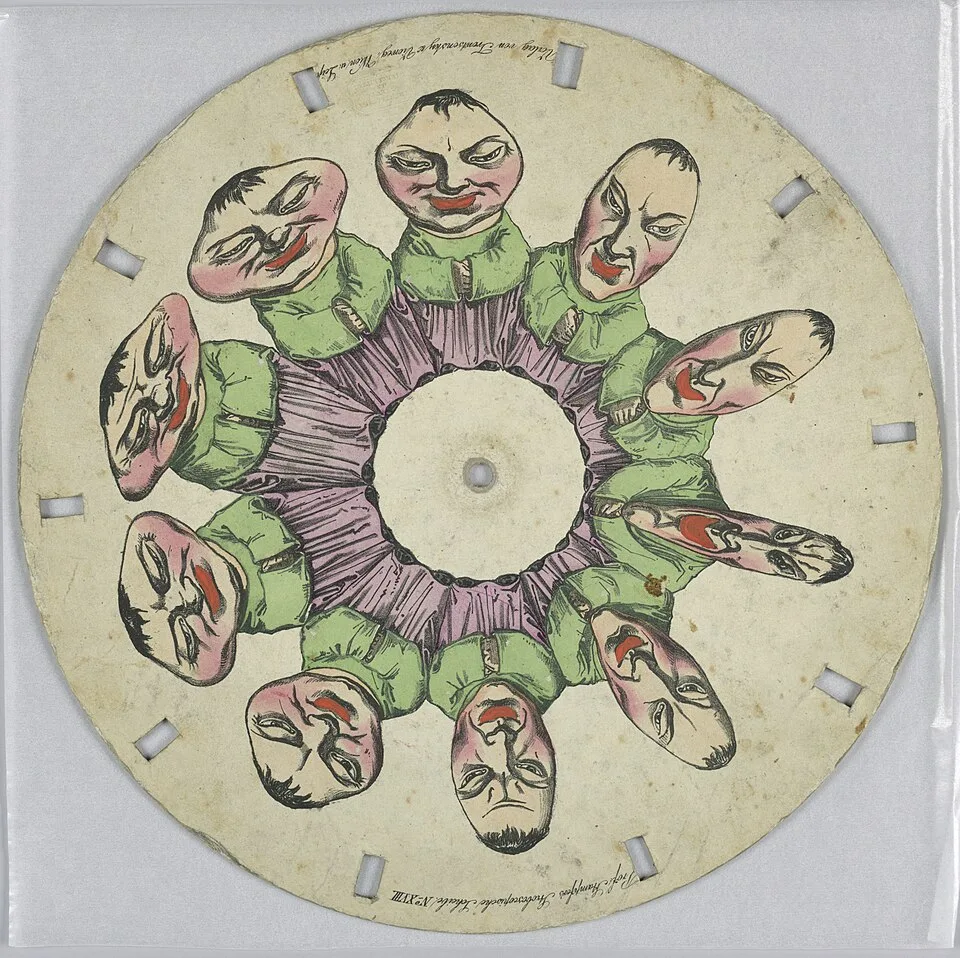
Transforming Faces Phenakistiscope Disc. A circular disc presents a ring of caricatured heads with progressively changing facial proportions and narrow viewing slots near its rim.Simon Stampfer · Public domain · via Wikimedia CommonsView source ↗
Prompt
Apply a Phenakistiscope Loop treatment with hand-drawn sequential poses arranged around a peripheral circular disc, separated by narrow radial viewing slits. Use muted printed colors, aged card texture, crisp silhouette changes, and faint rotational echoes, keeping the main image anchored within the center. Keep the original subject and underlying composition.
You see aseries of [sequential drawings arranged]in acircle on aflat disc. When viewed properly, these drawings merge into an [endlessly repeating moving image].
Principle
Narrow radial slits1block your vision while the disc spins, revealing each drawing only for asplit second. This rapid replacement creates the [illusion of continuous motion]through persistence of vision2.
Example
Joseph Plateau: Phénakisticope discs (published by Ackermann), 1833.
Try it out
Stand in front of amirror with aslotted paper disc, look through the slits, and spin it.
Background
Belgian physicist Joseph Plateau introduced the phenakistiscope in 1832. It was the first device to create afluid illusion of motion from static pictures. The device consists of acardboard disc with equidistant radial slits. Asequence of slightly changing images is drawn around the disc's center. To use it, aperson holds the disc facing amirror and looks through the moving slits. As the disc spins, the slits act as ashutter3. They prevent the images from blurring together. Your brain pieces these brief flashes together. This transforms asequence of flat drawings into alooping animation.
Distinction
The zoetrope uses aspinning drum with slits on the side instead of aflat disc. This allows multiple people to view the animation at once.
Aftermath
It proves that our visual system requires brief moments of darkness between images to perceive smooth motion.
Further examples · 8 images
02Animated Figures and Celestial FormsFigures in green jackets and red trousers surround concentric sequences of suns, circles, and stars on a slotted disc. Successive poses and changing geometric forms supply the frames of repeating animations viewed through the rotating slots.Unknown artistUnknown artist · Public domain · Wikimedia Commons03Animal Sequences on a Slotted DiscAnimal figures leap past stools around the outer ring of a disc, while donkey heads occupy an inner sequence. Radial viewing slots separate successive phases into brief glimpses, allowing both rings to animate in repeating loops.Unknown artistUnknown artist · Public domain · Wikimedia Commons04Geometric Phenakistiscope Animation DiscBlack circles overlap red-and-white segmented circles around a disc containing an inner ring of yellow and black forms. Their changing relationships across successive positions, paired with peripheral viewing slots, create a geometric phenakistiscope loop.Unknown artistUnknown artist · Public domain · Wikimedia Commons05Costumed Figure Movement SequenceA ring of costumed figures shows successive changes in leg position and body orientation, alternating with long radial slots. These carefully spaced drawings provide the individual phases of a movement that repeats when the spinning disc is viewed through its slots.University of Edinburgh Heritage Collection · CC BY 3.0 · Wikimedia Commons06Grotesque Faces in Concentric Animation RingsConcentric rings of green grotesque faces expand toward the edge of a disc pierced by radial viewing slots. The changing expressions and repeated radial sequences constitute a multi-ring phenakistiscope animation.University of Edinburgh Heritage Collection · CC BY 3.0 · Wikimedia Commons07Four Displayed Phenakistiscope Picture DiscsFour illustrated animation discs are displayed behind a clear panel, with circular sequences of figures, animals, and expressive faces. Their visible phase-by-phase drawings show the image-bearing medium of phenakistiscope loops, although the viewing slots are not clearly resolved.Sukkoria · CC BY-SA 4.0 · Wikimedia Commons08Phenakistiscope Discs and Handled ViewerSeveral circular picture discs display successive human poses, including one mounted on a handled assembly with a dark perforated rim. The repeated movement phases and visible viewing apertures demonstrate the components used to produce phenakistiscope loops.Simon Speed · Public domain · Wikimedia Commons
Question
Why does the traditional phenakistiscope require a mirror?
Show possible answer +Hide answer −
The mirror reflects the images back to your eye through the moving slits. These passing slits must act as ashutter directly in front of your face.