M 052 / 18302 Masks & Controlalgorithm output

Wireframe Overlay

segmentation, masks & control
Typeface · Rajdhani

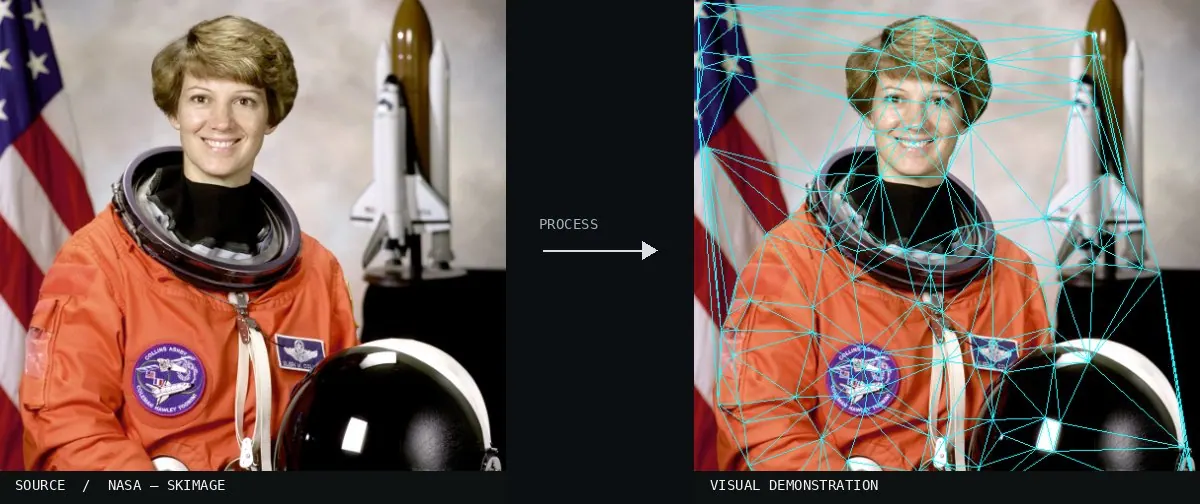
Real-world algorithm demonstration, applied to a NASA portrait.
Real-world algorithm demonstration, applied to a NASA portrait.Image: NASA / Eileen Collins · scikit-image (public domain)View source ↗

Prompt

Apply a Wireframe Overlay effect, covering the visible image surfaces with a fine triangular mesh of luminous cyan lines and small vertex dots. Vary triangle sizes around important contours, retain the photograph beneath, and create a precise technical appearance without solid polygon fills. Keep the original subject and composition.

Identify

A wire mesh covers the image surface.

Principle

Triangulation1 creates a geometric graph as a design overlay.

Try it out

Move control points2.

Classification

Calculated image processing result.

Further examples · 8 images

Suzanne
02 SuzanneA three-dimensional monkey head is shown with visible polygon edges. The mesh lines define the geometric structure of the model, illustrating the underlying triangulation used in digital image processing.Taliclan-ast · CC BY-SA 3.0 · Wikimedia Commons
3D wireframe render of an enamel pot
03 3D wireframe render of an enamel potA wireframe rendering of a cooking pot shows a series of quadrangular segments. The mesh lines act as control points for the vessel's shape, representing a calculated digital effect over a blank background.Apinanaivot · CC0 · Wikimedia Commons
3D wireframe render of an industrial lamp
04 3D wireframe render of an industrial lampAn industrial lamp is depicted through a wire mesh of complex geometric connections. The varying density of the lines demonstrates how triangulation and wireframe overlays are used to detail machine-like digital objects.Apinanaivot · CC0 · Wikimedia Commons
Subdivision surface of quadrilateral mesh level 3
05 Subdivision surface of quadrilateral mesh level 3A red subdivided surface is displayed alongside its original low-polygon control cage. The grid overlay shows how the wireframe defines the underlying geometry through calculated subdivision.Fredrik Orderud · Public domain · Wikimedia Commons
Conv diff deformedmesh wireframe
06 Conv diff deformedmesh wireframeA two-dimensional plane is covered in a complex triangulation mesh. The varying density of the geometric graph shows how wireframe overlays are used in finite element analysis.Hundertm · CC BY-SA 4.0 · Wikimedia Commons
Wireframe 3D Model by Camille Kleinman
07 Wireframe 3D Model by Camille KleinmanA human head is represented by a dense mesh of white lines on a black background. This shows a complex wireframe structure defining the three-dimensional topology of a digital character model.Camille Kleinman · CC BY-SA 4.0 · Wikimedia Commons
Hand-painted house 3D model stages
08 Hand-painted house 3D model stagesThe top-left quadrant displays the polygonal skeleton of a house model. This wireframe view reveals the underlying geometry and vertices before surfaces, textures, or shading are applied to the digital object.Drummyfish · CC0 · Wikimedia Commons