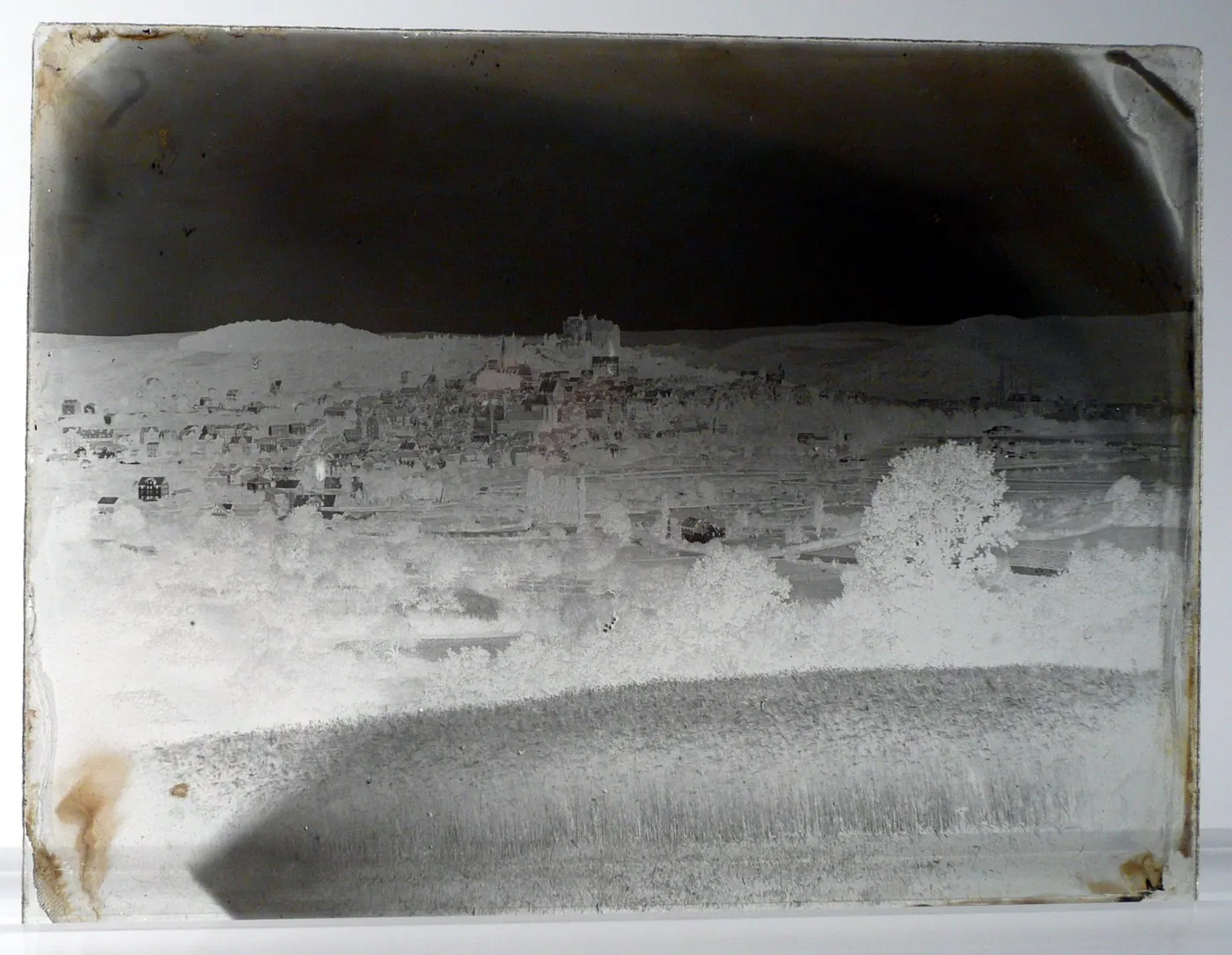
Wet-plate collodion. Introduced in 1851; influential until the 1880s
Typeface · Old Standard TT
Ludwig Bickell: Marburg, 1882–86. Original collodion glass negative.Heinrich Stürzl / CC BY-SA 4.0; Wikimedia CommonsView source ↗
Prompt
Apply a Wet-Plate Collodion effect with exceptionally crisp central detail, silvery monochrome tones, dense shadows, and pale blue-sensitive highlights. Introduce irregular poured-emulsion borders, faint chemical streaks, scattered pinholes, and subtle glass-plate imperfections, keeping these artifacts strongest near the edges. Keep the original subject and composition.
The light-sensitive collodion2layer is [exposed and developed while still wet].
Example
Ludwig Bickell: Marburg, 1882–86, glass negative.
Try it out
Mentally invert light and dark: What appears black in the trigger?
Background
Frederick Scott Archer published the wet plate process in 1851. The glass base allows for finer details than apaper negative. Coating, sensitization, exposure, and development had to be closely timed; therefore, adarkroom was part of the equipment when traveling. The historical negative shown illustrates that the camera image is not yet the final positive view.
Distinction
Irregular edges are possible traces of the working process, not anecessary characteristic of every collodion photograph. The negative should not be confused with the albumen print produced from it. Digital scratches alone do not reconstruct the process.
Aftermath
Process traces can make material and workflow visible.
Further examples · 12 images
02Greta Thunberg in Wet Plate Collodion by Shane Balkowitsch "Standing For Us All"Greta Thunberg stands in a field wearing necklaces. The image features the soft, chemical sky textures and high-contrast detail characteristic of wet-plate photography.Shane Balkowitsch · CC BY-SA 4.0 · Wikimedia Commons03William "Billy" Mervin Mills Wet Plate Collodion Photograph by Shane BalkowitschBilly Mills sits in a chair wearing a patterned shirt. Dark edges and chemical stains around the frame demonstrate the hand-applied nature of the collodion emulsion.Balkowitsch · CC BY 4.0 · Wikimedia Commons04"The North Dakotan" Josh Duhamel Wet Plate Collodion by Shane BalkowitschJosh Duhamel is shown in a leather jacket sitting by a window. The high-resolution texture of the face and clothing highlights the fine detail achievable on glass.Balkowitsch · CC BY 4.0 · Wikimedia Commons05John Allan Coffer "The Master of Tintypes" Wet Plate Collodion by Shane BalkowitschJohn Allan Coffer is shown in a close-up portrait wearing a straw hat. The shallow depth of field and silver-rich tones exemplify the wet-plate aesthetic.Balkowitsch · CC BY 4.0 · Wikimedia Commons06Michael Adam Spears "Buffalo Spider" Wet Plate CollodionMichael Adam Spears holds a rifle while wearing traditional regalia. Strong side-lighting and deep shadows reflect the specific light sensitivity of the historical process.Balkowitsch · CC0 · Wikimedia Commons07Colodión húmedo, collodion wet plate process, el colodión se vierte en una placa de vidrio, IPCE, Madrid, EspañaHands in black gloves pour liquid collodion onto a square glass plate. This demonstrates the required manual coating step before the plate is sensitized and exposed.CARLOS TEIXIDOR CADENAS · CC BY-SA 4.0 · Wikimedia Commons08The Capsizing of Humanity a Wet Plate Collodion CollaborationA group of people are posed on a raft to recreate a historical painting. Irregularities and chemical artifacts at the plate edges indicate the wet-plate development.Balkowitsch · CC BY-SA 4.0 · Wikimedia Commons09Gary Robert Dourdan "Mr. Brown" Wet Plate Collodion by Shane Balkowitsch 8-3-2023Gary Dourdan is depicted in a frontal headshot with visible skin texture. The vertical flow marks in the background are typical of liquid chemicals on glass.Balkowitsch · CC BY-SA 4.0 · Wikimedia Commons10Winona Helena LaDuke in Wet Plate Collodion by Shane BalkowitschWinona LaDuke is captured in a profile view wearing a patterned scarf. The dark, featureless background emphasizes the silver tones of the subject's face.Balkowitsch · CC BY 4.0 · Wikimedia Commons11"Soul" Jon Michael Batiste Wet Plate Collodion PhotographJon Batiste is shown in profile wearing a dark turtleneck. The sharp focus and specific sepia-like tonality are consistent with the collodion process.Shane Balkowitsch · CC BY-SA 4.0 · Wikimedia Commons12"Deadfall" Josh Duhamel Wet Plate Collodion by Shane BalkowitschJosh Duhamel stands on a fallen log holding a chainsaw. The bright sky and dark foliage demonstrate the unique way this process renders natural light.Balkowitsch · CC BY 4.0 · Wikimedia Commons
Question
Why did landscape photographers need an on-site darkroom?
Show possible answer +Hide answer −
Because the coated plate had to be exposed and developed before it dried.