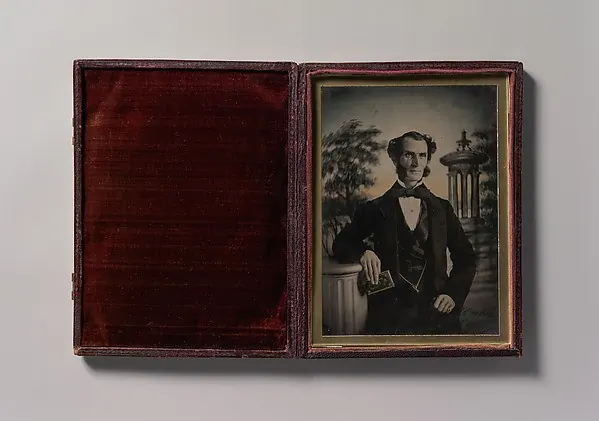
Patented in the USA in 1854; portrait fashion of the 1850s and 1860s
Typeface · Bentham
Man with book in front of painted background, 1850s–60s. Ambrotype with applied paint.The Metropolitan Museum of Art, 2015.400.104 / Public DomainView source ↗
Prompt
Transform this image into an Ambrotype, rendering the photograph as a delicate silver-gray positive on glass backed by deep black. Use subdued highlights, dark translucent shadows, fine detail, slight surface reflections, and uneven collodion edges with tiny scratches. Keep the original subject and composition.
Hold atransparent negative over white and black. Which one flips?
Background
In 1854, James Ambrose Cutting patented avariant of the collodion positive on glass in the USA. Ambrotypes were unique, direct camera prints and amore affordable alternative to the daguerreotype. Their principle utilizes the perception of afaint silver negative against adark surface. In the case, this creates an apparently positive portrait, even though the plate was exposed and developed as anegative.
Distinction
The positive impression depends on the dark background. Anormal positive scan does not show this optical change. The depicted object contains applied paint; the colorization is an additional intervention.
Aftermath
The background can reverse the perception of an image.
Further examples · 9 images
02Unidentified African American soldier in Union uniform with wife and two daughtersA Union soldier and his family are shown in a decorative case. The image demonstrates the positive effect created by a collodion negative against a dark backing.unattributed · Public domain · Wikimedia Commons03An ambrotype of two childrenThis portrait captures two children within an oval mat. It is a standard example of a direct camera print on glass using the ambrotype process.Unknown. In the collection of the Massachusetts Historical Society. · Public domain · Wikimedia Commons04Cute blond boyA seated boy is shown with visible deterioration around the edges of the glass plate. The silver negative tones appear positive against the dark areas of his clothing.Unknown photographer · Public domain · Wikimedia Commons05Ambrotype of Josias King, 1858This 1858 portrait of Josias King shows typical aging marks on the glass surface. The image highlights the affordable alternative to daguerreotypes popular in the mid-19th century.Unknown authorUnknown author · CC0 · Wikimedia Commons06Ambrotype on clear glassSmall figures and tinsel are photographed on a glass plate. The dark background allows the faint silver deposits to be seen as a positive monochromatic scene.Surprizi · CC BY-SA 4.0 · Wikimedia Commons07Ambrotype au collodionWet plate glass negatives are resting on a wooden rack near bottles of collodion and developer. They show the transparent state of the image before a dark backing is applied.Khriska · CC BY-SA 4.0 · Wikimedia Commons08Ambrotype 4 with black paper background (8257740895)A man and two children are shown with hand-colored pink details on their clothing. This illustrates the common practice of adding tint to the unique glass prints.Richard from USA · CC BY 2.0 · Wikimedia Commons09Bryan Grimes ambrotype c1860Bryan Grimes is pictured in a military uniform within a protective case. The lack of metallic reflection distinguishes this glass ambrotype from a metal daguerreotype.Unknown authorUnknown author · Public domain · Wikimedia Commons
Question
What happens when the dark background is removed?
Show possible answer +Hide answer −
The plate can be recognized as aweak negative; the positive impression is lost.