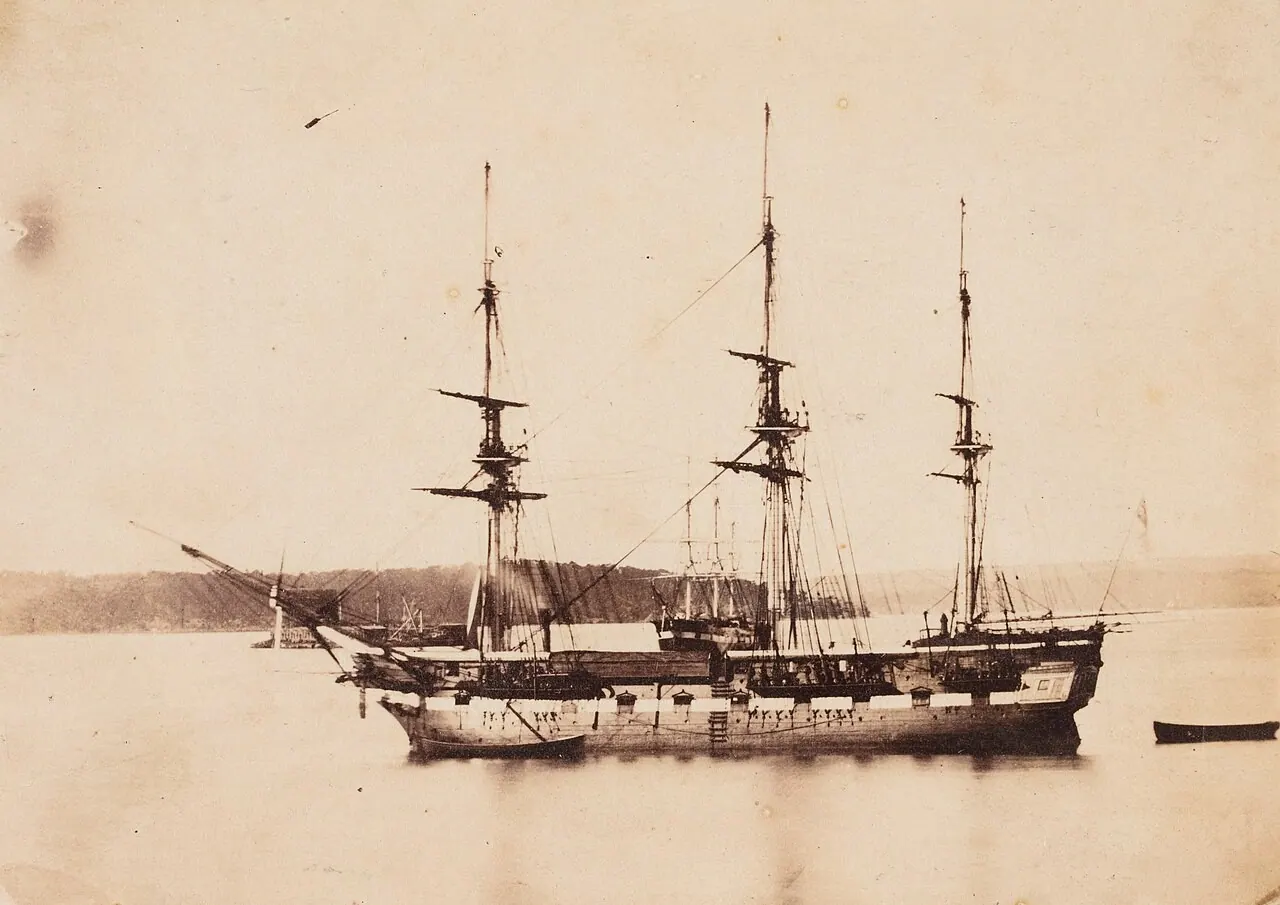
Albums print. Introduced in 1850; dominant withdrawal of the later 19th century
Typeface · Baskervville
H.M.S. Herald in Sydney Harbour, 1857. Albums print. State Library of New South Wales.Unknown authorUnknown author / Public domain; Wikimedia CommonsView source ↗
Prompt
Transform this image into an Albumen Print with finely resolved details, warm sepia and honey-brown tones, creamy paper highlights, and a smooth, subtly glossy protein-coated surface. Add delicate fading toward the margins and minimal visible grain rather than coarse texture. Keep the original subject and composition.
Compare albumin and salt paper: Where do details appear clearer?
Background
In 1850, Louis Désiré Blanquart-Evrard introduced the albumen process. The protein layer holds the silver image to the paper surface, enabling detailed reproduction. Together with glass negatives, albumen prints became the basis of large portrait and view print markets. The process of taking the photograph on the negative and the subsequent paper print remain two distinct steps.
Distinction
The typical warm tone is not evidence of asepia filter. During scanning, gloss and paper texture are partially lost. Ascreen reproduction therefore better explains the image effect than the complete material surface.
Aftermath
The substrate and its coating also contribute to the overall shape of the image.
Further examples · 12 images
02John Moran, "Tropical Scenery, Street, Chipigana", 1871, albumen print photographA village street in Chipigana shows thatched dwellings and a seated man. The albumen print captures complex textures in the roofing and woven walls with a sepia hue.John Moran · CC0 · Wikimedia Commons03William Blackwood (1858) Wiley & Son's basket wholesale warehouse, Park Street, SydneyA Sydney warehouse storefront displays numerous baskets and brooms hanging under a large sign. The process ensures clarity in the fine wicker patterns and painted lettering.Olaf William Blackwood · Public domain · Wikimedia Commons04Albumen print detailA macro detail view shows a dark, feathered form against a lighter background. It demonstrates how the image sits on the surface without sinking deep into paper fibers.Mauro J. Mazzini · CC BY-SA 3.0 · Wikimedia Commons05Gaudenzio Marconi, Auguste Neyt, modèle de L'Âge d'airain, 1877A male model poses as a statue against a stone-like wall background. The albumen layer allows for smooth transitions in skin tones and clear muscle definition.Gaudenzio Marconi (1841–1885) · Public domain · Wikimedia Commons06Albumen print detail with paper fiberA close-up of a woman's face emphasizes the fine lace of her cap. The surface sheen and sharp rendering of facial details are characteristic of the protein-based emulsion.Mauro J. Mazzini · CC BY-SA 3.0 · Wikimedia Commons07John Moyer Heathcote by Camille Silvy - albumen print - 9 October 1860A man sits in an armchair next to a table and heavy drapes. The small-scale portrait exhibits the deep brown tones and sharp focus typical of the 1860s market.Camille Silvy · Public domain · Wikimedia Commons08Napoleon III from carte de visite PXA 362A formal portrait of Napoleon III highlights facial hair and fabric textures. The glossy surface quality of the print supports high-contrast details and a warm color range.Unknown authorUnknown author · Public domain · Wikimedia Commons09Belle Plain Landing, Va., albumen print on card mountA landing area features several steamships and tents viewed through trees. The print maintains sharp silhouettes and distinct water reflections across the wide landscape composition.Civil War Glass Negatives and Related Prints · Public domain · Wikimedia Commons10Circa 1870 Young japanese lady (albumen print, Japan)A Japanese woman in a patterned kimono stands beside a flower arrangement. Detailed textile motifs and delicate plant stems are preserved by the smooth albumen coating.Photographic Heritage · Public domain · Wikimedia Commons11Harry Payne clown slnswThis portrait exhibits the characteristic sepia-toned highlights and sharp detail of the albumen process. Small spots indicate typical aging, while the protein binder maintains smooth surface transitions in the actor's costume.Unknown authorUnknown author · Public domain · Wikimedia Commons12George N. Barnard by Mathew BradyThe print demonstrates the high resolution achievable with albumen, visible in the textures of the coat and curtain. The warm, chocolate-brown tones are representative of gold-toned silver prints from the mid-19th century.Mathew Benjamin Brady / Adam Cuerden · Public domain · Wikimedia Commons
Question
Is an albumen print itself the camera negative?
Show possible answer +Hide answer −
No. It is apositive paper print that is exposed under anegative.