Video feedback. The video art wave of the 1970s. Experiments since the 1960s.
Typeface · Rye
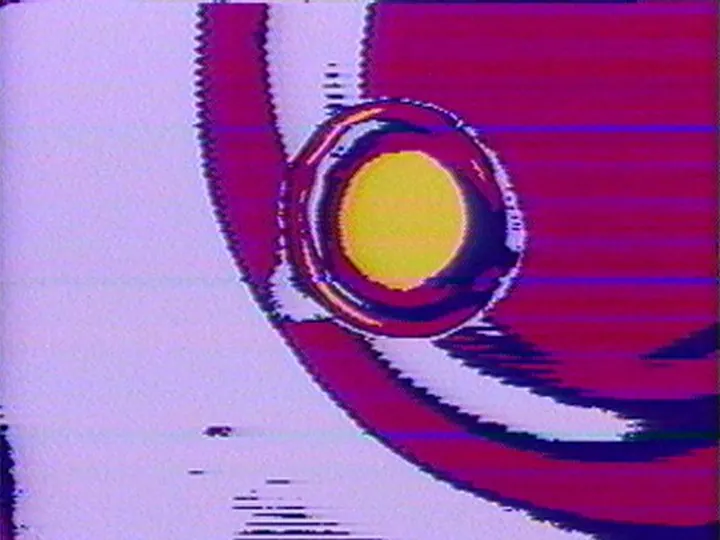
Skip Sweeney: Illuminatin’ Sweeney, 1975: Original video still.
Temporal effect: still image or image sequence.Skip Sweeney / Video Data Bank. Copyright protected; source image from Video Data Bank.View source ↗
Prompt
Apply a Video Feedback effect, repeating the image into progressively smaller luminous echoes that recede as a tunnel behind the main forms. Add slight rotational drift, phosphor glow, saturated rainbow fringes, deep black gaps, and accumulating analog noise without obscuring the primary silhouette. Keep the original subject and composition.
[Luminous tunnels and spirals]multiply an image seemingly endlessly into the depths.
Principle
A[camera films the monitor]displaying [its own live image]. Zoom, angle, and brightness change the feedback1.
Example
Skip Sweeney: Illuminatin’ Sweeney (1975), feedback processed and colored with synthesizers2.
Try it out
Point acamera at your screen. Tilt it slowly and observe the pattern change.
Background
Experimental since the 1960s; formative wave of video art in the 1970s.
Acamera films the monitor displaying its own live image. The image repeatedly loops through the same circuit. Camera angle, zoom, brightness, and color create spirals, tunnels, and pulsating patterns.
Skip Sweeney, Illuminatin’ Sweeney (1975): Feedback is processed with Moog and Vidium synthesizers.
Image: Historical original / source image. The camera-monitor feedback forms colored rings and image repetitions. Still image; the dynamic movement is shown in the linked video.
Distinction
Aclosed live camera loop like TV Buddha is not automatically the recursive tunnel pattern; for that, the camera must record the screen itself. No single year of invention is specified. The 1970s here represent public artistic exploration, not the invention itself.
Aftermath
The video signal itself becomes an instrument: Images are created from arunning system instead of just from afilmed scene.
Further examples · 7 images
02Video feedback octagon patternA television screen displays a recursive tunnel of octagonal camera interface icons. This illustrates classic optical feedback formed by a lens live-capturing its own output monitor at a slight angle.Deathgleaner · CC BY-SA 3.0 · Wikimedia Commons03Video feedback at last night's NYU IMPACT performance (by Ethan Hein)A stage projection displays a performer's figure repeating in a shrinking, diagonal sequence. This live recursive delay shows how feedback can be integrated into theater to create infinite human multiplication.Ethan Hein from Brooklyn, United States · CC BY 2.0 · Wikimedia Commons04Stevo Wolfson Synoid (1983) screenshotA neon-colored, star-shaped geometric pattern radiates from a central point against a black background. It demonstrates how video feedback, when processed electronically, creates intricate, kaleidoscopic mandalas common in 1980s video art.Siys · CC BY 4.0 · Wikimedia Commons05"The Artist"The image on the right shows a complex, self-similar geometric lattice generated through electronic feedback. It demonstrates the luminous, repeating structures and symmetrical depths characteristic of the technique when processed through a video loop.Fichoumarc · CC BY-SA 4.0 · Wikimedia Commons06Adam Savage HOPEA man stands before a projection showing multiple receding versions of himself. This illustrates the 'droste effect' variety of video feedback, where a camera-to-screen loop creates an infinite tunnel of nested, delayed images.Porkrind at English Wikipedia · CC BY-SA 3.0 · Wikimedia Commons07OBS 26 Screenshot DE 2020.12.27 - 14.44.35.44A screenshot of recording software displaying its own interface in an infinite recursive loop. This digital version demonstrates the fundamental principle of feedback where the output is continuously re-routed as input.Software by Hugh Bailey und andere Mitwirkende/Screenshot by PantheraLeo1359531 · GPLv2 · Wikimedia Commons