Early CAD history. Iconic cinematic use in Star Wars 1977.
Typeface · Chakra Petch
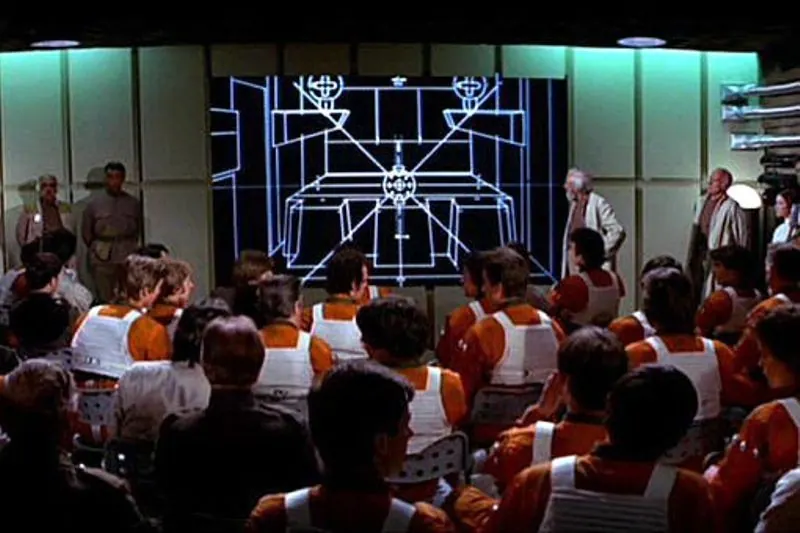
Star Wars, 1977: The Death Star briefing scene with wireframe graphics.
Temporal effect: still image or image sequence.Lucasfilm / Image: Computer History Museum. Copyright protected; source image courtesy of the Computer History MuseumView source ↗
Prompt
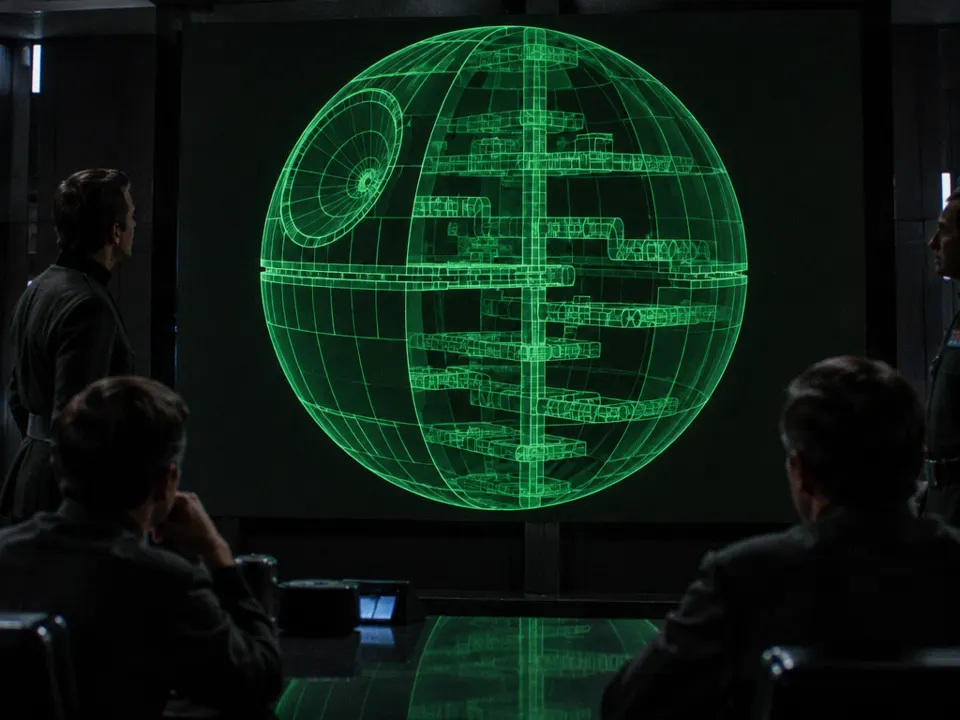
Transform this image into Wireframe CGI, tracing recognizable forms with luminous green and cyan polygon edges against a near-black background. Remove opaque surface fills, reveal rear-facing structural lines through transparent volumes, and use sparse perspective grids, slight raster aliasing, and restrained screen glow. Keep the original subject and composition.
Larry Cuba: Death Star Briefing for Star Wars: ANew Hope (1977).
Try it out
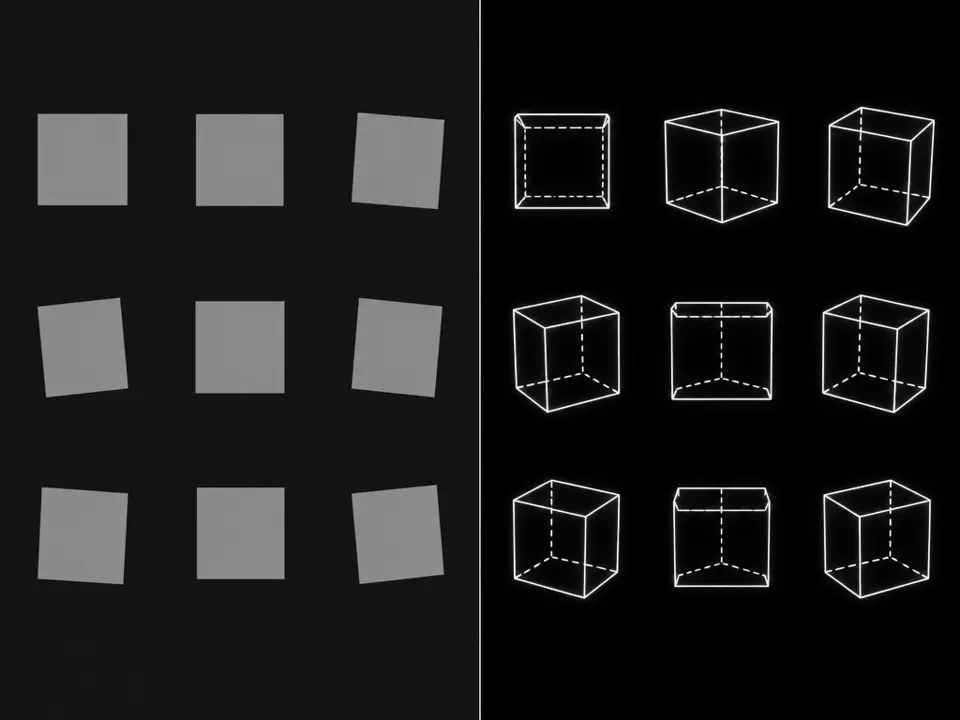
Show the same cube as aflat surface and as awireframe. Rotate both. Compare the visible spatial information.
Background
CAD prehistory from the 1960s; visible in mainstream cinema by 1977 at the latest.
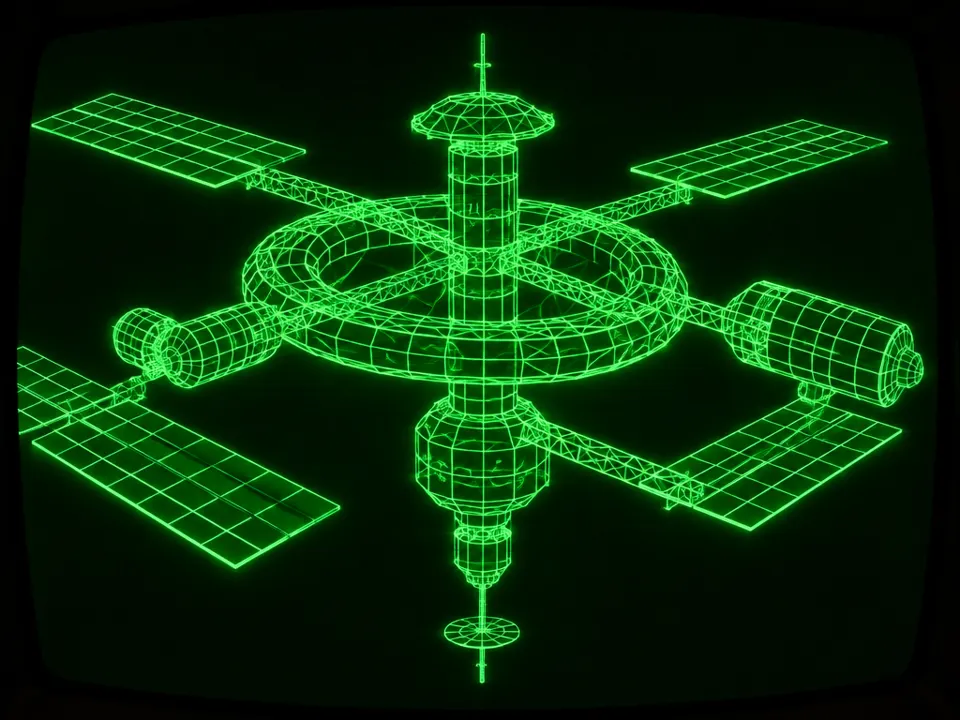
A3D model is represented solely by its edges or lines. Avirtual camera calculates how these lines appear perspectively on the screen.
Larry Cuba's Death Star briefing for Star Wars: ANew Hope (1977).
Image: Historical original / source image. Bright edges and perspective lines represent the 3D model without filled surfaces.
Distinction
Any neon grid will give asimilar look, but it's no guarantee of true 3D geometry. Star Wars wasn't the invention of 3D graphics, nor was it the first CGI film. What matters here is the iconic use of awireframe model.
Aftermath
The machine acquired avisible visual language. The technically determined model later evolved into aretro-futuristic look.
Further examples · 7 images
02European Patrol Corvette wireframe-001A computer-generated corvette is displayed from a low-angle perspective showing its structural edges. It exemplifies wireframe CGI by using lines to define the hull and water surface without solid textures.Rama · CC BY-SA 3.0 fr · Wikimedia Commons03Schläfli-Hess polychoron-wireframe-2A complex geometric polychoron is rendered using only its edges. This shows the transparent nature of wireframe CGI, where internal and external spatial structures are simultaneously visible without solid surfaces.Tomruen at English Wikipedia · Public domain · Wikimedia Commons043D wireframe render of a cake tinBlack outlines define the shape of a cake tin on a neutral background. The grid of edges makes the underlying geometric structure of the 3D model visible without any solid surface rendering.Apinanaivot · CC0 · Wikimedia Commons05AI illustration: A green luminous sphere displays internal structures and edges without soA green luminous sphere displays internal structures and edges without solid surfaces. This recreates the Death Star tactical briefing style where transparent geometry defines a complex technical body.Illustration generated for the Atlas (AI)06AI illustration: The image compares solid cubes with wireframe versions viewed from multipThe image compares solid cubes with wireframe versions viewed from multiple angles. It demonstrates how rotating luminous edges provide spatial information that is hidden on flat-shaded surfaces.Illustration generated for the Atlas (AI)07AI illustration: A complex technical structure is displayed on a CRT monitorA complex technical structure is displayed on a CRT monitor. Luminous green lines represent the object's geometry without solid surfaces, demonstrating a 3D wireframe mesh.Illustration generated for the Atlas (AI)