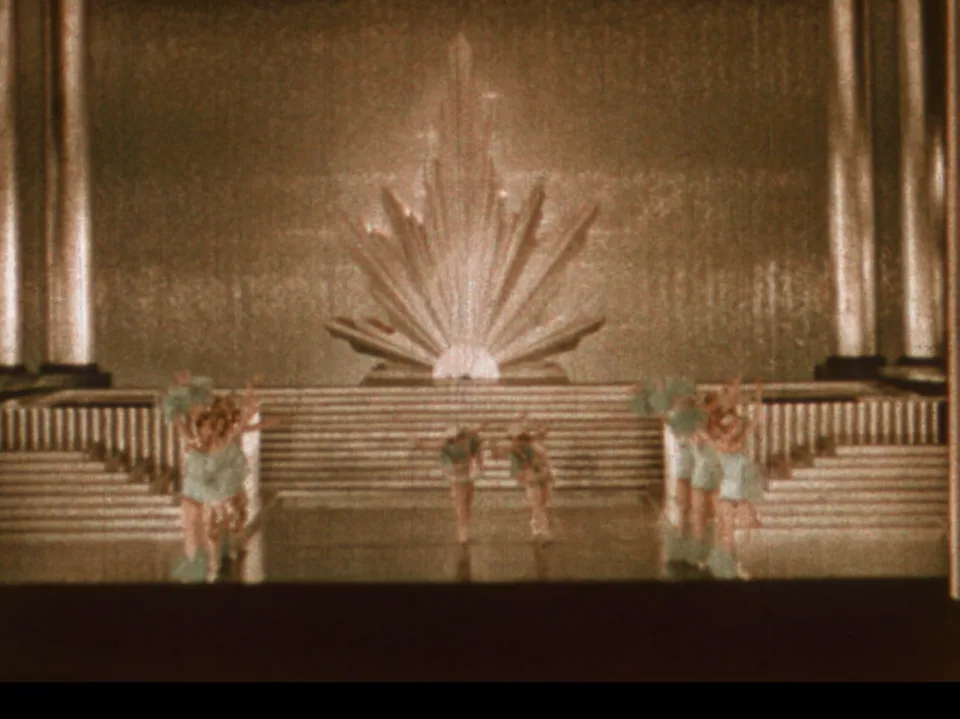
Art Deco Stage Scene In Limited Color. A stage scene from an early color film is depicted with a limited palette dominated by warm, golden-orange hues and teal shadows.Harry Beaumont / John Arnold · Public domain · via Wikimedia CommonsView source ↗
Prompt
Apply an Early Two-Color Cinema treatment using a restricted red-orange and cyan-green palette. Render skin or warm surfaces peach and coral, shift blues toward turquoise, and suppress distinct yellows and violets. Add gentle dye bleed, fine film grain, soft contrast, and slight color misregistration. Keep the original subject and composition.
[Flesh tones appear unusually warm], often leaning toward orange or peach. Skies look cyan1or greenish instead of deep blue. True yellows are [entirely missing].
Principle
Acustom camera exposes two consecutive frames simultaneously through red and green filters using abeam splitter2. Prints are made on thin film, dyed red-orange and cyan, and [cemented back-to-back].
Example
Chester M. Franklin: The Toll of the Sea, 1922.
Try it out
Look closely at a1920s color film and try to find anything bright yellow; you will only see muddy browns or pale oranges.
Background
Technicolor introduced its Process 2 in 1922 to solve flickering issues in earlier color systems. Instead of projecting through colored glass, this subtractive method3embedded color directly into the film. Aprism inside the camera split light to expose red and green records simultaneously. Laboratories printed these records onto half-thickness film stocks. Technicians dyed the red record cyan and the green record magenta-red. Finally, they cemented the two thin strips back-to-back. This created asingle projectable print displaying alimited but vivid color spectrum.
Distinction
Unlike Three-Strip Technicolor, Process 2 entirely lacked ablue record. Unlike Kinemacolor, Process 2 prints could play on standard projectors without spinning color wheels.
Aftermath
It proved that audiences desired color films, paving the way for full-spectrum cinematography in the 1930s.
Further examples · 9 images
02Woman In Green Dress Among Red FlowersA woman poses in a vibrant green dress amidst red flowers, displaying a striking contrast typical of early color cinema. Her distinctly warm, peachy skin tones and the restriction of all colors to red-orange and cyan-green hues clearly identify the specialized medium.Cinematography J.A. Ball / Editing by Hal C. Kern / Distributed by Metro Pictures Corpo… · Public domain · Wikimedia Commons03Figures Gathered Under A Greenish SkyA group of figures gathers near the water, their skin tones appearing distinctly warm and leaning toward an orange-peach hue. The sky behind them takes on a muted, greenish-cyan tint rather than a natural blue, illustrating the restricted color spectrum of the dual-filter technique.metro pictures · Public domain · Wikimedia Commons04Men On A Beach In Amber And CyanTwo figures are captured on a sandy landscape in a scene rendered entirely in shades of warm amber, red-orange, and dark cyan. The lack of any true yellow in the sand and the exaggerated warmth of the flesh tones clearly show the artifacts of the two-color camera.Albert Parker · Public domain · Wikimedia Commons05Women And Child In A Red-Cyan PaletteThree figures are seated outdoors, their clothing and surroundings rendered entirely in a palette of warm oranges, earthy reds, and cyan-greens. The artificial warmth of their skin and the complete absence of true yellow or deep blue highlights beautifully demonstrate the chemical limitations of cemented dyed films.Cinematography J.A. Ball / Editing by Hal C. Kern / Distributed by Metro Pictures Corpo… · Public domain · Wikimedia Commons06Woman Gesturing By The Cyan-Tinted SeaA woman stands against a coastal backdrop where the ocean and sky are rendered in distinct shades of cyan and sea-green. Her notably warm, peach-colored skin contrasts with the limited cool tones of the background, typical of images exposed simultaneously through red and green filters.Cinematography J.A. Ball / Editing by Hal C. Kern / Distributed by Metro Pictures Corpo… · Public domain · Wikimedia Commons07Flower Emulating Two-Color TechnicolorA blooming flower is rendered entirely in shades of peach-red and cyan, with natural greens and yellows completely absent. This restricted color palette mimics the chemical dye limitations characteristic of the two-color Technicolor process.SavidgeMichael · CC BY 4.0 · Wikimedia Commons08Berries and Foliage in Cyan and RedA cluster of berries appears vibrant red-orange against foliage that has been shifted to a distinct cyan hue. The image effectively demonstrates the signature bicolor look where true greens, yellows, and deep blues cannot be reproduced.SavidgeMichael · CC BY 4.0 · Wikimedia Commons09Rose Displaying Red-Orange and Cyan PaletteThe petals of a rose display a warm orange-red tone, while the surrounding leaves and background take on a greenish-cyan cast. The stark absence of true yellows and deep blues perfectly illustrates the visual limitations of this vintage motion picture process.SavidgeMichael · CC BY 4.0 · Wikimedia Commons
Question
Why do skies look greenish in Two-Color Technicolor films?
Show possible answer +Hide answer −
The system lacked ablue dye record to capture true blues. It relied purely on acyan dye. This dye often drifted toward green when mixed with other tones.