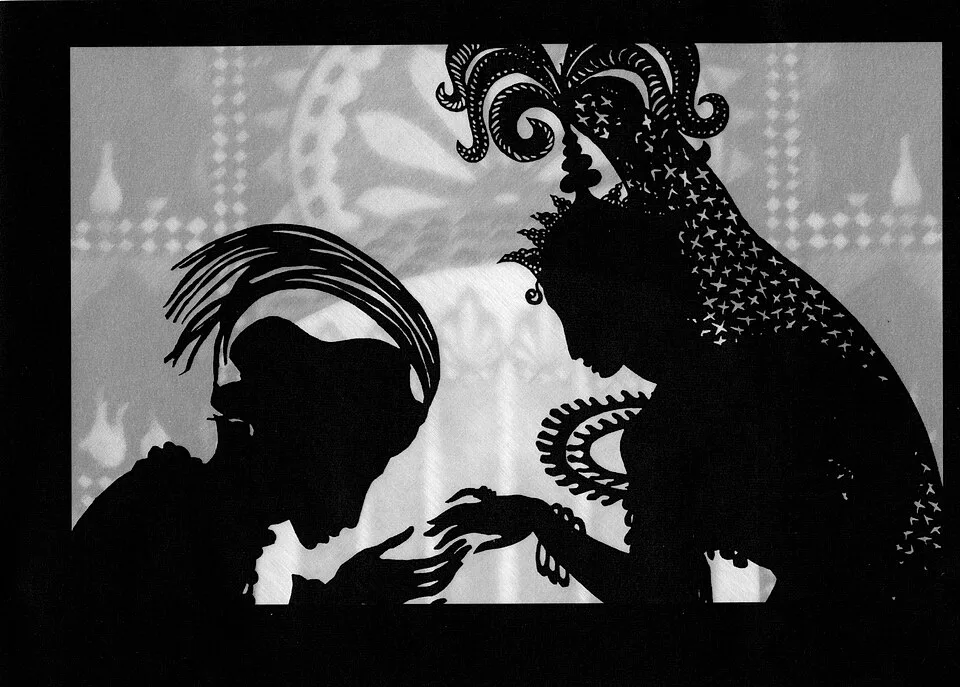
Silhouette Figures Against Layered Scenery. Two elaborately outlined black figures exchange a gesture before a softly illuminated, patterned background.Lotte Reiniger/Primrose Productions · CC BY-SA 4.0 · via Wikimedia CommonsView source ↗
Prompt
Transform this image into Silhouette Animation, reducing foreground subjects to opaque black paper cutouts without internal facial or clothing detail. Use crisp hand-cut contours, subtle joint overlaps, and layered scenery against a luminous ivory background with delicate gray decorative shapes and backlit paper texture. Keep the original subject and composition.
You see [stark black figures moving]against brightly lit, detailed backgrounds. The characters [lack internal details]like eyes or clothing patterns.
Principle
[Jointed paper or metal cut-outs]are placed on aglass table. Acamera above photographs them while lights shine from below.
Example
Lotte Reiniger: The Adventures of Prince Achmed, 1926.
Try it out
Hold acardboard shape flat against asunny window and notice how all surface details disappear into asolid black shadow.
Background
Silhouette animation adapts the ancient art of shadow puppetry into stop-motion1film. Lotte Reiniger pioneered this technique in the 1920s. She meticulously cut characters from black cardboard and thin lead. To allow movement, she connected their limbs with wire hinges. These figures rested on amulti-plane camera stand2consisting of glass layers. This setup created depth between the sharp black foreground and softly glowing tissue-paper backgrounds. Animators moved the figures slightly between each frame. Backlighting3from underneath ensured the characters remained completely opaque. This intense contrast forced viewers to focus entirely on outline and movement rather than texture.
Distinction
Unlike traditional cel animation, characters are opaque physical cut-outs rather than drawings. Traditional shadow puppetry happens live, whereas this is filmed frame-by-frame.
Aftermath
It shows how expressive character emotion can be conveyed entirely through body language and precise outlines.
Further examples · 11 images
02Silhouette Ensemble Beneath an ArchBlack figures gesture beneath an arched pavilion flanked by hanging lanterns. The detail-free bodies and sharply articulated poses against a bright field clearly display the visual construction of silhouette animation.C. Allan Gilbert · Public domain · Wikimedia Commons03Silhouette Encounter With a MonsterTwo black human figures confront a large, open-jawed creature beneath a trailing branch. Their cut-out contours and expressive poses within a high-contrast scenic frame demonstrate the silhouette animation aesthetic.C. Allan Gilbert · Public domain · Wikimedia Commons04Silhouette Figures in a Garden DoorwayThree silhouetted figures occupy a garden setting with a central doorway, climbing plants, and overhead pots. Opaque character shapes and delicate cut-out vegetation form the layered theatrical composition characteristic of silhouette animation.C. Allan Gilbert · Public domain · Wikimedia Commons05Animating Cut-Out Figures on an Illuminated TableAn animator adjusts black cut-out figures on an illuminated table beneath an overhead camera. The visible silhouettes and photographing arrangement directly demonstrate the production of silhouette animation.N.N./Agentur Primrose Film Productions · CC BY-SA 4.0 · Wikimedia Commons06Silhouette Scene Outside a ShopA capped figure gestures toward a shopkeeper amid hanging merchandise, a doorway, and a streetlamp. The characters are rendered as solid black cut-out shapes whose outlines convey action without internal modeling.C. Allan Gilbert · Public domain · Wikimedia Commons07Silhouette Figures Across a RavineTwo silhouetted figures reach toward each other across a rocky gap beneath a bare branch. Their sharply defined, articulated poses and opaque bodies against a pale background clearly demonstrate silhouette animation's visual language.C. Allan Gilbert · Public domain · Wikimedia Commons08Silhouette Figure at a Colorful WindowA featureless black figure holds a bowl beside a window overlooking brightly colored houses. The solid silhouette against a detailed luminous background clearly displays the defining contrast of silhouette animation.Directed by Lotte Reiniger and produced by the Crown Film Unit · Public domain · Wikimedia Commons09Silhouette Animation Production StandSeveral workers surround a tall animation stand, with cut-out scenery and figures visible on its illuminated lower working surface. The staged silhouettes and overhead photographic arrangement demonstrate the practical production of silhouette animation.N.N./Agentur Primrose Film Productions · CC BY-SA 4.0 · Wikimedia Commons10Silhouette Figures Beside a MirrorTwo black figures stand beside a tall mirror within a stark rectangular stage. Their featureless cut-out forms and backlit theatrical composition clearly exemplify the visual language of silhouette animation.C. Allan Gilbert · Public domain · Wikimedia Commons11Silhouette Pedestrians at a Road CrossingA black cut-out woman and child cross a striped roadway beside a car and crossing signals. Their simplified, internally featureless forms within a constructed graphic setting provide a clear example of silhouette-animation imagery.Unknown authorUnknown author · Public domain · Wikimedia Commons
Question
Why did animators use thin lead for the cut-outs?
Show possible answer +Hide answer −
Lead is heavy enough to lay perfectly flat on the glass without curling. It also bends easily to adjust acharacter's posture.