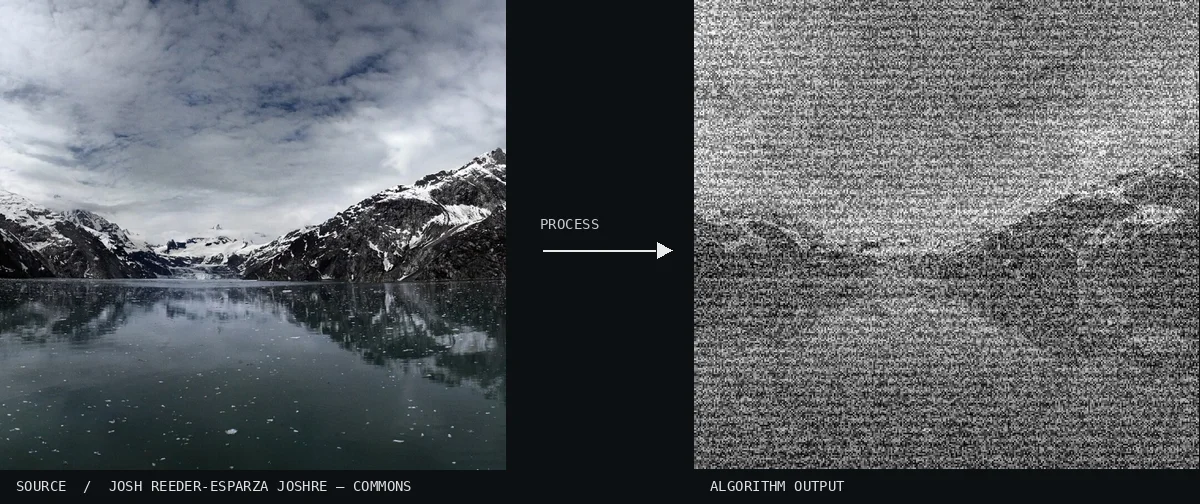
Atlas demonstration: the free source photo and the computed TV Static Snow. A wide landscape reveals a body of water framed by dark, sloping mountains under a pale sky. The entire composition is saturated with high-frequency grayscale interference that perfectly simulates the visual texture of a lost television signal.Image: Josh Reeder-Esparza joshre · CC0 (via Wikimedia Commons), processed for the AtlasView source ↗
Prompt
Apply TV Static Snow, covering the photograph with dense, irregular black, white, and gray pixel speckles resembling a frozen instant of television interference. Mix tiny sharp dots with occasional coarser noise clusters, partially obscuring details while leaving the underlying scene recognizable. Keep the original subject and composition.
You see a[rapidly flickering field]of black, white, and gray dots obscuring the original image.
Principle
The algorithm overlays [random grayscale noise1]onto the image. It rapidly updates this random pattern to mimic a[lost television broadcast signal2].
Try it out
Vary the noise intensity to see the image slowly vanish into the static.
Classification
Calculated image processing result.
Further examples · 9 images
02TV Static Snow, applied to “Woman playing with a child (Unsplash)”The scene depicts an interior setting with light reflecting off a surface and a vertical structure to the left. A dense field of black and white grain completely covers the frame, creating a stark, flickering aesthetic of analog corruption.Alexandr Podvalny freestockpro (photo); processed for the Atlas · CC0 · Wikimedia Commons03TV Static Snow, applied to “Lone Stranger in the Snow (Unsplash)”A modern building with large glass windows stands behind two thin trees and a streetlamp. The uniform application of random noise provides a gritty, electronic haze that obscures the urban detail.Austin Scherbarth ascherby (photo); processed for the Atlas · CC0 · Wikimedia Commons04TV Static Snow, applied to “Man Hoodie Salamanca (Unsplash)”A dark, silhouetted form appears in the center, contrasted against a lighter background. The grain is exceptionally prominent here, with the white and gray dots creating a rhythmic pattern of electronic distortion.Comete El Coco cometeelcoco (photo); processed for the Atlas · CC0 · Wikimedia Commons05TV Static Snow, applied to “Beachside Bridge (Unsplash)”A mountain range meets the sea under a hazy sky, with the outlines of landmasses barely visible. The heavy overlay of random pixels successfully mimics the snow-like appearance of a disconnected antenna feed.James Besser jcbesser (photo); processed for the Atlas · CC0 · Wikimedia Commons06TV Static Snow, applied to “Flowers (Unsplash 4kX1uoAAohY)”Floral shapes are arranged centrally, their bright petals contrasting against a darker backdrop. The grainy gray and white interference is distributed evenly across the image, giving it the appearance of an old broadcast transmission.Marivi Pazos marivi (photo); processed for the Atlas · CC0 · Wikimedia Commons07TV Static Snow, applied to “Bright cityscape at night (Unsplash)”A dense urban skyline is silhouetted against a bright, hazy sky. The scene is heavily saturated with high-frequency monochromatic grain that perfectly simulates a malfunctioning television signal.Yun Xu nightmare (photo); processed for the Atlas · CC0 · Wikimedia Commons08TV Static Snow, applied to “Barnyard Animal (Unsplash)”A side-profile view of a rooster is visible through a thick layer of digital interference. The uniform distribution of gray and black speckles effectively mimics the look of analog broadcast snow.Remy Baudouin philmouss (photo); processed for the Atlas · CC0 · Wikimedia Commons09TV Static Snow, applied to “Jellyfish swimming (Unsplash)”Several jellyfish float gracefully in a dark aquatic environment. The fine white and black points of the noise overlay create a convincing aesthetic of a lost transmission.Daniel Codina dcodina (photo); processed for the Atlas · CC0 · Wikimedia Commons