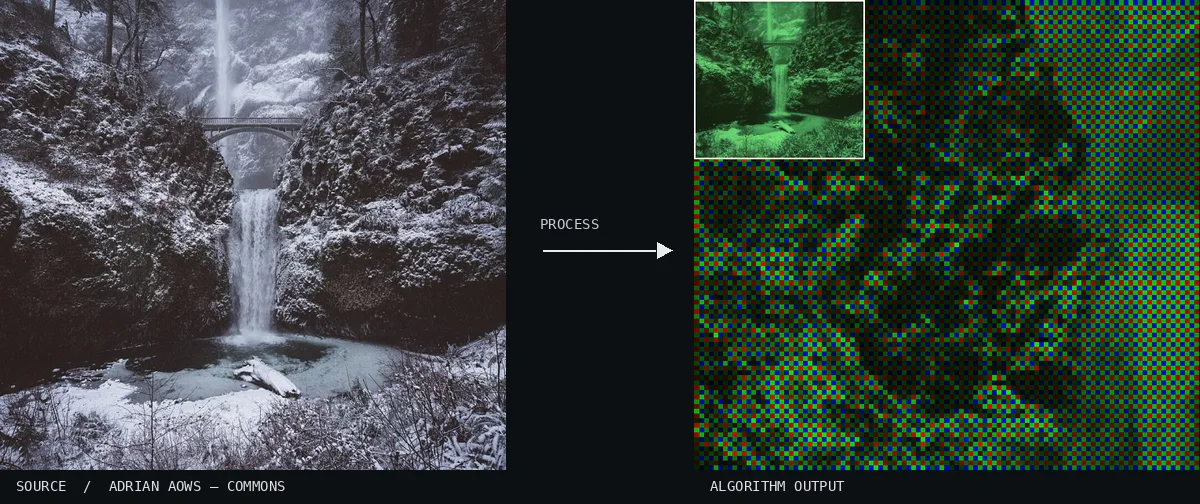
Atlas demonstration: the free source photo and the computed Bayer CFA Mosaic. A scenic landscape captures a waterfall cascading through a lush, verdant forest. The zoom reveals a precise, alternating grid of red, green, and blue pixels that reconstructs the forest's greenery.Image: adrian aows · CC0 (via Wikimedia Commons), processed for the AtlasView source ↗
Prompt
Apply Bayer CFA Mosaic, converting the photograph into a fine, visibly resolved checkerboard of single-channel samples. Repeat two-by-two tiles containing two green sites, one red site, and one blue site, each varying in brightness with the source image. Avoid blended pixel colors. Keep the original subject and composition.
The image becomes a[fine grid]of red, green, and blue samples, with a[repeating checkerboard texture].
Principle
The algorithm imitates aBayer color filter array1, repeating a[two-by-two tile]with two green sites, one red, and one blue. Each site retains one color channel2from the source image; the other two are set to zero for display.
Try it out
Zoom in to inspect the repeating tile and compare its appearance across bright and dark areas.
Classification
Calculated image processing result.
Further examples · 9 images
02Bayer CFA Mosaic, applied to “Female vintage photographer (Unsplash htYqmybzOcI)”A person holds a vintage camera while seated outdoors in a relaxed pose. The microscopic detail shows how individual color samples form the texture of the camera's body and the surrounding light.Angelina Litvin linalitvina (photo); processed for the Atlas · CC0 · Wikimedia Commons03Bayer CFA Mosaic, applied to “Patch of closed tulips (Unsplash)”A field of vibrant red and yellow tulips stands against a dark, moody background. The mosaic structure is clearly defined, with red pixels dominating the flower heads and green pixels forming the stems.Victoria Heath vheath (photo); processed for the Atlas · CC0 · Wikimedia Commons04Bayer CFA Mosaic, applied to “Orio Nguyen 2017-05-25 (Unsplash)”A couple stands together in a wide, open pasture filled with a large flock of sheep. The digital filter creates a rhythmic pattern of primary colors that softens the edges of the subjects and the horizon.Orio Nguyen orionguyen (photo); processed for the Atlas · CC0 · Wikimedia Commons05Bayer CFA Mosaic, applied to “BIke and plants with brick (Unsplash)”A bicycle is parked next to a house with thick vines climbing the exterior wall. The transformation shows a sharp, repeating tile pattern where the green channels highlight the organic shapes of the leaves.EVREN AYDIN evrenaydin (photo); processed for the Atlas · CC0 · Wikimedia Commons06Bayer CFA Mosaic, applied to “Yulia Chinato 2015 (Unsplash)”A close-up view focuses on a guest tag attached to the spokes of a bicycle wheel. The fine mesh of color sites makes the typography of the tag visible through a distinct geometric screen.Yulia Chinato yuliachinato (photo); processed for the Atlas · CC0 · Wikimedia Commons07Bayer CFA Mosaic, applied to “Always smile (Unsplash)”A portrait shows a man smiling against a solid background. The vibrant grid of primary colors creates a sharp, mathematical texture across his skin and clothing.michael m_minimal (photo); processed for the Atlas · CC0 · Wikimedia Commons08Bayer CFA Mosaic, applied to “Letchworth Garden City, United Kingdom (Unsplash r8lDTtSWGUc)”This scene captures food cooking in a large wok over a heat source. The microscopic arrangement of red, green, and blue pixels defines the shapes of the ingredients and steam.Clem Onojeghuo clemono2 (photo); processed for the Atlas · CC0 · Wikimedia Commons09Bayer CFA Mosaic, applied to “Sharks and Fish (Unsplash)”Sharks swim through clear, shallow water viewed from an aerial perspective. The repeating geometric color pattern is highly distinct against the bright, aquatic background.Jakob Owens jakobowens1 (photo); processed for the Atlas · CC0 · Wikimedia Commons