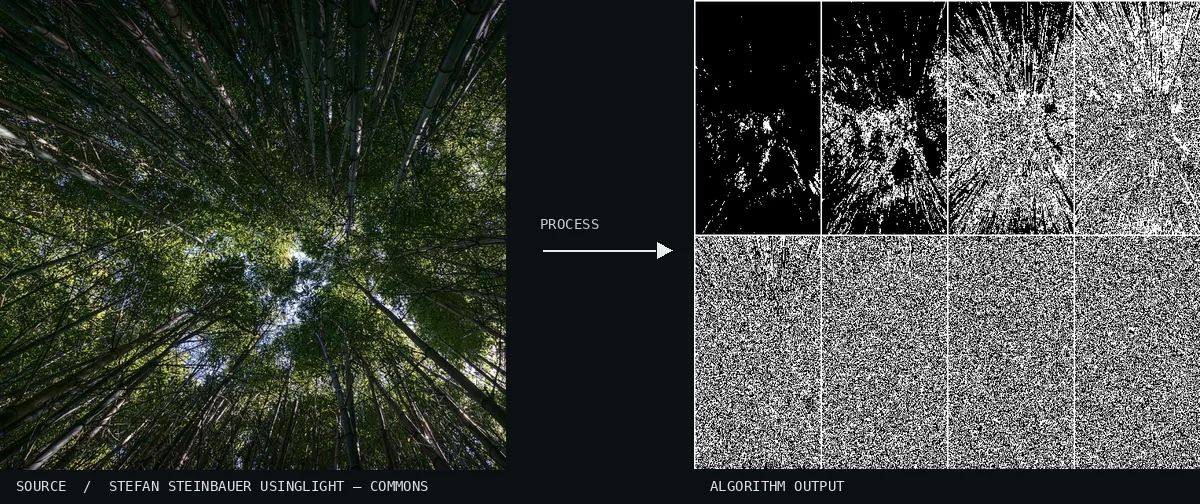
Atlas demonstration: the free source photo and the computed Bit-Plane Slicing. A perspective view looking up through a dense canopy of trees shows branches radiating from the center. The decomposition demonstrates how primary shapes are stored in the top panels while the bottom panels dissolve into chaotic binary noise.Image: Stefan Steinbauer usinglight · CC0 (via Wikimedia Commons), processed for the AtlasView source ↗
Prompt
Apply Bit-Plane Slicing, rendering the photograph as overlapping binary layers of stark black and white. Combine broad threshold-like silhouettes with finer fragmented contours and granular static patterns, suggesting separate high-order structural bits and low-order noise. Keep recognizable forms beneath the digital abstraction. Keep the original subject and composition.
You see an image broken into several stark, high-contrast layers ranging from solid shapes to [seemingly random static].
Principle
The algorithm separates digital pixel values1into their [underlying binary bits2]. The highest bits hold the [main image structure], while the lowest bits capture fine noise.
Try it out
Examine the lowest bit planes to reveal hidden noise or secret data.
Classification
Calculated image processing result.
Further examples · 9 images
02Bit-Plane Slicing, applied to “Horse and Fence (Unsplash)”The interior of a subway car is captured through a window, showing vertical bars and seating. High-order bits preserve the stark geometry of the train car, while lower-order bits reveal the subtle textures of the metal surfaces.Chance Anderson chanceanderson (photo); processed for the Atlas · CC0 · Wikimedia Commons03Bit-Plane Slicing, applied to “Mountains and Lake in Bariloche (Unsplash)”A mountain range sits under a clouded sky, with steep slopes descending toward a valley. The transition from recognizable silhouettes to pure digital static is clearly visible across the eight sequential panels.Roger Burkhard roger_burkhard (photo); processed for the Atlas · CC0 · Wikimedia Commons04Bit-Plane Slicing, applied to “Písac Perú veggie market (Unsplash)”A close-up view of organic clusters, possibly fruit or stones, displays a repetitive circular pattern. The process highlights the contours in the upper bit-planes before the image information is lost to the randomness of the final bit.hey! Andrw heyandrw (photo); processed for the Atlas · CC0 · Wikimedia Commons05Bit-Plane Slicing, applied to “Rocky beach 1 (Unsplash)”A calm body of water reflects a distant mountain range under a wide sky. The breakdown separates the solid dark masses of the mountains from the granular, high-frequency details of the water's surface.Kate Geraets kategeraets (photo); processed for the Atlas · CC0 · Wikimedia Commons06Bit-Plane Slicing, applied to “Brooklyn Bridge tower (Unsplash)”The complex cable structure of a suspension bridge creates a series of intersecting diagonal lines against the sky. As the bits descend, the structural integrity of the bridge cables gradually transforms into a field of white noise.Jacob Copus cacobjopus (photo); processed for the Atlas · CC0 · Wikimedia Commons07Bit-Plane Slicing, applied to “Bird and gazebo on winter lake (Unsplash)”A bird takes flight over a body of water near a tall structure. The sequence demonstrates a clear progression from significant structural silhouettes in the upper bits to disorganized static in the lower bits.shontz photography shontzphotography (photo); processed for the Atlas · CC0 · Wikimedia Commons08Bit-Plane Slicing, applied to “Real life best friends (Unsplash)”A close-up view captures the face of a cat peering forward. The process reveals the facial features through high-level binary data while the fur textures dissolve into grain at the lower levels.Krista Mangulsone krista (photo); processed for the Atlas · CC0 · Wikimedia Commons09Bit-Plane Slicing, applied to “Negev desert (Unsplash)”A landscape shows a mountain peak beneath a sky filled with dramatic clouds. The algorithm highlights the topographical contours in the top panes, while the clouds transform into psychedelic zebra-like bands in the middle panes.Tatiana Zhukova tatiana19 (photo); processed for the Atlas · CC0 · Wikimedia Commons