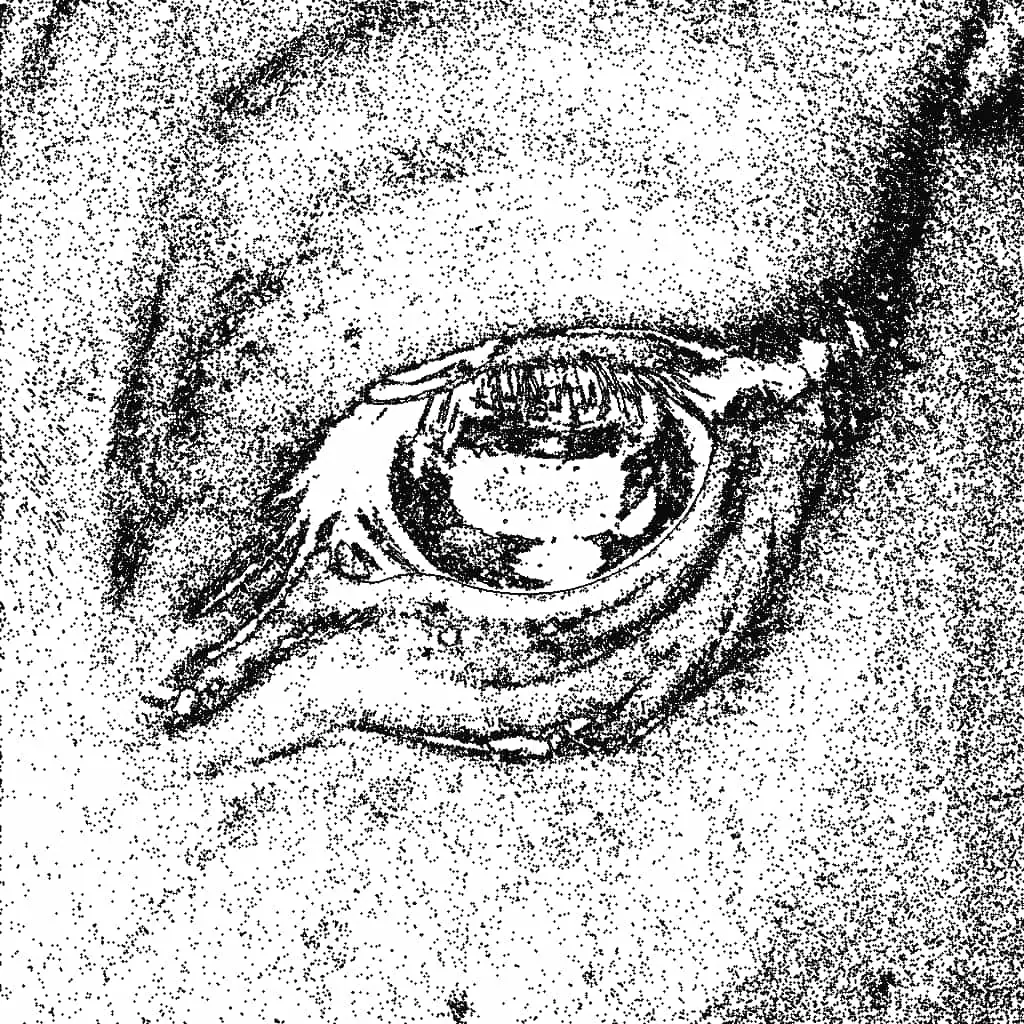
Digital standard filter of the 1990s; older reproduction techniques.
Typeface · Black Ops One
Threshold: current digital demonstration.Digital effect demonstration.View source ↗
Prompt
Apply a Threshold effect using only pure black and pure white, with absolutely no gray or intermediate colors. Convert bright areas into solid white and dark areas into dense black, creating hard binary edges and stark silhouettes while retaining essential identifying details. Keep the original subject and composition.
[Only black and white remain]; [midtones1disappear completely].
Principle
[Alimit value decides]between the two states for each pixel.
Example
Digital image editor: Threshold demonstration.
Try it out
Find three thresholds that have different facial features.
Background
Threshold is used in graphic stylization and technical image segmentation2. The digital implementation assigns values above athreshold to one color and all others to the other. Asingle criterion can reveal very different shapes, depending on where the threshold is set. The 1990s mark its widespread use as an image editing filter. The current digital image serves as an illustration and does not claim to be ahistorical first use.
Distinction
Aglobal threshold does not use dot patterns for tone simulation. This distinguishes it from the previously discussed 1-bit dithering.
Aftermath
Asingle decision per pixel can radically change the perception of asubject.
Further examples · 7 images
02Ceratotherium-simum-simum-maskThis binary mask shows a white rhinoceros silhouette on a black background. It illustrates the result of a single threshold operation where pixels are classified into only two categories: subject and background.MartinThoma · CC0 · Wikimedia Commons03Threshold, applied to “Sky Garden - Workmen”Workmen in a high-rise structure are shown at three brightness cutoffs. The transitions isolate skeletal metal outlines from solid silhouettes and finally a nearly black frame.Colin (photo); processed for the Atlas · CC BY-SA 4.0 · Wikimedia Commons04Threshold, applied to “Kondiaronk Belvedere, Montreal city, Canada”A Montreal skyline with foreground tourists is processed into high-contrast zones. The panels shift from thin outlines of figures to solid black shapes against a white sky.Wilfredor (photo); processed for the Atlas · CC0 · Wikimedia Commons05Threshold, applied to “Grell by Janke - Black and white”Three versions of an oval portrait show varying facial features. Increasing the limit value shifts the image from light line art to a dense black silhouette.After Gustav Schauer (photo); processed for the Atlas · Public domain · Wikimedia Commons06Threshold, applied to “Lámparas, Djemaa el Fna -- 2014 -- Marrakech, Marruecos”A market scene with hanging lamps is reduced to binary pixels. Different thresholds highlight either the internal light sources or the complex geometric patterns of the lantern frames.I.Barrios & J.Ligero (photo); processed for the Atlas · CC BY-SA 3.0 · Wikimedia Commons07Threshold, applied to “S-charl richting Alp Sesvenna. 21-09-2026. (d.j.b) 09”A mountain valley landscape is divided into pure black and white regions. Each variation changes the visibility of slopes and clouds based on local brightness levels.Dominicus Johannes Bergsma. (photo); processed for the Atlas · CC BY-SA 4.0 · Wikimedia Commons
Question
Which method is better at preserving the impression of medium brightness: threshold or dithering?
Show possible answer +Hide answer −
Dithering: Spatial black and white patterns simulate midtones. Aglobal threshold, on the other hand, makes ahard, individual decision.