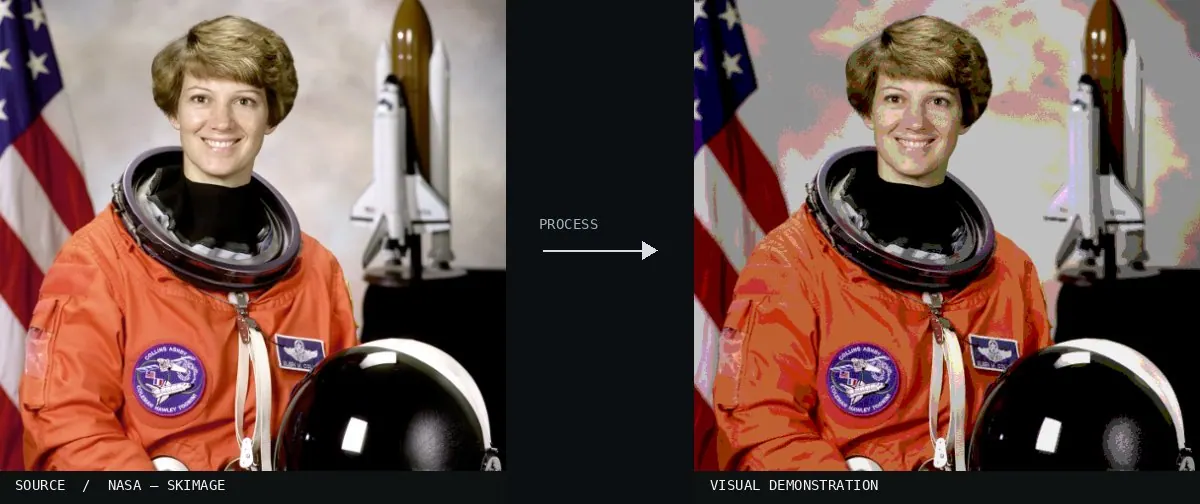
Digital standard filter of the 1990s; older graphical predecessors.
Typeface · Archivo Black
Posterization: official Microsoft Direct2D sample image.Microsoft Learn, Direct2D documentation.View source ↗
Prompt
Apply a Posterization effect by reducing the image to a few distinct tonal levels per color channel. Turn smooth gradients into flat, sharply separated color bands, simplify shadows and highlights, and retain recognizable contours without introducing pixel blocks, grain, or drawn outlines. Keep the original subject and composition.
Posterization refers to atonal shift that can occur unintentionally or intentionally as agraphic simplification. In digital filters, each color channel is limited to aselected number of values. Microsoft and Adobe document this process as adistinct effect. Its classification in the 1990s marks amilestone in desktop filter culture; similar flat image effects originate from printing and photographic tonal separation and are significantly older.
Distinction
Afew levels per color channel are not the same as the same total number of colors. The spatial resolution can also be fully preserved.
Aftermath
Control over tonal values transforms photography into aflat system of symbols.
Further examples · 12 images
02Benya Krik posterThis illustrated poster uses distinct tonal separation to define highlights and shadows on the faces. The transitions between flesh tones are rendered as hard-edged color steps rather than smooth gradients.Konstantin Bolotov · Public domain · Wikimedia Commons03Audio bit reduction from 24 bit to 8 bit with and without ditheringThe middle waveform shows quantization in the signal, where smooth curves become fixed steps. This demonstrates the mathematical principle of bit reduction that causes visual posterization.Guney Ozsan · CC BY-SA 3.0 · Wikimedia Commons04Posterization, applied to “Friction d'une allumette”A hand strikes a match against a box. The four vertical sections show a decrease in color levels, turning smooth light gradients into flat, distinct tonal bands.Yann SEGALEN (photo); processed for the Atlas · CC BY-SA 4.0 · Wikimedia Commons05Posterization, applied to “Colorful sky with orange and pink clouds reflecting in the water of a paddy fiel”A landscape shows clouds reflecting in water. The rightmost panels demonstrate heavy posterization, where the colorful sky transitions are reduced to a few high-contrast, solid color shapes.Basile Morin (photo); processed for the Atlas · CC BY-SA 4.0 · Wikimedia Commons06Posterization, applied to “Antigua (Fuerteventura, Spain), Museo de las Salinas del Carmen, Kristallisierun”Salt crystals form on a textured surface. The right side shows extreme reduction in channel values, resulting in harsh, flat red and white areas instead of organic details.Dietmar Rabich (photo); processed for the Atlas · CC BY-SA 4.0 · Wikimedia Commons07Posterization, applied to “2Fi02473 Pont national US Army retouchée”A grayscale photo depicts a destroyed bridge. The sections show the image being simplified from continuous gray tones into a high-contrast black and white graphic with few steps.US army photograph (photo); processed for the Atlas · Public domain · Wikimedia Commons08Posterization — machine versionReal-world algorithm demonstration, applied to a NASA portrait.Atlas of Visual Effects09Posterized photo of the central plaza of MeurcourtA photographic scene is reduced to a limited color palette with distinct boundaries between tones. This demonstrates digital posterization where smooth gradients in the sky and grass are replaced by flat, stepped color zones.Yves Vinot Meurcourt France · CC BY-SA 4.0 · Wikimedia Commons10Posterization, applied to “Olive harvest combs. Anthidona. Greece”A photo of harvest tools on a stone floor. The stone surface shows harsh blocks of color, which become finer as levels increase from 3 to 9.Jebulon (photo); processed for the Atlas · CC0 · Wikimedia Commons11Posterization, applied to “Strandkörbe in Sellin”Beach chairs under a cloudy sky. The soft sky gradients are replaced by distinct color bands that refine as the level count rises.Ansgar Koreng (photo); processed for the Atlas · CC BY 3.0 de · Wikimedia Commons12Posterization, applied to “Santarém May 2015-9a”An aerial view of a bridge crossing a river. Smooth water reflections turn into solid shapes, showing the reduction of tonal range in the 3 and 5 level tests.Alvesgaspar (photo); processed for the Atlas · CC BY-SA 4.0 · Wikimedia Commons
Question
Why can a two-stage RGB filter display more than just black and white?
Show possible answer +Hide answer −
Each of the three channels has two states. Two times two times two results in eight possible color combinations.