Texture mapping. 1970s: Foundations of modern textured computer graphics.
Typeface · Space Grotesk
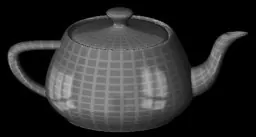
Blinn / Newell: Teapot with texture, 1976. Original illustration by Jim Blinn.Jim Blinn and Martin E. Newell; Jim Blinn author archive.View source ↗
Prompt
Apply an early Texture Mapping effect, rendering existing forms as simple three-dimensional surfaces wrapped in visibly low-resolution image textures. Make patterns follow perspective and curvature, with stretched texels on steep angles, occasional mapping seams, basic lighting, and slightly angular silhouettes. Keep the original subject and composition.
Ed Catmull's work on curved surfaces forms an important background to early texture imaging. Jim Blinn and Martin Newell published *Texture and Reflection in Computer Generated Images* in 1976; Blinn shows arasterized teapot on his own publication page. This slide uses this documented example as amilestone. The question of mapping and distortion remains relevant, even though today's material systems have significantly more channels.
Distinction
Texture mapping can control color and many other material parameters. Acolor texture alone does not change the silhouette or the actual relief.
Aftermath
Atexture is aclassification rule, not simply apasted-on photo.
Further examples · 11 images
02Texture Mapping exampleA 2D flattened face map is shown alongside a 3D model of a human head. This demonstrates how UV coordinates translate flat pixel data onto complex curved geometry.Asier03 · CC BY-SA 4.0 · Wikimedia Commons03Texture+MappingAn illustration combines a gray sphere with a flat world map to create a 3D globe. It simplifies the concept of wrapping a 2D image around a 3D volume.Asier03 · CC BY-SA 4.0 · Wikimedia Commons04Texture mappingA triangular shape is filled with a repeating brick wall pattern. This shows how a 2D sample can define the visual surface properties of a simple polygon.Mewtow · CC0 · Wikimedia Commons05Affine texture mapping vs no perspective diagramTwo checkerboard diagrams compare standard grids against affine texture mapping. The right image shows how 2D textures are distorted when mapped to polygons viewed at an angle.Gustavo Pezzi · Public domain · Wikimedia Commons06PS1 texture warpingA close-up view shows rock textures on jagged 3D terrain. This exemplifies the use of mapping to provide realistic surface detail to low-polygon environments.Codrin-Mihail (Kodrin on GitHub) · MIT · Wikimedia Commons07Mandelbulber – texture mapping sphericalA 3D scene displays objects with spherical texture mapping applied to their surfaces. This shows the resulting distortion patterns when a flat grid is wrapped spherically.Krzysztof Marczak
Graeme McLaren
Sebastian Jennen
Stephen Sink
Robert Pancoast · GPLv3 · Wikimedia Commons08Cube Representative UV UnwrappingA 3D cube is shown alongside its 2D unfolded UV mesh and the corresponding checkered texture. This demonstrates how a flat 2D pattern is systematically wrapped around a spatial volume.- Zephyris Talk.
Original uploader was Zephyris at en.wikipedia · CC BY-SA 3.0 · Wikimedia Commons09UVMappingA diagram illustrates the mathematical mapping between 3D spatial points and 2D texture coordinates. It shows how a flat world map is projected onto a spherical 3D globe.Tschmits · CC BY-SA 3.0 · Wikimedia Commons10UV mapping checkered sphereTwo spheres are shown with checkered textures using different mapping methods. This clearly demonstrates how texture coordinates determine the placement and distortion of a pattern on a curved surface.Jleedev · CC BY-SA 3.0 · Wikimedia Commons11UV Map Demonstrated With Santa ChocolateA real-world analogy of texture mapping using a chocolate Santa. The comparison between the 3D figure and its flattened foil wrapper illustrates the concept of UV unwrapping and projection.Hdyar · CC0 · Wikimedia Commons
Question
Why are squares in the test pattern stretched in some model positions?
Show possible answer +Hide answer −
The surface coordinates distribute the flat texture unevenly. This indicates UV or parameterization distortion.