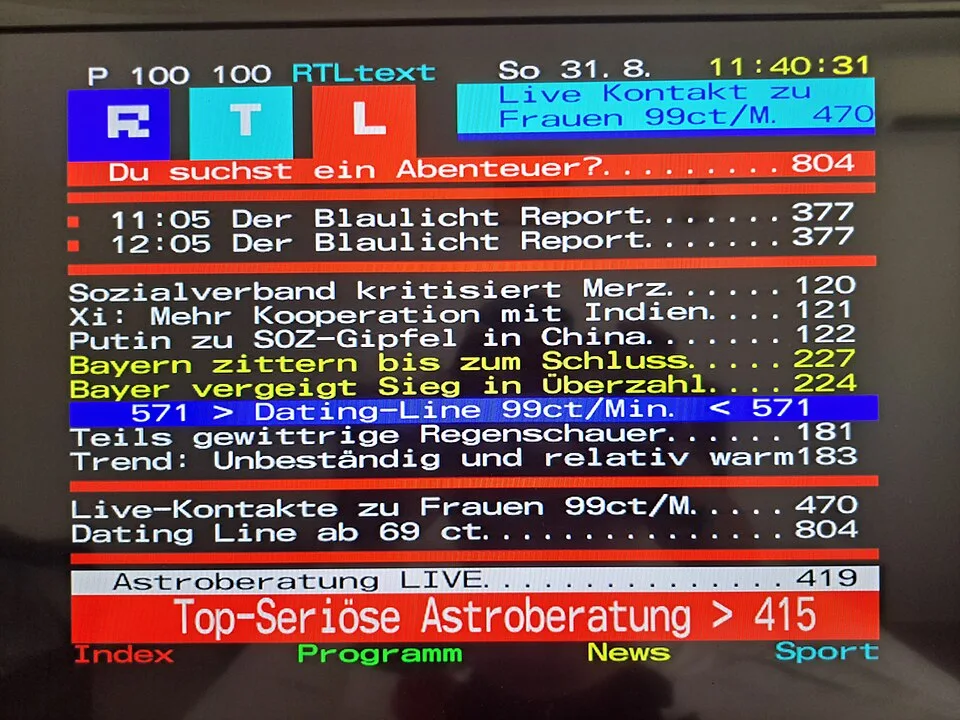
RTL Teletext Index. An RTL teletext index displays German headlines, page numbers, and advertisements in bright horizontal bands.Gabidgjtx · CC0 · via Wikimedia CommonsView source ↗
Prompt
Transform this image into teletext graphics, translating forms into chunky rectangular mosaic cells on a rigid character grid. Limit colors to saturated red, green, blue, cyan, magenta, yellow, white, and black. Use stepped silhouettes, flat fills, and sparse character-like marks without smooth gradients. Keep the original subject and composition.
You see [chunky, grid-based images]built from [colored rectangles]and simple text characters. They appear on black backgrounds in bright, saturated colors.
Principle
Broadcasters hid digital text data within the invisible lines of an [analog television signal]. Adecoding chip1inside the TV translated this data into visual blocks.
Example
BBC: Ceefax weather maps, 1974.
Try it out
Draw apicture using only a 40 by 24 grid of colored sticky notes to understand the resolution limits.
Background
Teletext was invented in the United Kingdom to send text information to televisions. Engineers realized the standard TV signal had hidden gaps called the vertical blanking interval2. They inserted digital data into these blank lines. Aspecial decoder inside the television read the data. It displayed this information as pages of text and crude graphics. The graphics relied on block mosaic characters3, dividing asingle text space into smaller squares. Because memory was expensive in the 1970s, teletext stored an entire screen using only one kilobyte of data.
Distinction
Teletext graphics are generated by the TV using character codes. This differs from raster graphics, which store data for every individual pixel.
Aftermath
It demonstrates how tight hardware limits can create adistinct and lasting visual aesthetic.
Further examples · 11 images
02TVR Teletext Welcome PageA Romanian TVR teletext page combines a large angular heading with colorful panels of news and service listings. The mosaic lettering and rigidly aligned characters visibly express teletext’s character-cell construction.Gabidgjtx · CC0 · Wikimedia Commons03Bulgarian Teletext MenuA Bulgarian teletext page presents an oversized blue masthead above Cyrillic menus and a yellow advertising strip. Stepped mosaic shapes, saturated primary colors, and fixed-width text make its teletext construction especially evident.AleSla · CC0 · Wikimedia Commons04ARTE Teletext Program ListingsAn ARTE teletext page sets red mosaic lettering and program information within white and blue panels. Its stepped letterforms, fixed-width character rows, and numbered navigation clearly show the teletext display format.arte · Public domain · Wikimedia Commons05France 2 Teletext IndexA France 2 teletext index layers red information panels above vividly colored advertising bands. Block-assembled masthead lettering and tightly aligned character cells demonstrate the graphic vocabulary of broadcast teletext.France Télévisions · Public domain · Wikimedia Commons06ARD Text News IndexAn ARD Text index places a large white mosaic masthead above German headlines and blue program listings. The visibly stepped graphics, restricted colors, and uniform character grid are characteristic of teletext rendering.ARD, Adrio · Public domain · Wikimedia Commons07ORF Teletext News IndexAn ORF teletext index combines a block-built station heading with news rows and bright promotional strips. Its numbered entries, rectangular color fields, and fixed character-cell layout clearly demonstrate teletext graphics.Österreichischer Rundfunk · Public domain · Wikimedia Commons08ZDF Teletext Index PagesTwo ZDF teletext pages arrange colored headlines, page numbers, and block-built station banners against black backgrounds. Their fixed character grids, saturated color bands, and mosaic lettering clearly exhibit teletext rendering.Unknown author · CC BY-SA 3.0 · Wikimedia Commons09Enhanced Teletext Hurricane News PageA hurricane news page combines a large yellow heading, a simplified globe, and colored text over blue bands. The identified Level 2.5 teletext test page demonstrates enhanced teletext graphics through block-built lettering and expanded background colors.Teletext-Manager · CC BY-SA 4.0 · Wikimedia Commons10BBC Ceefax Football IndexA BBC Ceefax football index displays green block lettering above tightly aligned headlines and page numbers. Its mosaic-style heading, enlarged character rows, and saturated navigation bars visibly demonstrate teletext graphics.BBC · Public domain · Wikimedia Commons11Simpatico Teletext NoticeboardA Simpatico noticeboard index uses cyan and yellow lettering, numbered entries, and contrasting rectangular highlights. Its rigid character spacing and limited-color blocks demonstrate the visual structure of a teletext page.Protalina · CC0 · Wikimedia Commons
Question
How did teletext display graphics using only text characters?
Show possible answer +Hide answer −
It used special mosaic characters. The space for asingle letter was split into agrid of smaller blocks.