1970s, popularized by the Cokin square filter system
Typeface · Changa
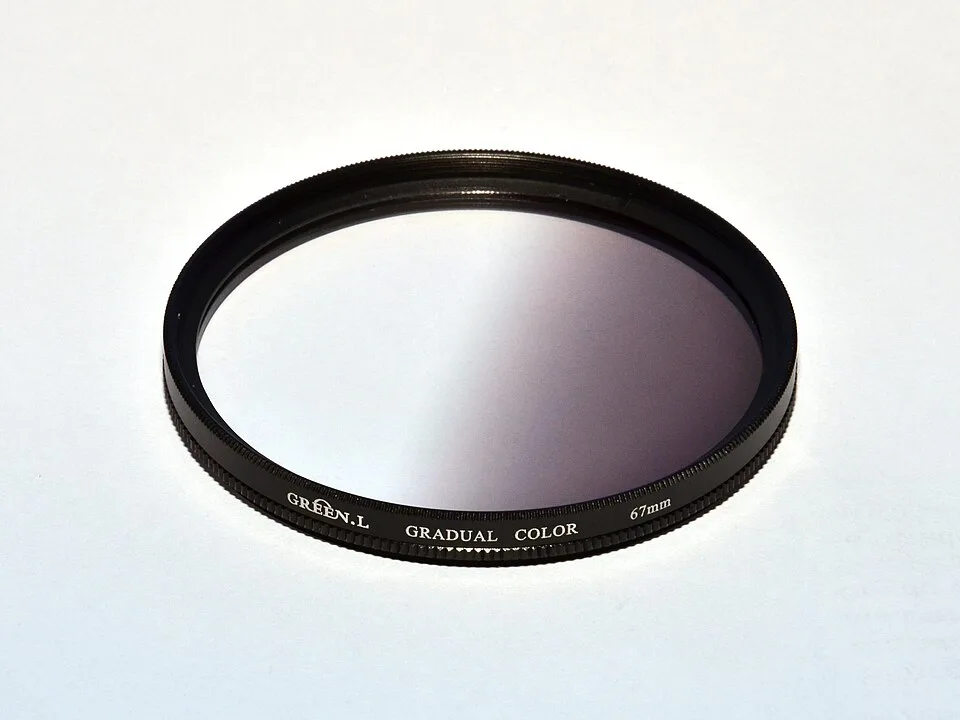
Circular Graduated Color Filter. A circular screw-in filter transitions smoothly from nearly clear glass to a violet-gray tint.Esquilo · CC BY-SA 3.0 · via Wikimedia CommonsView source ↗
Prompt
Apply a graduated filter effect, darkening the upper half with a restrained smoky amber tint that fades smoothly to clear across the middle. Preserve natural surface textures, crisp detail, and realistic highlights, with no visible dividing line or artificial vignette around the edges. Keep the original subject and composition.
You see aphotograph where one half is noticeably darker or differently colored than the other. The [transition between the two halves]is smooth and seamless.
Principle
Aglass or resin1filter is placed in [front of the camera lens]. It is tinted on one side and [fades to clear]on the other.
Example
Galen Rowell: Rainbow over the Potala Palace, 1981.
Try it out
Look at abright sky through half-tinted sunglasses to see how the ground becomes easier to view.
Background
Before digital editing, capturing abright sky and adark landscape in one shot was difficult. Film could not record both extremes at once. If the sky looked good, the ground was pitch black. If the ground was visible, the sky turned completely white. Photographers solved this by placing agraduated filter over the lens. The dark half covered the sky, reducing its brightness. The clear half covered the ground, letting in full light. This optical trick balanced the exposure2directly on the film. In the 1970s, square filter systems made it easy to slide the gradient3up or down.
Distinction
Unlike apolarizing filter, which darkens skies based on the sun's angle, agraduated filter darkens any physically covered area.
Aftermath
It shows how physical optical tools solved dynamic range limits long before digital software existed.
Further examples · 11 images
02Dark-to-Clear Graduated FilterA rectangular filter leaning against its case fades from dark gray at the top to transparent below. Its smooth transition directly displays the defining structure of a graduated neutral density filter.Rob Nunn · CC BY 2.0 · Wikimedia Commons03Graduated Filter Demonstration over a LakeA hand holds a rectangular filter over part of a lake view, darkening the cloudy sky while leaving the lower scene relatively unchanged. The adjacent uncovered sky makes the selective action of the graduated filter clearly visible.No machine-readable author provided. BenFrantzDale~commonswiki assumed (based on copyri… · CC BY-SA 3.0 · Wikimedia Commons04Graduated Color Filter PlatesRectangular filter plates display amber and blue-gray tinted areas fading smoothly into clear sections. The visible tint gradients directly demonstrate the medium used to selectively color or darken part of a photograph.Cokin-Filtersystem_01_08.jpg: Хрюша derivative work: Ggia (talk) · CC BY-SA 3.0 · Wikimedia Commons05Graduated Density Filter in HolderA rectangular filter sits in a black holder, with a soft transition from dark gray to clear visible across its circular opening. This graduated density allows one portion of a scene to receive less light without a sharply defined boundary.The original uploader was Smial at German Wikipedia. (Original text: Smial) · CC BY-SA 3.0 · Wikimedia Commons06Orange Graduated Filter Over RooftopsAn orange upper sky fades toward nearly neutral rooftops and trees within a dark circular border. The localized color wash and soft transition clearly demonstrate a colored graduated filter over the scene.brx0 from Portland, USA · CC BY-SA 2.0 · Wikimedia Commons07Graduated Color Filters and HoldersRectangular colored filters stand among mounting rings, holders, and storage cases. The foreground plates visibly fade from tinted upper portions to clear lower portions, displaying the graduated filter medium.Хрюша · CC BY-SA 3.0 · Wikimedia Commons08Graduated Filter Mounted on a CameraA rectangular filter sits in a holder in front of a camera lens, with a gray upper region and a clearer lower edge. The plate visibly demonstrates the graduated tint and its placement in the optical path.Rob Nunn · CC BY 2.0 · Wikimedia Commons09Camera with Graduated Neutral Density FilterA Nikon camera carries a large rectangular filter that darkens toward the top and clears toward the bottom. The mounted plate shows how graduated filtration can reduce light from the upper portion of a scene.Хрюша · CC BY-SA 3.0 · Wikimedia Commons10Graduated Filtration with Highlight WarningsA lake-view filter demonstration includes red highlight-warning patches, concentrated in the uncovered bright sky. The filtered portion retains a darker sky with fewer warnings, illustrating graduated filtration's role in controlling bright areas.BenFrantzDale · CC BY-SA 3.0 · Wikimedia Commons11Amber Graduation Across the ThamesLondon's riverside skyline appears above a strongly amber-colored Thames, while the upper sky retains cooler gray tones. The smooth increase in warm tint toward the bottom visibly illustrates selective coloring with a graduated filter.Øyvind Holmstad · CC BY-SA 4.0 · Wikimedia Commons
Question
Why are graduated filters usually rectangular instead of circular?
Show possible answer +Hide answer −
Arectangular filter can slide up and down in its holder. This lets the photographer align the gradient exactly with the horizon line.